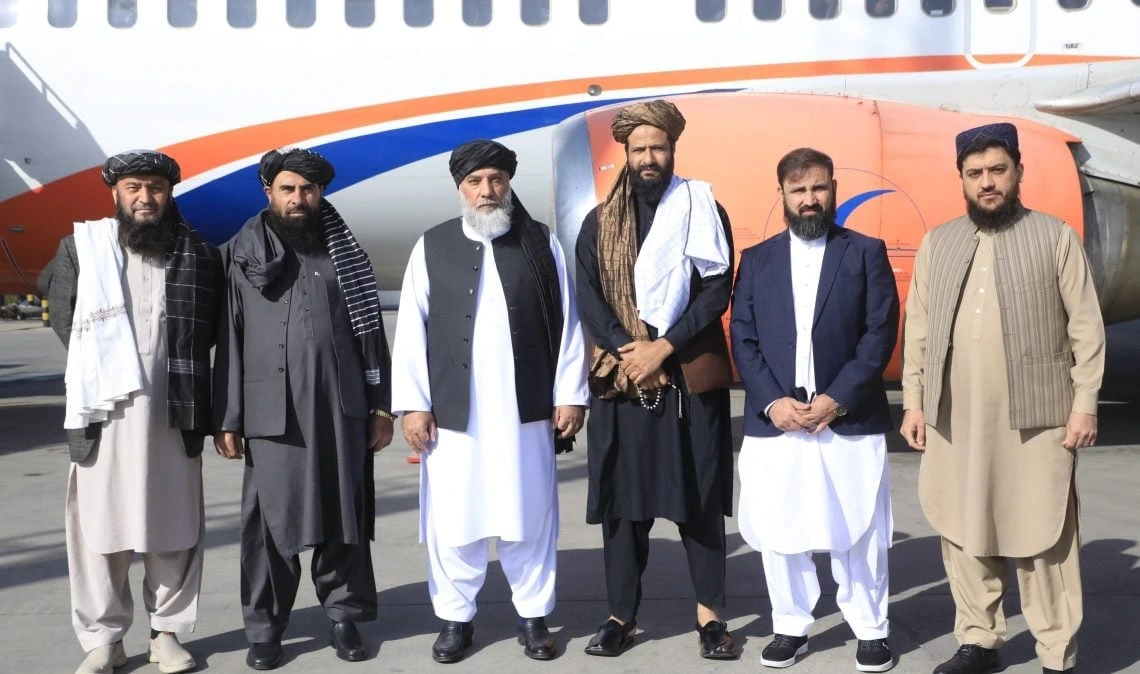
Kabul — Afghanistan’s Minister of Industry and Commerce, Nooruddin Azizi, recently concluded a six-day official visit to India, once again raising the debate over “high optics, low economic substance” in Kabul–New Delhi relations. While the Afghan Ministry of Industry and Commerce claimed that Indian investors were offered “special incentives” such as tax exemptions, reduced tariffs, and free industrial land, ground realities and regional trade constraints raise serious questions about the practical implementation of these promises. The Afghan ministry stated that Indian investors were offered tax breaks and free land as part of these incentives.
Latest Find!!
— HTN World (@htnworld) November 24, 2025
Afghanistan's Minister of Industry and Commerce, Nooruddin Azizi, met with India's Minister of Industry and Commerce, during which both sides discussed strengthening bilateral economic relations, HTN sources confirm.
According to the ministry's statement, Azizi… pic.twitter.com/96xS0ZfY8X
Air Corridor Revival Announced
Azizi also indicated the revival of the Kabul–New Delhi air corridor, which he hailed as a significant development. However, similar to the Ashraf Ghani era, the corridor has historically struggled to support Afghan exports on economic grounds due to high costs, low volumes, and logistical constraints, and the same challenges persist today. With no functioning land transit via Pakistan or Central Asia, trade cannot scale to normal volumes. Moreover, the air corridor is primarily suitable for premium, low-volume exports and cannot serve as a breakthrough for large-scale bilateral trade.
India’s Cautious Taliban Engagement
During Azizi’s visit, India only discussed technical-level trade possibilities, highlighting a cautious approach by New Delhi. India has not officially recognized the Taliban politically, no major financial or industrial investment announcements were made in Doha or New Delhi, and no Indian business chamber issued a roadmap for investment. The Indian Ministry of External Affairs limited its statements, saying discussions were confined to technical aspects of trade, humanitarian aid, and development projects, reflecting a deliberately cautious policy.
Also see: Nooruddin Azizi’s Claim of Expanding India–Afghanistan Economic Cooperation: Reality or Diplomatic Optics?
Regional Obstacles: Ghani Era Issues Persist
Much like previous Afghan governments, the Taliban administration faces a fundamental challenge: Afghanistan–India trade cannot grow substantially without regional connectivity. Changing Afghanistan–Pakistan relations have made land routes to India practically impossible, while the Chabahar port is not yet operational at a level that could provide Afghanistan with a reliable trade route to India. In this context, analyst Salman Javed told HTN that India’s economic engagement with the Taliban is primarily diplomatic theater, and until regional land routes are operational, trade will not move beyond symbolic announcements. While the Afghan ministry’s incentive offers are significant on paper, realities on the ground tell a different story.
Afghan Incentives: Reality or Necessity?
The Taliban government’s offer of incentives to Indian investors, including tax breaks, reduced tariffs, and free land, is largely a response to a severe investment crisis, dollar shortages, and an uncertain policy environment. Kabul is effectively over-incentivizing foreign investors, but this strategy can only succeed if investors have confidence in political stability, international banking channels are open, and regional transit routes are feasible, conditions that currently remain weak.
While Nooruddin Azizi’s visit drew diplomatic and media attention, its economic impact remains limited. Afghanistan’s incentives are conditional on regional realities, and India has shown no willingness for major economic commitments. Just as during the Ghani administration, persistent regional obstacles continue to be the main barrier preventing Afghanistan–India trade from moving beyond symbolic enthusiasm into practical outcomes.