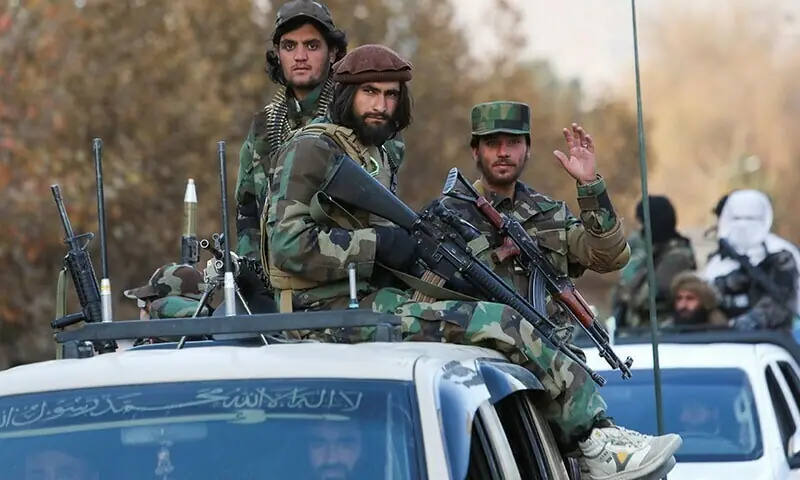
A final report by a US watchdog has confirmed that billions of dollars’ worth of American-supplied weapons, military equipment, and security infrastructure left behind during the 2021 withdrawal from Afghanistan now form the backbone of the Taliban’s security apparatus.
Parallel findings from UN monitoring teams and a Washington Post investigation indicate that some of these weapons have already filtered to the banned Tehreek-i-Taliban Pakistan (TTP), strengthening a group responsible for escalating attacks inside Pakistan.
The 137-page report, released this week by the Special Inspector General for Afghanistan Reconstruction (SIGAR), recounts the scale of the two-decade American project to rebuild Afghanistan. Congress, it notes, provided roughly $144.7 billion between 2002 and 2021 to reconstruct the country and to support a democratic transition — “yet ultimately delivered neither.”
Recent UN assessments reinforce the regional implications of that failure. A UN panel reported that the Afghan Taliban continue providing logistical and operational support to the TTP, while the Washington Post has documented that dozens of US-origin weapons are now surfacing in Pakistan in the hands of terrorists targeting the state.
SIGAR attributes part of this spillover to the abrupt loss of visibility after the Taliban takeover in Afghanistan. “Due to the Taliban takeover, SIGAR was unable to inspect any of the equipment provided to, or facilities constructed for, the Afghan National Defence and Security Forces (ANDSF) following the Afghan government’s collapse,” the report states.
The US Department of Defence, however, has confirmed that approximately $7.1bn worth of American-provided equipment was left behind — including thousands of vehicles, hundreds of thousands of small arms, night-vision devices and more than 160 aircraft.
The consequences of this transfer are already manifesting in Pakistan.
According to the Washington Post, serial numbers of at least 63 seized weapons inside Pakistan match those originally supplied by Washington to Afghan forces. The Washington Post report cited Pakistani officials as saying that some of these rifles and carbines are “significantly superior” to the weaponry commonly used by TTP fighters before 2021.
UN monitoring reports echo this concern. The 36th Monitoring Report (2025) estimates that the TTP maintains a force of around 6,000 fighters spread across Ghazni, Helmand, Kandahar, Kunar, Uruzgan, and Zabul provinces of Afghanistan, and shares training facilities with Al Qaeda.
Addressing the UN Security Council, Denmark’s deputy permanent representative Sandra Jensen Landi said the TTP continues to receive “logistical and substantial support from the de facto authorities” in Kabul.
Earlier UN reports detailed Taliban-provided guesthouses, weapons permits, movement authorisations, and immunity from arrest for TTP leaders — arrangements that have allowed the group to entrench itself deeper in Afghan territory. SIGAR’s own quarterly reports for 2025 cite a string of cross-border attacks, including an assault in South Waziristan that killed 16 Pakistani security personnel.
SIGAR’s final review also revisits the scale — and the futility — of US investment in Afghanistan’s security sector. Between 2002 and June 2025, Washington obligated $31.2bn for ANDSF infrastructure, transportation, and equipment. The US purchased 96,000 ground vehicles, more than 427,000 weapons, 17,400 night-vision devices, and at least 162 aircraft for Afghan forces. As of July 2021, just before the then-Afghan government collapsed, the Afghan Air Force still had 131 operational US-supplied aircraft — virtually all of which are now under Taliban control, according to the report.
Another $11.5bn funded construction of bases, headquarters, and training facilities across Afghanistan, most of which are now either controlled by the Taliban or completely inaccessible to US inspectors, it says.
The report concludes that America’s ambition to build a stable and democratic Afghanistan was hamstrung from the outset by flawed assumptions and misaligned partnerships. Early US decisions to back “corrupt, human-rights-abusing powerbrokers,” SIGAR argues, undermined governance, fuelled insurgent recruitment, and gradually hollowed out the institutions the US was trying to build. The watchdog estimates that $26–29.2bn was lost to waste, fraud, and abuse.
The human cost was far greater. Tens of thousands of Afghans and more than 2,450 US service members were killed, only for the Taliban regime to be restored — and now strengthened by the very equipment the US spent years procuring for its adversaries, it adds.
Despite the collapse, the United States has remained Afghanistan’s single largest donor, having disbursed more than $3.83 billion in humanitarian and development assistance since August 2021 — underscoring Washington’s continued struggle to balance humanitarian obligations with security fears.
As SIGAR ends its mandate after nearly two decades, the final report offers a sobering warning. The Afghanistan experience, it concludes, should serve as a cautionary tale for any future effort to rebuild fragile states on a massive scale — a failure whose ripple effects are now reshaping the security landscape of the wider region.