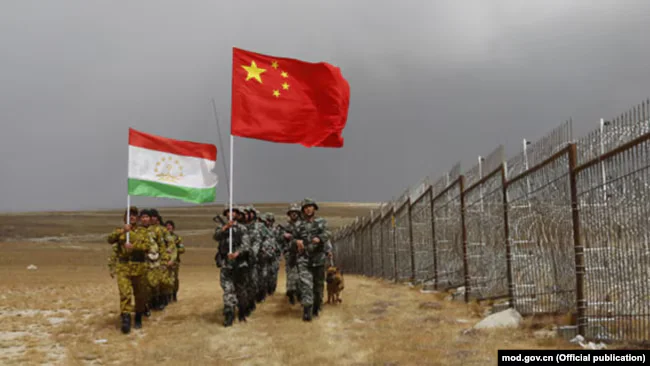
Kabul – The East Turkestan Liberation Front (ETLF), a Uyghur terrorist organization, has claimed responsibility for a drone attack targeting Chinese workers in Tajikistan. According to HTN sources, the ETLF is not a standalone entity but rather an extension of the East Turkistan Islamic Movement (ETIM). It was, in fact, established by Al-Qaeda to serve as a cover organization.
This marks a significant and public re-emergence for the ETLF, which had gone largely underground following its initial establishment and a few early operations.
Terror Camps Activated Across Four Afghan Provinces
Intelligence indicates that the Afghan administration has systematically facilitated the presence of Uyghur militant groups within its territory.
Since 2023, ETIM and other Uyghur terrorists have been given camp facilities across four Afghan provinces, i.e., Balkh, Badakhshan, Baghlan, and Kabul. While these were initially provided under the cover of other terrorist organizations, the camps were fully activated in the name of Uyghur terrorists after April 2025. This consolidation suggests a deliberate strategic decision by the current regime to allow these groups to operate openly.
ETIM/TIP Resurfaces as ETLF to Dodge Chinese Scrutiny
According to the source, now that China is extremely sensitive about the ETIM name, on Al-Qaeda’s advice, ETIM and the Turkistan Islamic Party have decided to bring the ETLF name to the forefront while staying in the background.
ETLF and ETLO are two names of the same organization; ETLF claims a military role, while ETLO claims a political role. Its foundation was laid in 1997 by a Uyghur politician named Muhammad Amin Hazrat, alias Abdul Hazrat, in Turkey, who had become disillusioned with politics.
The Al-Qaeda Strategy and Surprising US Links
The roots of this modern Uyghur militant alliance trace back to Waziristan, where Al-Qaeda forged unity among disparate Uyghur terrorist organizations. Under the adopted strategy, all groups were to be maintained, with different names activated or deactivated as geopolitical needs changed. ETLF and ETLO were initially deactivated in favour of ETIM and TIP.
The command chain later involved non-Uyghur leaders, such as the Egyptian citizen Hamid bin Muhammad al-Masri, an expert in chemical attacks and urban warfare who took over leadership after Amin Hazrat was killed in 2003.
Small cells supporting the movement have been established in Turkey, Kazakhstan, Kyrgyzstan, Pakistan, and other Central Asian cities for recruitment, liaison, and arms smuggling. By 2023, all Uyghur organizations had reportedly settled in Afghanistan.
The most surprising intelligence suggests that the Afghan Taliban, Al-Qaeda subsidiaries (like TIP), and the Uyghur terrorist organizations have also established a working relationship with the East Turkestan Government in Exile (ETGE), a political body established in Washington under American influence in 2004. This exiled government, whose current leadership, including President Mamtimin Ala and Prime Minister Abdul Hadi Noor, is present in the United States, considers itself the official representative of the Uyghur diaspora.
Secret Meeting with Mullah Hebatullah and Wasiq
The recent consolidation and activation of these groups were sealed at the highest levels. A source revealed that in October 2024, a delegation of Uyghur terrorist organizations, led by TIP chief Abdul Haq, met with the current Afghan leadership, Mullah Hebatullah and Abdul Haq Wasiq.
The primary outcome of this meeting was the decision to formally organize Uyghur terrorists in northern Afghanistan. Under this unified command, all Uyghur terrorist organizations are currently united under the leadership of Abdul Haq, with China’s most wanted terrorist, Usman Khan, serving as the military chief. Usman Khan is reportedly based in Badakhshan, while Abdul Haq resides in Baghlan. The visit of Commander Abdul Aziz Dawood Khudaberdi, alias Abu Muhammad Turkistani, to Afghanistan in the third week of November is seen as further confirmation of this centralized structure.
Internal Fissures
The growing readiness of the administration to host transnational organizations such as the ETIM/ETLF is inseparably connected with its internal centralization, as well as hardline ideology. The root cause of this internal instability is old Taliban rifts that have witnessed power being forcefully consolidated at Kandahar. The movement is becoming more exclusionary, with power increasingly concentrated within the circle of Hebatullah, where Pashtun hardliners are given preference, and other, more pragmatic forces and leaders, non-Pashtun, are marginalized.
The repression and successful departure of Afghan voices such as former Prime Minister Gulbuddin Hekmatyar is a caution to any other party that wants a stake in a truly inclusive government. Hekmatyar, the once-dominant Hezb-e-Islami group, has been completely marginalized, which indicates the will of the regime to establish a dogmatic, Pashtun-focused regime that cannot allow any political standpoint of the old guard or internal pragmatists.