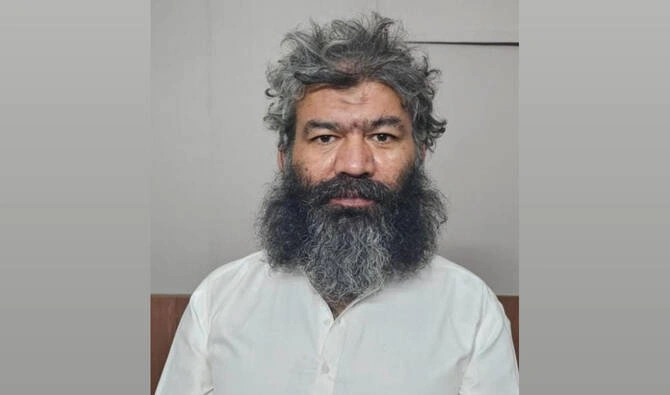
For years, his voice was familiar, calm, and almost comforting to late-night radio listeners in eastern Afghanistan. Today, that same voice is remembered for threats, fear, and extremist propaganda. The arrest of Sultan Aziz Azzam—confirmed months later by the United Nations and Islamabad—has once again drawn attention to a disturbing question: how does an educated, socially integrated individual descend into violent extremism?
Seven months after his detention, Pakistani authorities officially acknowledged that their forces had arrested Sultan Aziz Azzam, a prominent figure of the so-called Islamic State Khorasan Province (ISKP). Once a journalist and radio host, Azzam later emerged as one of the most recognizable propagandists of ISIS in Afghanistan’s Nangarhar province.
A Scholar Who Chose the Microphone
Born 47 years ago in Batikot district of Nangarhar, Azzam’s early life did not hint at the path he would eventually take. He studied Sharia at Nangarhar University, an academic route often associated with religious scholarship and jurisprudence. Yet, instead of pursuing a conventional religious or legal career, he gravitated toward journalism.
After completing short-term journalism training in Jalalabad, Azzam found his niche on local FM radio stations. His late-night programs featured readings from historical novels, particularly the works of Naseem Hijazi—stories rich with themes of war, conquest, and ideological struggle. Slowly, his voice became a recognizable presence across the airwaves.
Colleagues who interacted with him during this period describe a man who was approachable and unassuming. “He was calm, sociable, kept a short beard, styled his hair neatly, and enjoyed sitting with fellow journalists,” recalled two local reporters. “He joked, blended in, and showed no visible signs of radical tendencies.”
The Sudden Shift
The year 2015 marked a dramatic turning point. Friends and former colleagues were stunned when they heard Azzam’s voice on Voice of the Caliphate, an FM radio station operated by ISIS in parts of Nangarhar. The transformation was stark and unsettling.
The man who once read poetry and fiction was now issuing death threats, glorifying violence, and calling for allegiance to a self-proclaimed caliphate. Broadcasting from undisclosed locations, Azzam became one of the most prominent media faces of ISIS-K, using the same broadcasting skills he had honed as a journalist to spread fear and radical ideology.
This evolution highlights a critical and often overlooked aspect of modern extremism: the strategic use of educated individuals and media professionals to amplify militant narratives.
Arrest and Regional Implications
Azzam’s arrest by Pakistani forces—and the delayed confirmation of it—underscores the sensitive nature of counterterrorism operations in the region. His detention is being viewed as a significant blow to ISIS-K’s propaganda apparatus, particularly its ability to communicate in local languages with cultural fluency.
Security analysts note that Azzam’s case reflects a broader regional challenge: militant groups increasingly recruit individuals with academic backgrounds, media skills, and social credibility to legitimize and disseminate their messages.
Lessons Beyond One Man
The story of Sultan Aziz Azzam is not merely about one individual’s radicalization. It is a cautionary tale about how ideology, grievance, opportunity, and narrative manipulation intersect. It exposes the fragile boundary between influence and indoctrination, and between free expression and weaponized media.
As South and Central Asia continue to grapple with extremism, Azzam’s journey—from university lecture halls to radio studios, and ultimately to militancy and arrest—serves as a stark reminder: the battle against terrorism is not fought only on the battlefield, but also in classrooms, newsrooms, and on the airwaves.
The microphone, as his story proves, can be as powerful—and as dangerous—as a gun.