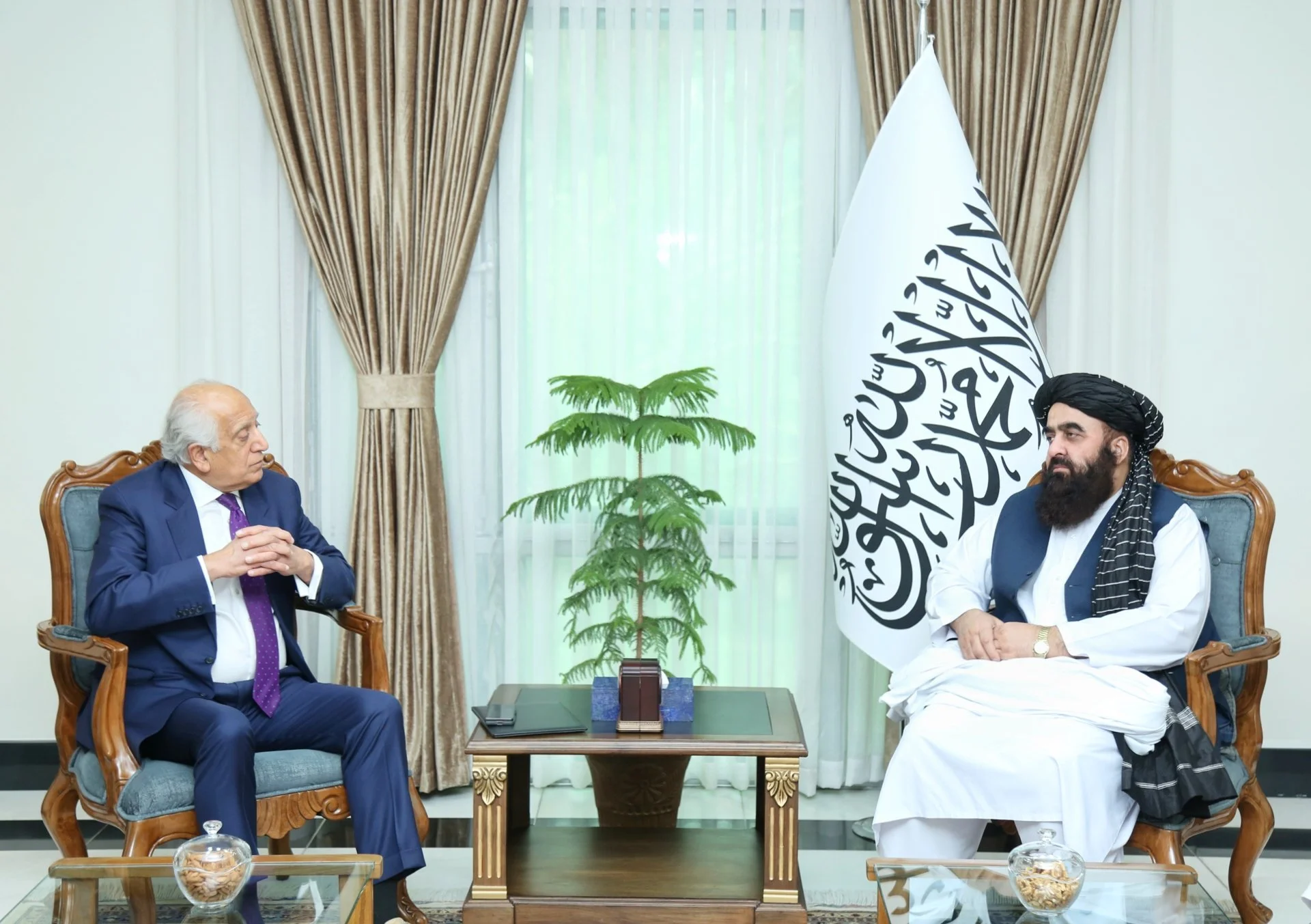
Kabul – Zalmay Khalilzad, a former US envoy, visited the capital of Afghanistan on Dec 28 and met with the Foreign Minister of the Taliban, Amir Khan Muttaqi.
Although it was presented by Kabul as a step in a new phase of cooperation, the reality on the ground could give the impression that it is a much more complex and transactional relationship.
The Kabul engagement by Zalmay Khalilzad is timed when Afghanistan is diplomatically isolated and economically stretched.
In the talks, Muttaqi sounded sanguine, indicating that bilateral relations were in a phase of wider discourse since the US withdrawal.
نن د ا.ا.ا د بهرنیو چارو وزیر محترم مولوي امیر خان متقي سره د افغانستان لپاره د امریکا متحده ایالتونو پخواني ځانګړي استازي ښاغلي زلمي خلیلزاد وکتل.
— Ministry of Foreign Affairs – Afghanistan (@MoFA_Afg) December 28, 2025
په دې ناسته کې د افغانستان او متحده ایالتونو د دوو اړخیزو اړیکو د پراختیا پر لارو چارو، فرصتونو او ستونزو هر اړخیزې خبرې وشوې. pic.twitter.com/Xh6ihTAt03
To the Taliban, such high-profile visits are a strategic step towards creating an image of international acceptance. But in the case of Washington, there is no more than a pragmatic interaction.
The US maintains a hard line, denying official political recognition and holding more than 7 billion of Afghan central bank funds frozen.
The Security Gap
As Khalilzad is quoted praising the situation of stable security and reconstruction activities in the country, these arguments are violently opposed by the international community.
The continuing United Nations monitoring reports paint a different picture, with Afghanistan remaining an international terrorism hub. Regardless of the Taliban discourse of peace, analysts opine that there are over 20 terrorist organizations in the country, including the affiliates of al-Qaeda and ISIS-K.
Zalmay Khalilzad’s Kabul engagement highlights a disconnect between diplomatic talk and regional safety. Countries such as Pakistan and Iran are still highly worried about cross-border militancy.
It has been reported that organisations such as the TTP still have room to operate in Afghanistan, and there are widespread attacks that destabilize the argument by the Taliban that they have complete control internally.
Background: Khalilzad in 2025
Zalmay Khalilzad has occupied a special place in the affairs of Afghanistan since 2025. No longer a representative of the US government in an official capacity, he is considered by many to be acting under an official but unofficial mandate in the current administration as a backchannel.
He has already traveled to Kabul at least four times this year and has frequently been seen with US Special Envoy for Hostage Response Adam Boehler discussing prisoner swaps.
A Washington Post reporter on Afghanistan, Haq Nawaz Khan, describes this Kabul interaction of Zalmay Khalilzad as having acquired a more acute strategic cutting-edge.
“Khalilzad specially put pressure on Afghanistan to play its role in handing over to airstrips to the US against China and Russia,” according to Haq Nawaz Khan.
Such an action is regarded as a direct counteraction to the growing regional presence of China and Russia.
With the ability to gain access to these facilities, Washington is hoping to hold a strategic presence in a region where its competitors are making heavy investments in mineral wealth and infrastructure.
Netizens Question Khalilzad’s Role
The visit has attracted a chorus of doubt on social media, especially on X (formerly Twitter), where netizens have questioned whether the former envoy had a legal and official status.
The question many are posing is how a common citizen can be involved in the top-level negotiations with frozen national funds, bilateral banking issues, and military resources such as airstrips.
Zalmay Khalilzad’s visit to Kabul and meeting with Acting Foreign Minister Amir Khan Muttaqi signal a cautious political engagement, using backchannels to balance non-recognition with avoiding a strategic vacuum amid security and economic pressures. pic.twitter.com/aX68gIFJNG
— Dr.Burhani,Ph.D. professor (@DrShenwari) December 28, 2025
Others have labelled the Secretary of State, Marco Rubio, of the US government, urging him to be clear about the mandate of Khalilzad.
One user posed the question, in what capacity does he do this? And if he is simply visiting, what about making promises on matters that are the province of governments?
What exactly is Zalmay Khalilzad’s authority today? He holds no official position in the U.S. government yet he freely travels to Kabul and inserts himself into talks framed as bilateral relation with the Taliban. On whose mandate does he operate & who empowered him to pic.twitter.com/emL4mSMwvi
— Roya Safi 🇦🇫 (@RoyaSafiwr) December 29, 2025
Another one remarked that Khalilzad is a person who looks unemployed but plays the role of a pseudo-representative and wonders who gave him the authority to represent the US interests or the Afghan financial system.
Khalilzad is unemployed but he keeps showing up in Kabul and meeting Taliban leaders as US representative, "promises cooperation" on banking/economic challenges and even discusses Afghanistan's frozen funds.
— Natiq Malikzada (@natiqmalikzada) December 29, 2025
Can US's @SecRubio clarify in what capacity is he doing this? If he’s… https://t.co/KiVmVPERKV
A Transactional Future
To the typical Afghan citizen, these high-level discussions have never been translated into better living standards.
The social policies and the devastating economic collapse continue to be the order of the day.
The dialogue is an essential instrument of humanitarian access and fundamental coordination, but the structural distance between the West and the Taliban has not become smaller.
In the absence of tangible advancements on the issue of human rights and a verifiable effort to put extremist networks in check, the Zalmay Khalilzad Kabul engagement will certainly stay a pattern of an act play instead of a road towards political normalization.
The world is waiting with bated breath to see whether words will at last be given tangible action on the ground.