
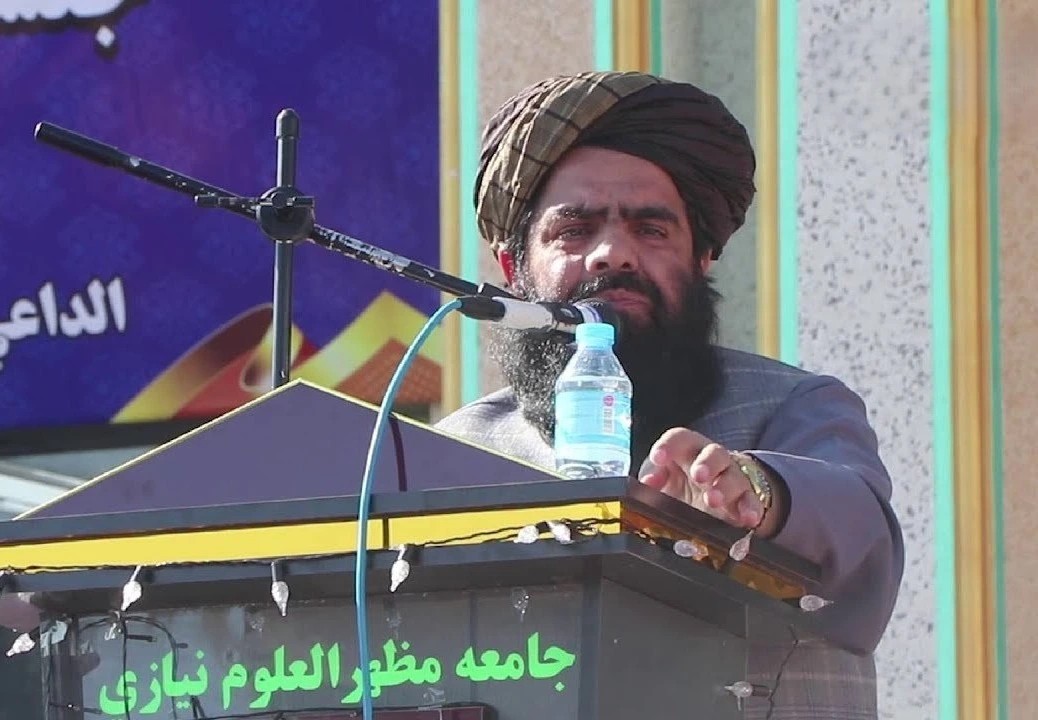
The governor of Afghanistan’s Khost province, Maulvi Abdul Qayum Mukhtar has claimed that Afghan soil will not be allowed to be used against any other country, while warning that jihad would become obligatory if Afghanistan itself is attacked.
He made the remarks while addressing a graduation ceremony at a religious seminary in Khost.
Mukhtar said the Islamic Emirate and the Afghan people must respect the Doha Agreement and a declaration issued by clerics in Kabul, and avoid any form of jihad outside Afghanistan.
Addressing militants, he said that since the Islamic Emirate has signed an agreement, it is not permissible to go to any other country for jihad or any other purpose.
He urged fighters to show patience and remain loyal to the agreement, presenting his remarks as a call for regional restraint and responsibility.
The Khost governor also announced a strict measure to discourage suicide attacks.
He said funerals and condolence gatherings of those who carry out suicide attacks would now be limited to close family members only, citing political and security reasons.
He also stressed the need to enforce Sharia punishments to prevent the killing of innocent people.
At the same event, Afghan Red Crescent chief Shahabuddin Delawar said Afghanistan faces many enemies and conspiracies, but these can be defeated through unity, public service, and loyalty to the system.
However, the situation on the ground tells a different story. Since 2021, thousands of cross-border attacks and infiltration attempts have been recorded in Pakistan, many linked to the banned Tehreek-e-Taliban Pakistan (TTP) and its affiliates.
These attacks have continued despite repeated assurances from Kabul that Afghan soil will not be used against neighboring countries.
United Nations monitoring team reports from 2022 to 2025 have repeatedly documented the presence of TTP in Afghanistan, including training camps, leadership structures, and logistical networks.
These findings contradict the Doha Agreement’s clause that prohibits providing shelter, training, or facilitation to militant groups.
The narrative of “jihad only inside Afghanistan” appears calm on the surface, yet TTP fighters continue to move freely, reorganize, issue propaganda, and claim attacks inside Pakistan.
This raises serious questions about whether these statements reflect real policy or remain limited to speeches.
Pakistan has paid a heavy price. Since 2021, hundreds of civilians and security personnel have lost their lives in TTP-linked violence.
Real implementation of the Doha Agreement requires verifiable action, not declarations, including dismantling sanctuaries, arresting leadership, and shutting down training networks.
Until that happens, claims of compliance will remain political messaging, not effective policy.











