
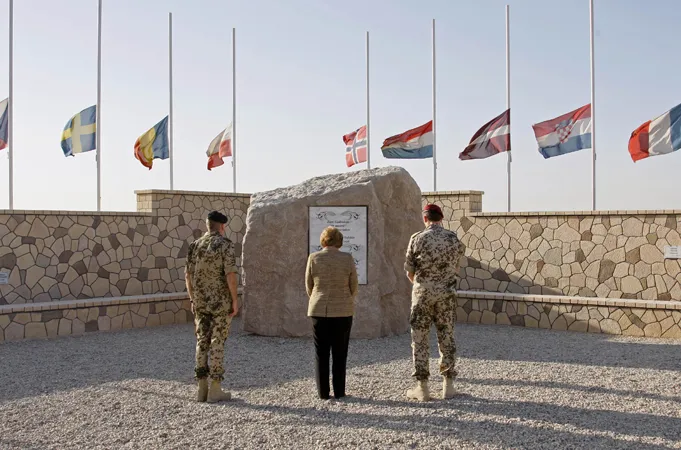
Donald Trump’s claim that NATO troops stayed “a little off the front lines” during the war in Afghanistan has sparked anger across the United Kingdom, particularly among veterans, families of fallen soldiers and political leaders.
Keir Starmer’s office described the remarks as wrong, while British veterans called them deeply disrespectful. The White House response, which avoided directly correcting the statement and instead pointed to US contributions to NATO has only reinforced the sense that allied sacrifices are being dismissed.
UK PM Keir Starmer calls US President Donald Trump's remarks about Nato troops in Afghanistan "insulting and frankly appalling" https://t.co/HY02kDGRug
— BBC Breaking News (@BBCBreaking) January 23, 2026
The comments have reopened one of the most painful chapters of the post-9/11 era and revived a wider debate not just about who fought in Afghanistan but about what the war ultimately achieved and who paid its price.
UK PM Keir Starmer calls US President Donald Trump's remarks about Nato troops in Afghanistan "insulting and frankly appalling" https://t.co/HY02kDGRug
— BBC Breaking News (@BBCBreaking) January 23, 2026
NATO invoked article 5 and fought a 20-year war in Afghanistan
After the 9/11 attacks on New York and Washington, the United States invoked Article 5 of the NATO treaty for the first and only time in its history. This meant an attack on one was treated as an attack on all.
More than 50 countries took part in the conflict that followed. NATO’s role was not symbolic. Allied troops fought alongside US forces for two decades in some of the most dangerous regions of the country.
“Maybe we should have put NATO to the test: Invoked Article 5, and forced NATO to come here and protect our Southern Border from further Invasions of Illegal Immigrants, thus freeing up large numbers of Border Patrol Agents for other tasks.” – President Donald J. Trump pic.twitter.com/pc0BabACOm
— The White House (@WhiteHouse) January 23, 2026
The scale of sacrifice is documented. The United States lost 2,465 personnel. The United Kingdom lost 457. Canada lost 158. When measured by population, countries such as Denmark, the UK, and Estonia suffered some of the highest casualty rates.
A former US Marine and senior Pentagon official, Mick Mulroy, has said he personally witnessed NATO soldiers returning home in coffins and that they served “with courage and dedication on the front lines”.
British soldiers did not stand back, they paid in blood
For those who fought, Trump’s remarks are not a matter of political disagreement but of personal pain. Veterans in the UK have said the comments erase the reality of daily combat and risk.
Janette Binnie, whose son Sean was killed in Helmand province in 2009, said the president’s words “diminish everything our children did,” reported by BBC. The Royal British Legion has also stated that the service and sacrifice of British personnel in Afghanistan “cannot be called into question”, reminding the public that thousands continue to live with physical and psychological scars.
Donald Trump in an interview said that NATO troops stayed away from the frontline in Afghanistan; these troops were sent after 9/11 attacks on US#DNAUpdates | #DonaldTrump | #NATO pic.twitter.com/v3gM5ykXg7
— DNA (@dna) January 23, 2026
Political fallout in Britain and a defensive response from Washington
The backlash in Britain has crossed party lines. Labour, Conservative, Liberal Democrat, and Reform UK leaders have all rejected Trump’s remarks. Some have called them a disgrace, others a huge insult.
In Washington, however, the response has focused not on correcting the statement but on highlighting US defence spending and NATO burden-sharing, a familiar argument Trump has used before.
Many observers see this as an attempt to change the subject rather than confront the substance of the criticism.
Downing Street has said Donald Trump was 'wrong' to claim that Nato troops avoided frontline combat in the war in Afghanistan. https://t.co/dyS1wjDFWo pic.twitter.com/FxzOA1Dhlr
— Financial Times (@FT) January 23, 2026
The war failed to build a stable Afghanistan
The war in Afghanistan began in 2001 to destroy Al-Qaeda and prevent the country from ever again becoming a base for international terrorism. Twenty years later, NATO forces withdrew, and the Afghan state collapsed within days.
The Taliban returned to power and many of the social and political gains of the previous two decades disappeared almost overnight.
Afghanistan today is poorer, more isolated, and more repressed than it was before the intervention.
Years of war hollowed out institutions and made the state dependent on foreign aid.
Dementia Donald @realDonaldTrump @POTUS, who formed the Billionaire Boys Club anti-NATO Board of Peace and stole NATO's logo, claims that @NATO (and Europe) has done nothing for the U.S., forgets that NATO countries aided the U.S. after 9/11 and sent military to Iraq and… pic.twitter.com/kgaFf94rcy
— John J. Mesh (@Ohnjaye4) January 23, 2026
Pakistan and the region paid a heavy price for this war
The consequences of the Afghanistan war did not remain confined within Afghan borders. Pakistan, in particular, suffered enormously from the spillover in the form of terrorism, extremism, refugee flows and deep social and economic damage.
Tens of thousands of Pakistanis, both civilians and security personnel, lost their lives over the years.
NATO Didn’t Hide in Afghanistan — Trump Just Forgot the History and the Coffins
— Vicky Richter🇩🇪🇺🇸🇧🇷🇬🇧 (@VickyRichterUSA) January 23, 2026
Donald Trump’s latest pot-shot at NATO — claiming that allied troops “stayed a little back, off the front lines” in Afghanistan — isn’t bold, strategic commentary. It’s disrespect packaged as… pic.twitter.com/9VWuR6e2Ar
The Afghanistan war destabilized the entire region and left scars that remain visible today.
In this context, Trump’s remarks can be seen as a criticism of NATO wrongdoings in the region. They trivialize a conflict that destroyed a country, destabilized a region, and cost countless lives including those of NATO soldiers who were very much on the front lines.
Read more: Donald Trump Sends US Armada Towards Iran ‘Just in Case’











