
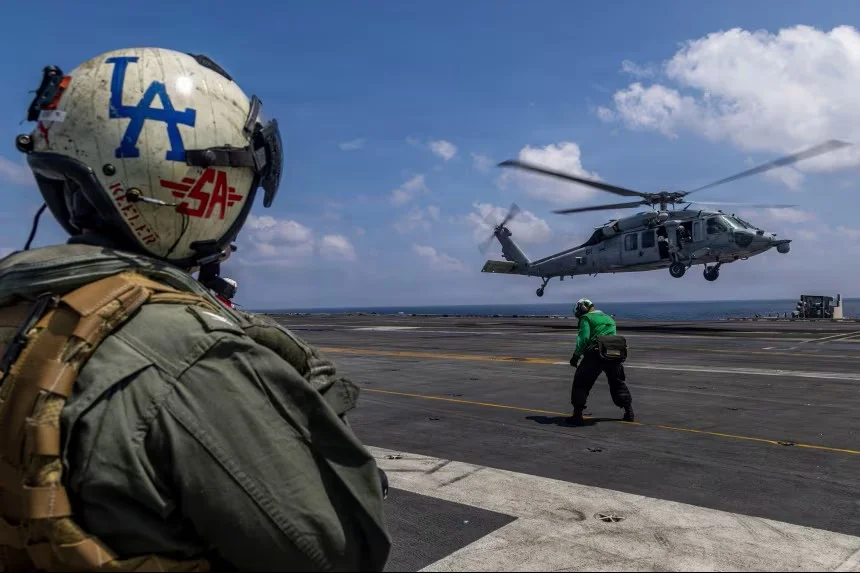
The United States has moved a powerful aircraft carrier strike group led by the USS Abraham Lincoln, into the Middle East, signaling a new phase of pressure on Iran.
At the same time, President Donald Trump has said that “diplomacy remains an option” and claimed that Iran has reached out to make a deal.
This combination of military pressure and political messaging may look contradictory but in fact it follows a clear and well-known strategic pattern in international relations.
A US official confirmed that the carrier and its accompanying warships are now operating under US Central Command.
Trump also told US media that America now has a “big armada next to Iran,” while repeating that he would “rather not see anything happen.”
This shows that Washington is trying to shape Iran’s behavior without moving toward open war.
The Middle East as a regional security system
In international relations theory, the Middle East is often described as a regional security complex. This means that the security of each country in the region is deeply connected to the others.
A crisis involving Iran does not stay limited to Iran. It immediately affects Israel, the Gulf states, Iraq, Syria and global energy routes.
Because of this, the US does not treat Iran as an isolated problem. By sending a carrier strike group, Washington is trying to influence the entire regional balance of power.
The move reassures US allies, warns Iran against escalation, and signals to other regional players that the US remains the main security actor in the region.
In this kind of security system, big military moves are often not meant to start wars. They are meant to shape calculations, prevent sudden surprises and control the overall strategic environment.
Coercive diplomacy and controlled pressure
This strategy fits another classic concept: coercive diplomacy. This means using military pressure to push an opponent toward negotiations without actually crossing the line into war. The US carrier group is not just a fighting force. It is a political message floating on the sea.
Trump’s statements support this reading. He says Iran “wants to make a deal” and that diplomacy is still possible. This suggests the military deployment is meant to strengthen Washington’s bargaining position not to trigger conflict.
From a strategic point of view, neither side wants a full war. Iran risks devastating strikes. The US risks a regional explosion, attacks on allies and chaos in global energy markets.
So both sides are likely to continue playing a dangerous but controlled game of pressure and signaling.
In short, the US “armada” near Iran is not about invasion. It is about deterrence, leverage, and regional power management using force not to fight but to influence choices before the situation spins out of control.
Read more: Donald Trump Sends US Armada Towards Iran ‘Just in Case’











