
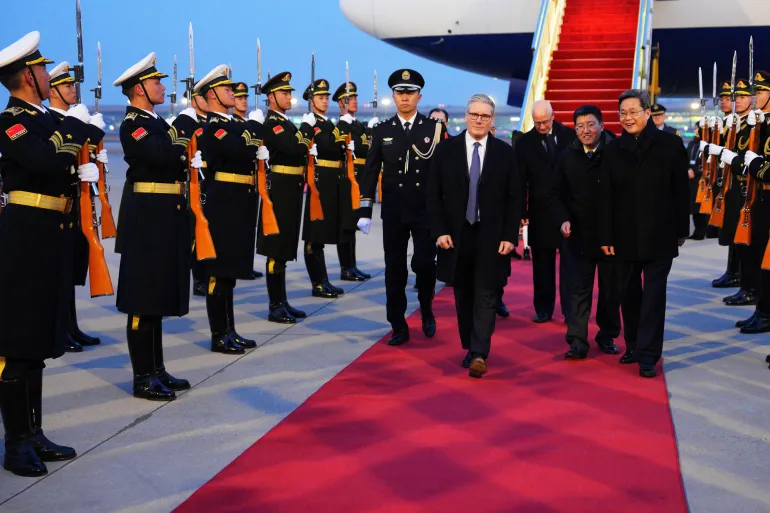
When British Prime Minister Keir Starmer arrived in Beijing today, it was presented as a trade and diplomacy mission. But taken together with Canadian Prime Minister Mark Carney’s recent visit and a steady stream of European leaders heading to China, it points to something much larger.
This is not normal diplomacy. It is a sign that America’s closest allies are adjusting to a world in which US leadership no longer feels stable or predictable.
A visit that is bigger than it looks
Starmer is the first British prime minister to visit China in eight years. Carney, before him, announced a “new strategic partnership” with Beijing and signed preliminary trade and energy agreements.
France has already been. Germany is next. Several of these countries are formal US treaty allies. All of them are now quietly diversifying their options.
The Starmer doctrine: pragmatism without strategy
Starmer insists that Britain should not “choose” between the United States and China. China, he says, is too big to ignore. His foreign policy style is openly non-ideological. He prefers “problem-solving” to grand strategy and believes engagement in every direction can be managed without hard trade-offs.
But this is not really a strategy. It is an avoidance of strategy. In a world shaped by great power rivalry, pretending that there are no structural conflicts is not realism.
The world he pretends does not exist
The US–China rivalry is no longer a passing dispute. It is structural, long-term, and increasingly defines global politics, technology, trade and security. In such a system, middle powers cannot escape pressure forever.
The idea that Britain, Canada or Europe can indefinitely sit comfortably between Washington and Beijing belongs to a different era.
From hegemon to disrupter
The real driver of this Western rebalancing is not love for China. It is growing distrust of the United States under Donald Trump.
A stable hegemon provides predictability, public goods and a sense of order. Trump’s America does the opposite. It threatens allies with tariffs, openly uses trade as a weapon, talks about annexing Greenland and treats alliances as protection rackets rather than partnerships.
Trump’s strongman rhetoric about having the “best army”, forcing solutions on Iran, bullying Venezuela and claiming only the US can impose peace reflects an imperial mindset not a leadership one.
Canada as the clearest warning sign
Mark Carney’s China visit is the most revealing case. Canada is one of America’s closest allies and still sends about 75 percent of its exports to the US. Yet Carney has openly said the world order is “ruptured” and that Canada must reduce its dependence on the American market.
His Beijing trip was not symbolic. He announced trade, energy and clean technology cooperation and spoke of a new strategic partnership. This is not a pivot away from the US. However, it is an insurance policy against American unpredictability.
China’s counter-offensive: selling order
Beijing understands this moment very well. At Davos and other multilateral institutions, Chinese leaders are presenting China as a defender of multilateralism, free trade, the WTO and the UN system.
China is trying to fill a narrative vacuum by presenting itself as a responsible, system-supporting power. Whether one believes this story or not is secondary. The fact that many countries are listening is what matters.
Trading with a threat
And yet the Western position is full of contradictions. Britain’s intelligence services call China an “epoch-defining challenge”. Huawei was banned after warnings of deep security risks. Officials travel to China with burner phones. MI5 says China is its top priority target.
At the same time, Western governments talk about trade, investment and engagement. They approve mega-embassies and send business delegations. This is not hypocrisy because China is seen as both an economic necessity and a strategic threat.
What Starmer’s trip really means
Starmer’s visit is not pro-China. It is not anti-American. It is something more rooted in classical IR theories which portray such behaviors as post-hegemonic resetting, and the UK has shown these instincts in the current visit to China.
It reflects a growing belief in Western capitals that the US is still powerful but no longer reliably stabilizing.
The same logic explains Carney’s trip, Macron’s outreach and Germany’s planned visit.
The wall that is coming
But ambiguity has limits. In a world of sanctions, tech blocs and potential crises over Taiwan or other flashpoints, pressure will grow. At some point, countries will be forced to align more clearly. The luxury of “not choosing” will shrink.
The age of hedging
We are entering a world where trusts with China is improving, fewer and fewer countries fully trust the United States, and almost everyone is hedging.
Starmer and Carney are not designing a new world order. They are navigating the slow collapse of an old one, an order that once revolved around American leadership and now revolves around uncertainty.
Read more: UK Labour Leader Visits China to Repair Diplomatic Ties Amid US Tensions











