
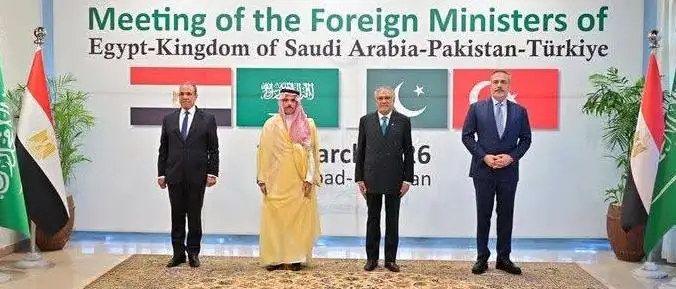
ISLAMABAD: Prime Minister Shehbaz Sharif on Monday expressed his gratitude to the foreign ministers of Saudi Arabia, Turkiye, and Egypt following a quadrilateral meeting in Islamabad aimed at easing tensions in the Middle East. He appreciated their confidence in Pakistan’s efforts to promote peace and stability in the region.
The meeting, chaired by Deputy Prime Minister and Foreign Minister Ishaq Dar, brought together officials from Pakistan, Saudi Arabia, Turkiye, and Egypt. It focused on de-escalating hostilities between the United States and Iran, which have raised concerns about regional instability and the disruption of global energy supplies.
It was a pleasure to receive His Highness Prince Faisal bin Farhan this evening.
— Shehbaz Sharif (@CMShehbaz) March 29, 2026
I conveyed my respectful regards to His Majesty King Salman bin Abdulaziz Al Saud and warm greetings to my brother His Royal Highness Mohammed bin Salman, the Crown Prince.
I reaffirmed Pakistan’s…
“It was a pleasure to receive His Highness Prince Faisal bin Farhan. I reaffirm Pakistan’s unwavering solidarity with the Kingdom and appreciate Saudi Arabia’s restraint in these challenging times,” PM Shehbaz said in a social media post. He also recognized Saudi Arabia’s leadership among Islamic countries and emphasized the importance of unity.
Similarly, he welcomed Turkish Foreign Minister Hakan Fidan and Egyptian Foreign Minister Dr. Badr Abdelatty. He thanked both countries for their contributions and stressed the need for collective efforts to bring an urgent end to hostilities that are causing loss of life and economic damage across the region.
At the conclusion of the consultations, FM Ishaq Dar stated that Pakistan is ready to host direct talks between the US and Iran to achieve a lasting settlement. Diplomatic sources indicate that the meetings could involve US Secretary of State Marco Rubio and Iranian Foreign Minister Abbas Araghchi, with hopes for confidence-building measures and a possible ceasefire.
Pakistan’s proactive diplomacy highlights its growing role as a neutral mediator and reflects the country’s commitment to regional peace and stability.











