
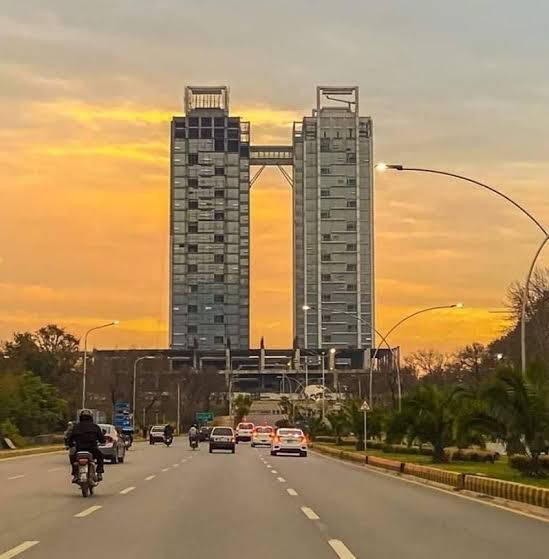
Islamabad: The Grand Hayat / One Constitution Avenue case is one of the most prolonged and legally complex real estate disputes in the capital, involving regulatory violations, court rulings, and financial defaults spanning nearly two decades.
The project originally began in 2005 when the Capital Development Authority (CDA) leased 13.5 acres of land for the development of a five-star hotel. The agreement clearly stated that any service apartments would only function as part of the hotel operations and could not be sold as independent residential units.
Over the following years, CDA repeatedly reaffirmed this condition. By 2012, the authority had formally restricted the developer from marketing or selling any units. Despite these directives, the project gradually shifted into a residential-style development, with apartments being sold to buyers on a large scale.
Court records presented in 2017 showed that approximately 240 units had already been booked, along with detailed payment records submitted by the developer itself. Authorities viewed this as evidence of a structured commercial shift beyond the approved scope of the lease.
In 2016, CDA cancelled the lease due to violations. The Islamabad High Court upheld this decision in 2017 and again in 2018, reinforcing the legal standing of the cancellation.
In 2019, the Supreme Court provided a conditional opportunity for revival, allowing the lease to be restored if the developer paid Rs. 17.5 billion in installments. However, only around Rs. 2.9 billion was deposited, while the remaining amount was left unpaid and financial guarantees lapsed.
As a result, the lease was cancelled once again in March 2023, with the project formally reverting to CDA control. Public notices warned that the former developer had no legal authority and that any transactions would be at the buyer’s own risk.
In April 2026, the Islamabad High Court dismissed all remaining petitions, effectively bringing legal closure to the long-running case.
At present, out of 253 total units, only 69 are reportedly occupied, while the majority remain vacant or sealed, reflecting the unresolved nature of ownership and occupancy.
The case is widely viewed as a regulatory and legal precedent, highlighting issues of land use conversion, unauthorized sales, financial non-compliance, and prolonged litigation. It underscores how a project initially approved as a hotel structure was transformed beyond its legal framework, leading to its eventual cancellation through due process.











