
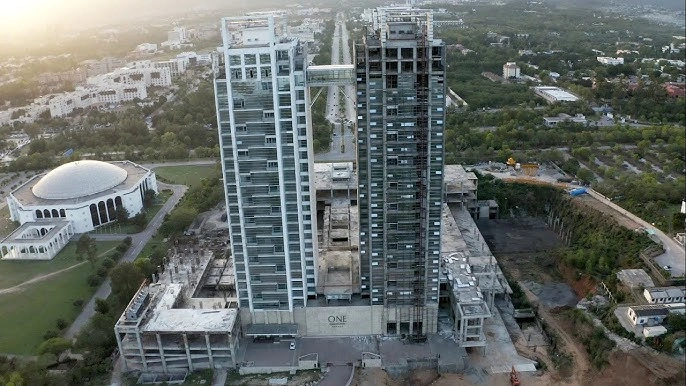
Islamabad — The ongoing controversy surrounding One Constitution Avenue in Islamabad has sparked a wave of competing narratives, with officials and observers pushing back against what they describe as disinformation and vested-interest-driven claims.
Sources familiar with the situation argue that recent public discourse has shifted away from legal facts toward politically charged interpretations. They say certain voices are portraying ongoing legal proceedings as “political victimization,” despite the matter being rooted in contractual violations and regulatory enforcement.
Questions have also been raised about reports involving security forces. Contrary to claims circulating on social media, there is no evidence suggesting that Rangers were deployed for any takeover operation. Officials note that Rangers have long maintained a routine presence in the Red Zone for security purposes, and presenting this as part of a specific operation is misleading.
Similarly, claims regarding a large number of foreign diplomats residing in the building have been challenged. Available information suggests that only a limited number of diplomats were living there, far fewer than widely reported figures. Authorities have also dismissed reports of any formal diplomatic protest, stating that no such demarche has been issued to Pakistan’s Foreign Office.
Other circulating narratives, including alleged involvement of a Lahore-based developer in future plans for the property, have been described as unfounded. Observers say such claims appear to be speculative and lack credible evidence.
Attention has also turned to a photograph shared online, purportedly linked to recent developments. Analysts point out that the image is outdated and dates back to a period when previous stakeholders were seeking international investment, unrelated to current events.
Officials emphasize that the case is not directed against any specific social group but is instead a legal matter concerning land use, contractual obligations, and long-standing violations. They argue that attempts to frame the issue as targeting the middle class obscure the core legal realities.
Details of the original project plan further complicate the narrative. The development was not limited to a small construction footprint but included a broader design featuring towers, commercial areas, landscaped zones, and supporting infrastructure. Experts warn that presenting partial information can distort public understanding.
The project also faced delays and financial issues. Construction timelines were not met, and required payments under court-mandated conditions were only partially fulfilled. These factors, officials say, contributed to the legal actions taken over time.
Authorities maintain that the Capital Development Authority operates as an independent regulatory body, and its decisions are based on legal frameworks rather than political considerations. They caution against linking every enforcement action to political motives without evidence.
Analysts conclude that the case highlights broader risks associated with investing in disputed or legally contested properties. They note that such investments often carry significant legal and financial uncertainties, regardless of the profile of the individuals involved.
As the debate continues, observers stress the importance of distinguishing between verified facts and narrative-driven claims in shaping public perception.











