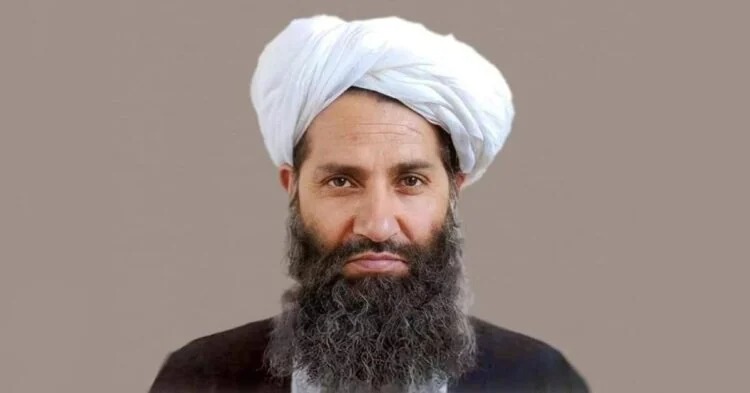
Taliban-aligned media have claimed that a gathering of clerics at Kabul University on November 16 and 17 declared Mullah Haibatullah Akhundzada “Sheikh al-Islam”. The author argues the move is a sign of his lust for power and personality cult. In 1,448 years of Islamic history, the author writes, no one has put himself forward for this title. It was always scholars across the Muslim world who, impressed by someone’s learning, used it to acknowledge his standing. When the title was given to figures such as Sheikh al-Islam Mufti Taqi Usmani, they responded with humility, described themselves as students of religion and said they did not deserve it.
According to the author, Mullah Haibatullah is the only such case in Islamic history: he used state power to gather handpicked people under an official arrangement and pressed them to accept him as Sheikh al-Islam. The author adds that, more absurdly, even this official gathering did not formally approve the proposal. Sources present at the gathering say Sirajuddin Haqqani, head of the Haqqani Network, reacted strongly. In his speech he reportedly said that in Islam no single individual has the right to impose domination, acknowledged that many people disagree with Haibatullah, and told the audience by name to stop praising Haibatullah and get to work, because without public support this system would fail. The author also cites reports that after Haqqani’s speech, clerics linked to the Haqqani group walked out of the meeting. As a result, the author says, the clerics’ opinion on the resolution was never taken, and the announcement was simply made in controlled media that the clerics had declared Haibatullah Sheikh al-Islam.
The Reality and Status of the Title “Sheikh al-Islam”
From the early centuries of Islam, “Sheikh al-Islam” has been used to acknowledge scholars who were the most distinguished of their age and regarded as authorities on Islamic teaching. Imam Ibn Taymiyyah, Imam Ibn Hajar al-Asqalani, Imam Ibn Kathir and Imam Zakariyya al-Ansari are examples. It was purely a recognition by scholars of another scholar’s high rank.
The Ottoman Caliphate gave the title formal legal status. There, the Sheikh al-Islam was the highest religious official, appointed by the sultan. His legal standing was somewhat above that of a chief justice. He provided religious guidance to the entire caliphate, including the caliph, and could review the caliph’s actions and rule on whether they were right or wrong. History records several cases in which a caliph took a decision and withdrew it once the Sheikh al-Islam’s fatwa came out. In a sense, it was a religious check on the caliph and the state. (Here, the author asks, Haibatullah is demanding this authority while being the ruler himself, so where has the check gone?) The Ottoman Sheikh al-Islam’s powers included issuing fatwas, overseeing religious and legal matters, supervising judges and religious institutions, and guiding and holding the state to account. The post ended with the fall of the Ottoman Caliphate. Since then, it has been a title used by contemporary scholars to acknowledge one person’s knowledge and spiritual insight, but no one, the author says, has tried to proclaim himself Sheikh al-Islam as Haibatullah has.
Why Does Haibatullah Want to Be Sheikh al-Islam?
The author says it is important to ask why Haibatullah was so eager to be declared Sheikh al-Islam that he awarded himself this honour through an official arrangement. One explanation, he writes, is that psychologists claim that when an inferiority complex goes beyond limits, a person comes to suffer from a compulsion to declare himself honourable. He points to Haibatullah’s earlier self-description as Sheikh al-Hadith and then Sheikh al-Hadith al-Quran as signs that would make this claim credible. But the second and more important purpose, in the author’s view, is Haibatullah’s lust for power and his pathological habit of concentrating authority in his own hands.
In the recent past, the author writes, he took from the prime minister the power to convene cabinet meetings, stripped ministers of decision-making, and brought everything under his control, from appointments and transfers in the armed forces to the hiring of low-level state employees and technical matters such as the budget. Through this title, the author argues, he has now also taken away the decision-making power of ordinary judges, and has tried to deceive the public into believing that as Sheikh al-Islam he has the right to enforce whatever interpretation of Islamic law he wishes. The author contends that the real aim was to gain, under cover of this title, the power to behead opponents and to force the whole country onto his preferred school of jurisprudence.
The gathering, held under the Taliban’s higher education authorities, brought clerics together to endorse the leader’s orders. Granting a historic scholarly title to someone who already holds the rank of Amir al-Mu’minin sends an unambiguous message, the author says, that religious authority and political power are concentrated in one person. Akhundzada’s presence in the capital and his address to the crowd leave no doubt that obedience to his leadership is unconditional.
Haibatullah’s Address as “Sheikh al-Islam”
In his address at Kabul University, Mullah Haibatullah said the multiplicity of schools of thought in Afghanistan had ended, that he had now chosen the path, and that everyone would follow the Hanafi school, with no one permitted to follow Shafi’i jurisprudence. He added that the decisions of all Taliban courts are now uniform, and that this is the result of his command and decision. The Taliban’s supreme leader also demanded that the clerics affiliated with the group firmly support Taliban rule and strive by every possible means to sustain it. In one part of his speech, Akhundzada expressed concern about internal differences emerging among Taliban members, and appealed to clerics and members to keep their unity and stand firmly behind the Taliban system of government. He directed judges that all death sentences and other severe punishments must first come to him for approval.
The author writes that every word of the one-hour-and-ten-minute speech is enough to prove that Haibatullah, let alone being Sheikh al-Islam, does not deserve to be called a legitimate Muslim ruler. In the author’s view, the speech announces that this is a sectarian extremist, not someone worthy of so lofty a position as Sheikh al-Islam. A person who accepts no Islamic jurisprudential understanding other than his own, and declares any other a crime, does not even have the right to be a mufti of Hanafi jurisprudence, the author argues, because Hanafi jurisprudence is the most moderate and practical interpretation, one in which the rejection of compulsion is present at every step.
In a brief review of the speech, the author says Haibatullah misused Quranic verses and Hadith for his own rule and declared that “the nation is like a flock of sheep, whose shepherd is the Amir.” The author notes that the shepherd metaphor is used in the sense of servant and protector: just as a shepherd is responsible for every need of his flock and does not let it come to harm, so is the Amir. Jurists used the word “shepherd” to remind the Amir of his responsibility, the author says, but Mullah Haibatullah adopted it in the sense of “owner”, declared the public his property, in effect his slaves, and announced openly that no one has the right to adopt a school of thought or jurisprudence without Haibatullah’s will. The author calls this a hundred-per-cent un-Islamic act and open rebellion against the teachings of Islam.
His second announcement, according to the author, was to take away even the minor decision-making power the already-compliant judiciary had, declaring that every judge will issue his ruling only after Haibatullah’s approval. The author calls this also a hundred-per-cent rebellion against Islamic teachings and against the commands and rulings of the Prophet Muhammad (peace be upon him). The Prophet made agreements with the Jews of Medina and gave them freedom even in worship, the author notes. When a delegation of Christians from Najran came, they were allowed to pray in the Prophet’s Mosque itself. Yet Haibatullah, the author says, is saying he will not let anyone pray under the jurisprudence of any imam other than the Hanafi school. “What kind of Islam is this?” the author asks, arguing that it rebels even against the teachings of Imam Abu Hanifa. What Haibatullah says and does is not Islam or Hanafi jurisprudence, the author writes, but perhaps some new, self-invented “Kandahari jurisprudence”, not an interpretation of Islam under Hanafi law.
Taking the power to decide from judges and confining it to himself runs counter to the Islamic spirit of justice, indeed amounts to its slaughter, the author argues. In the Islamic system of justice, every caliph from Abu Bakr to Ali ibn Abi Talib was answerable to the judiciary. Figures as eminent as Umar and Ali appeared in court, took part in proceedings, had rulings issued against them and accepted those rulings. If the power of decision itself is handed to the ruler, the author asks, what justification remains for the ruler’s subordination to the judiciary or for accountability? Both announcements in his speech prove, in the author’s view, that Sheikh al-Islam is a very high office, and that Mullah Haibatullah is not even qualified to be an ordinary ruler.
Compulsory Hanafi Jurisprudence and the Effects of the Ban on Others
At the recent gathering, Mullah Haibatullah Akhundzada declared clearly that only Hanafi jurisprudence must be followed in Afghanistan, while following Shafi’i jurisprudence is impermissible and illegal. The author says this is not merely a claim of religious uniformity but part of a political and religious strategy aimed at eliminating religious diversity entirely and establishing a hardline, centralised religious order under the Taliban. The apparent purpose, he writes, is to end differences in the judicial system, worship and educational institutions and run everyone on a single compulsion. Akhundzada himself said that the Amir selects one from among the opinions of the jurists and enforces it. The larger aim behind this, according to the author, is to further strengthen his absolute position and to make any religious or jurisprudential opposition illegal.
The author describes the announcement as an open declaration of war against Salafis, Shia and Hazara Muslims, saying no further pretext is now needed to act against them. Haibatullah’s order alone would suffice, he writes, for followers of these schools to be declared “against Sharia” and for their mosques, seminaries, educational institutions and other centres to be closed. The most immediate consequence, he says, will be that action against these minorities will intensify ruthlessly: their mosques could be seized, their right to worship taken away, and restrictions imposed on their clerics and students.
The author argues that this policy will not only end religious freedom but also heighten sectarian tension in Afghanistan. The Hazara, Salafi and Shia communities, already subject to restrictions, could now be targeted legally as well, he writes, and the decision gives the Taliban government a formal justification for seizing these minorities’ institutions and curbing their religious activities. Viewed alongside the body of laws issued in January 2026, the author says, a very frightening picture emerges. Article 13 of that law lists those who may be put to death on grounds of expediency (maslahat), that is, without having committed a specific crime. Under sub-clause 1 this includes a person who continuously spreads corruption (fasad), and Haibatullah, the author notes, had the previous day declared everyone except followers of Hanafi jurisprudence to be causing fasad.
The author adds that under sub-clause 2, a person who attempts to spread fasad; under sub-clause 4, one who defends a false belief; and under sub-clause 5, one who teaches or preaches a false belief, are also liable to be sentenced to death purely on grounds of expediency. Now that he has declared only his preferred version of Hanafi jurisprudence to be right, the author writes, everything else has been declared false and fasad, so “every Salafi, every Shia and Hazara will now be liable to be killed.”
Haibatullah’s New Guise and al-Qaeda
By declaring himself Sheikh al-Islam, the author says, Mullah Haibatullah is announcing that following Shafi’i jurisprudence will be a crime. The question, he asks, is whether he will apply these laws and orders to al-Qaeda, the East Turkistan Islamic Movement (ETIM) and other Arab and international militants, since al-Qaeda’s official creed is Salafi, meaning its members are Shafi’i, Maliki and Hanbali alike. He poses a series of questions:
- Will Haibatullah act against Osama bin Laden’s Shafi’i son, Hamza bin Laden?
- Will the same law be applied to Saif al-Adel, who follows the Shafi’i school?
- Will action be taken against Abdul Haq Turkistani, head of ETIM in Kabul, who is Maliki?
- Will action be taken against Gul Agha, the governor of Panjshir, who is Shafi’i?
- What will happen with all the foreign al-Qaeda militants on whose strength Haibatullah established his hold on Afghanistan, who are Shafi’i, Hanbali or Maliki?
The author says one can be certain that Mullah Haibatullah will resort to his old hypocrisy, with al-Qaeda exempted from the very grounds on which he is carrying out what the author calls a massacre of Afghans. It would be exactly as in his book Aqeedat Ahl al-Sunnah, the author writes, in which he declared taking up arms against Muslims a crime, while keeping the TTP, which kills Muslims, in his lap.