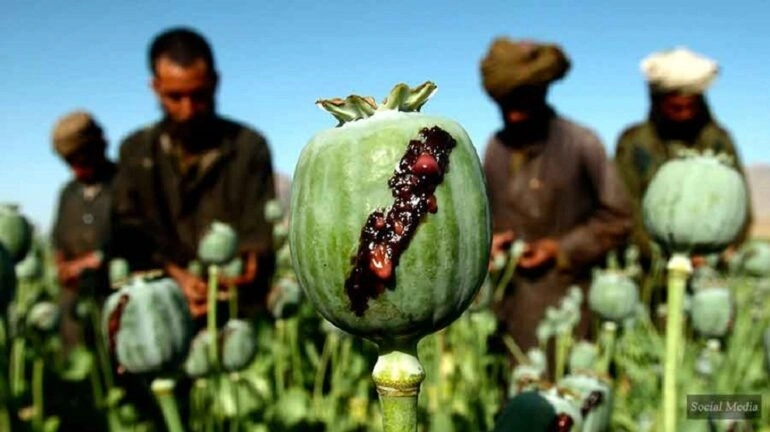
Afghanistan continues to play a pivotal role in the global narcotics market, according to the 2025 Turkish Drug Report, which highlights the country’s evolving role in both traditional opiate production and the rising synthetic drug industry. Despite policy interventions by the Taliban, Afghanistan remains a major hub for production, trafficking, and international distribution of illicit substances.
Central Role in Global Opiate Supply
Historically, Afghanistan supplied nearly 80% of the world’s opium demand, with extensive cultivation and trafficking networks spanning West Asia, Central Asia, Europe, and Africa. Following the Taliban’s 2022 ban on poppy cultivation, opium production initially fell sharply, with a 95% decline in 2023, temporarily allowing Myanmar to overtake Afghanistan as the leading producer. However, cultivation rebounded by 19% in 2024, illustrating the controlled and managed nature of the market rather than a policy failure.
Shift Toward Synthetic Drugs
Alongside opiates, Afghanistan is increasingly emerging as a major source of synthetic drugs, particularly methamphetamine. Traffickers are utilizing locally abundant ephedra plants to produce precursors such as ephedrine, enabling large-scale methamphetamine production. The report notes that bans on poppy cultivation have not curtailed this trade, which now stretches to Europe, East Africa, and beyond. Synthetic drugs offer higher profit margins, easier transport, and reduced exposure to agricultural and law enforcement risks, making them strategically appealing to criminal networks.
Strategic Trafficking Routes
Türkiye serves as a crucial bridge along the Balkan Route, facilitating heroin transit while also emerging as a key corridor for cocaine and methamphetamine from Latin America and Asia. The report emphasizes that criminal networks are diversifying, combining high-potency synthetics with traditional opiates, and adapting quickly to market demands and law enforcement pressures.
Economic and Market Implications
The 2022 Taliban poppy ban introduced managed scarcity, driving opium and heroin prices upward while protecting existing stockpiles. Afghan traffickers were able to absorb market shocks due to extensive reserves, ensuring continued participation in international markets. For example, dry opium prices rose from $110 per kilogram in 2022 to $780 in 2024, reflecting market adjustments rather than production collapse.
Despite lower opium yields, Afghanistan has leveraged synthetic drug production and controlled cultivation to maintain influence over global narcotics markets. The strategic management of supply, demand, and stockpiles has transformed narcotics from peripheral criminal byproducts into instruments of economic and strategic power under Taliban governance.
Governance and Policy Dynamics
The Taliban’s approach has shifted from volume-driven production to selective control, using restrictions and enforcement to influence market conditions. While the 2022 poppy ban was implemented to address oversupply in international markets, it was accompanied by selective enforcement, leaving trafficking networks and precursor supply chains largely intact. This allowed Afghanistan to retain centrality in global drug trade while repositioning its narcotics economy toward managed scarcity and synthetic diversification.
Broader Implications
The Turkish Drug Report highlights that Afghanistan’s narcotics economy has become a global security concern, transcending national borders. The country’s continued influence on drug flows, pricing, and trafficking patterns underscores the complexity of controlling international drug markets. The report emphasizes that the transition toward synthetic drugs is deliberate, not accidental, reflecting strategic diversification by criminal networks.
Conclusion
Afghanistan remains a central hub in the international drug economy, balancing reductions in traditional opium production with the rapid expansion of synthetic drugs. The Taliban’s policies have reorganized, rather than dismantled, the narcotics infrastructure, making Afghanistan a critical node shaping global supply, pricing, and trafficking of illicit substances.
Authorities and international monitoring agencies continue to track these developments, noting that Afghanistan’s evolving narcotics landscape has far-reaching implications for regional stability, law enforcement, and global drug control strategies.
Read more :Trump’s “Board of Peace” Expands as Multiple Countries Join Initiative