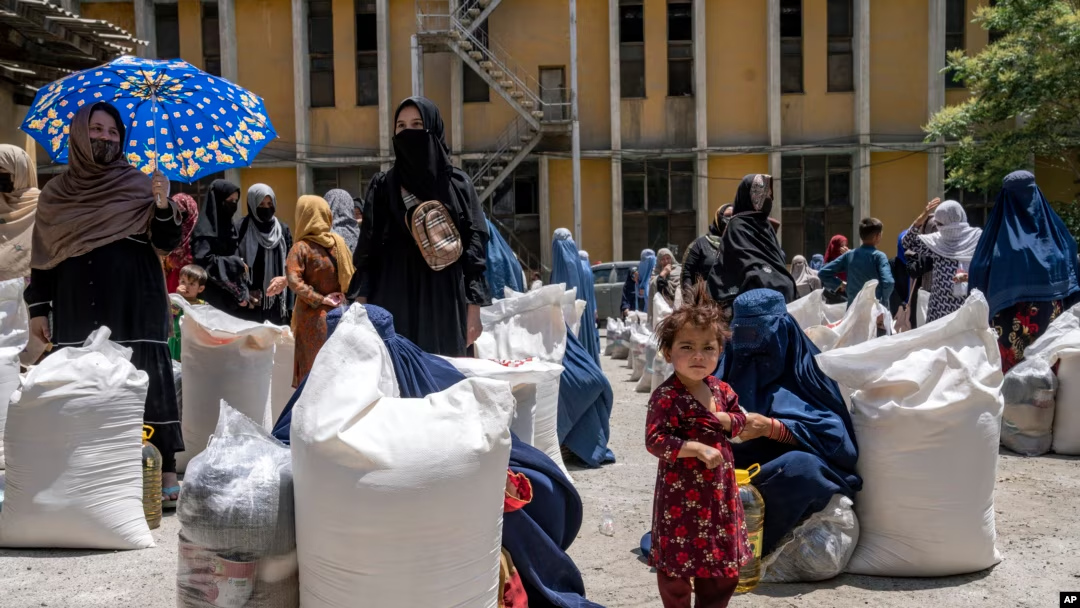
Afghanistan once again stands on the brink of a severe humanitarian catastrophe. The latest report from the United Nations Office for the Coordination of Humanitarian Affairs (OCHA) paints a chilling reality: 21.9 million Afghans, nearly half the population, will require humanitarian assistance in 2026 to survive. These figures are not just statistics; they represent the cry of a society collapsing under its own weight.
Over three years of Taliban rule, Afghanistan’s economic activity has frozen, employment opportunities have vanished, and a profound governance vacuum has taken hold. The country has reached a point where daily survival has become the most pressing struggle for millions. According to OCHA, half of the population in immediate need of aid reflects only the visible part of the crisis; the remaining half is also consumed by poverty, inflation, food insecurity, and rising social fragmentation.
A New Elite Rises as the Nation Falls
Amid this humanitarian disaster, the Taliban administration has fostered a new ruling elite, a narrow circle with access to power and financial resources. While this small group may temporarily shield itself from the devastation around them, no elite can remain insulated in a nation whose economy is eroding from the ground up. Wealth and power may offer short-term comfort, but they cannot substitute for a sustainable future.
Regional Destabilization and Cross-Border Fallout
Adding to Afghanistan’s internal turmoil is the troubling rise of cross-border militancy, including documented support for anti-Pakistan elements. Over the past three years, the Taliban’s failure to rein in extremist groups has strained four decades of Pak–Afghan relations, harmed bilateral trade, and injected new volatility into an already fragile region. It appears the Taliban government is not only failing to address domestic suffering but is also aggravating the hardships faced by its own people through its external policies.
Global Attention Fading as Danger Rises
Equally alarming is the world’s diminishing attention toward Afghanistan. International media coverage has become sporadic, while donors continue to scale back funding. Yet the ground reality suggests that time is running out and the danger is growing. Without meaningful global action, 2026 could mark the collapse of Afghanistan’s economic, social, and administrative structures.
A Threat Beyond Borders
History has repeatedly shown that a destabilized Afghanistan is never a crisis contained within its borders. A failed Afghan state becomes a breeding ground for extremism, regional insecurity, mass displacement, and humanitarian desperation.
The question now confronting the international community is clear:
Will the world allow another silent disaster to unfold, one that will not remain confined to Afghanistan? Or will it recognize that assisting Afghanistan today is an investment in regional peace and human dignity?