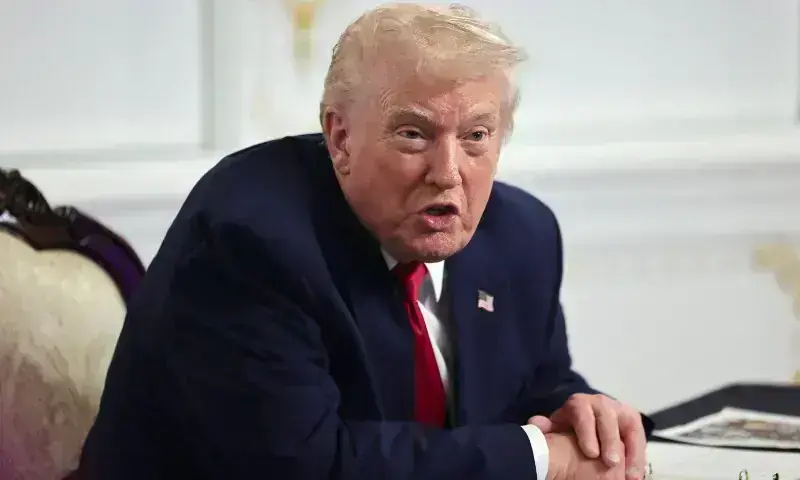
United States President Donald Trump has said that member states of the Board of Peace have committed thousands of personnel and billions of dollars to support an international stabilization effort in the Gaza Strip, as preparations advance for the body’s upcoming meeting in Washington.
In a statement posted on Truth Social, Trump said the pledges would be formally announced when the Board of Peace convenes on February 19 at the Donald J Trump Institute of Peace, which serves as the board’s headquarters.
According to him, participating states have collectively committed more than $5 billion for humanitarian assistance and reconstruction in Gaza alongside personnel for an International Stabilization Force and local policing support.
Trump said the proposed force is intended to help maintain security and stability for civilians in Gaza following the ceasefire agreed last year.
He also reiterated that Hamas must adhere to what he described as a full and immediate demilitarization commitment, a condition that remains a point of contention amid ongoing tensions on the ground.
The Board of Peace was first proposed in September 2025 and formally established last month, with the United States acting as its official depository under the charter.
A United Nations Security Council resolution adopted in November authorized the board and cooperating states to form an international stabilization force after a ceasefire came into effect in October under a Trump-backed plan accepted by Israel and Hamas.
Despite this, the truce has remained fragile, with repeated violations reported, particularly by Israel.
However, Pakistan’s decision to join the Board reflects a pragmatic and strategic response to an ongoing humanitarian and political crisis rather than a search for symbolism.
With hundreds of Palestinian civilians under daily threat and humanitarian access repeatedly disrupted, disengagement or remaining on the sidelines would not have helped ease suffering on the ground.
Islamabad’s approach is based on the belief that active participation in multilateral forums, even imperfect ones, offers more leverage to protect civilian lives and push for outcomes aligned with international law.
Since the Board’s framework began taking shape, humanitarian access has improved and civilian casualties have reportedly declined, suggesting that coordinated international pressure and engagement can produce real, measurable results.
Pakistan’s involvement signals a preference for practical diplomacy over rhetoric, aimed at turning political mechanisms into life-saving action rather than statements.
Concerns have also been raised about whether Pakistan’s role could be seen as part of a military arrangement. The government maintains that its participation is strictly political and diplomatic, clearly separate from any proposed International Stabilization Force or military component.
This distinction allows Pakistan to uphold its principles while focusing on humanitarian priorities rather than strategic or military objectives.
Another key question is whether Palestinian priorities remain central. Pakistan has consistently reaffirmed its support for a sovereign Palestinian state within pre-1967 borders with Al-Quds as its capital, protection of civilians and immediate humanitarian relief.
By staying engaged, Pakistan argues it can keep these demands present in critical discussions rather than allowing them to be sidelined.
Furthermore, Pakistan is set to participate in the Washington meeting. Foreign Office spokesperson Tahir Andrabi has confirmed that Prime Minister Shehbaz Sharif will attend, accompanied by Deputy Prime Minister and Foreign Minister Ishaq Dar. Details of the wider delegation and engagements are expected to be shared later.
Originally conceived to oversee Gaza’s interim governance, the Board of Peace has since expanded its mandate to address broader international conflicts, with Trump describing it as a potentially transformative global forum.
Read more: Pakistan Defends Its Role in Gaza’s Board of Peace Amid Growing Debate