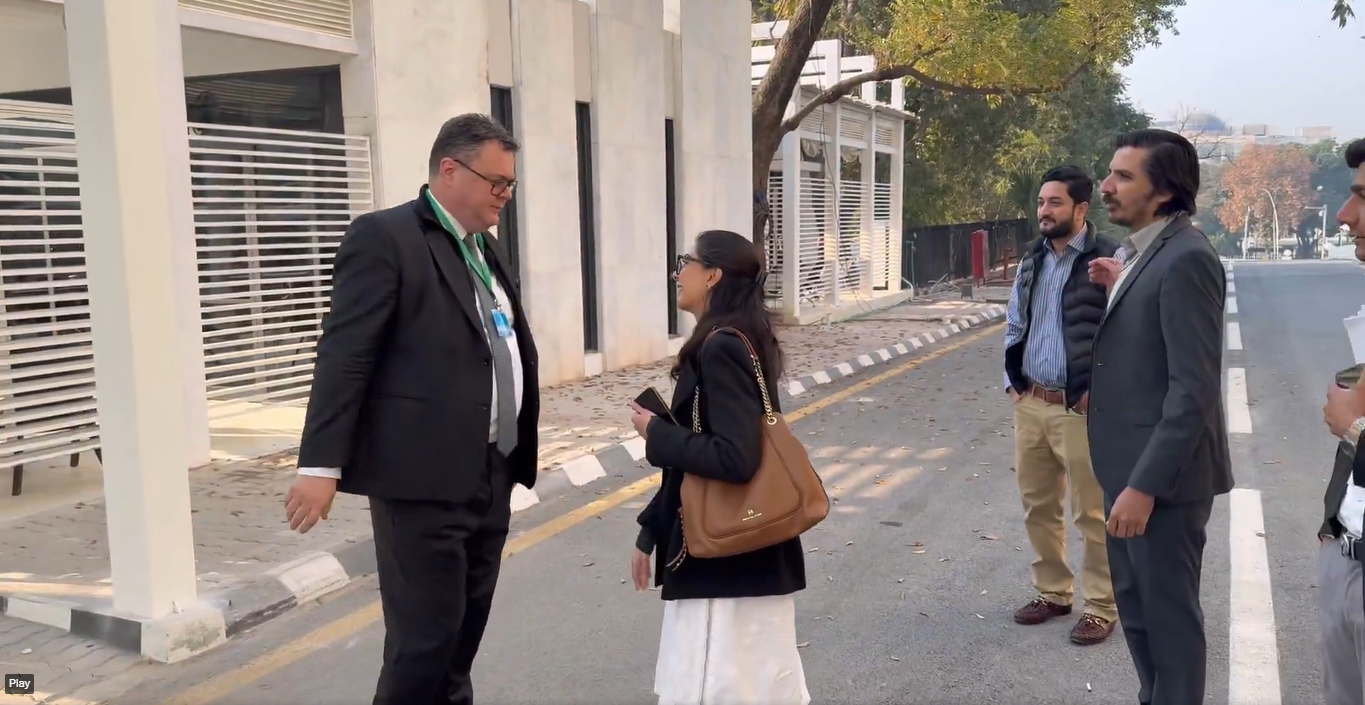
Islamabad _ A rare diplomatic episode unfolded in Islamabad on Thursday when Norway’s Ambassador to Pakistan, Per Albert Ilsaas, appeared inside the Supreme Court to observe proceedings.
The proceedings of Advocate Imaan Hazir Mazari and Advocate Hadi Ali Chattha, both charged under the Prevention of Electronic Crimes Act (PECA) for allegedly posting anti-state content on social platform X.
The case initiated by the National Cyber Crime Investigation Agency (NCCIA) formally indicted the pair on October 30. While both defendants pleaded not guilty.
Foreign envoy’s visit sparks questions on diplomatic norms
The ambassador’s attendance, highlighted by journalist Matiullah Jan, has raised legitimate questions about diplomatic propriety and whether the visit constitutes inappropriate signalling toward Pakistan’s judiciary.
Under the Vienna Convention on Diplomatic Relations (VCDR, Article 41), diplomats are required to respect the domestic laws of the host country and must refrain from any action that could be construed as interference in internal affairs.
The current Norwegian Ambassador to Pakistan H.E. Mr. Per Albert Ilsaas, arrives at Supreme Court of Pakistan to observe proceedings in the appeals filed by Advocate Imaan Hazir Mazari & Advocate Hadi Ali Chatta against their trial under controversial PECA Act. pic.twitter.com/nsMbJ5BI2M
— Matiullah Jan (@Matiullahjan919) December 11, 2025
Unlike consular visits, this case involves no Norwegian nationals, no treaty obligations, and no humanitarian exemptions, making the ambassador’s presence especially unusual.
Observers note that diplomats worldwide do not attend courtroom hearings involving private citizens of the host country.
Analysts warn that such selective attendance risks creating the perception of pressure on judicial proceedings.
Concerns over political signalling and selective engagement
Norway’s posture has drawn further scrutiny due to PEN Norway’s open advocacy for Mahrang Baloch, linked to individuals associated with the US-designated terrorist group BL.
Moreover, it’s consistent platforming of Imaan Mazari, who has publicly supported BLA, BYC, and other separatist networks.
When viewed in this context, the ambassador’s appearance does not appear impartial but rather a deliberate act of political pressure.
Critics argue that Norway itself would never tolerate a Pakistani diplomat sitting inside its own courtroom to “observe” a politically sensitive case.
Diplomatic channels exist for engagement, official meetings, reports, and structured dialogues, not physical presence inside domestic courts during active proceedings.
Pakistan has repeatedly emphasized that its judiciary is independent and that any external influence, direct or perceived, is unacceptable.
While engagement with civil society is welcome, experts insist that diplomatic missions must abide by international norms. Diplomats observing domestic judicial processes, especially in cases touching political agitation and national security, risk crossing a clear red line.
Read more: Afghan Clerics’ New Fatwa: A Positive Signal or Another Unfulfilled Promise?