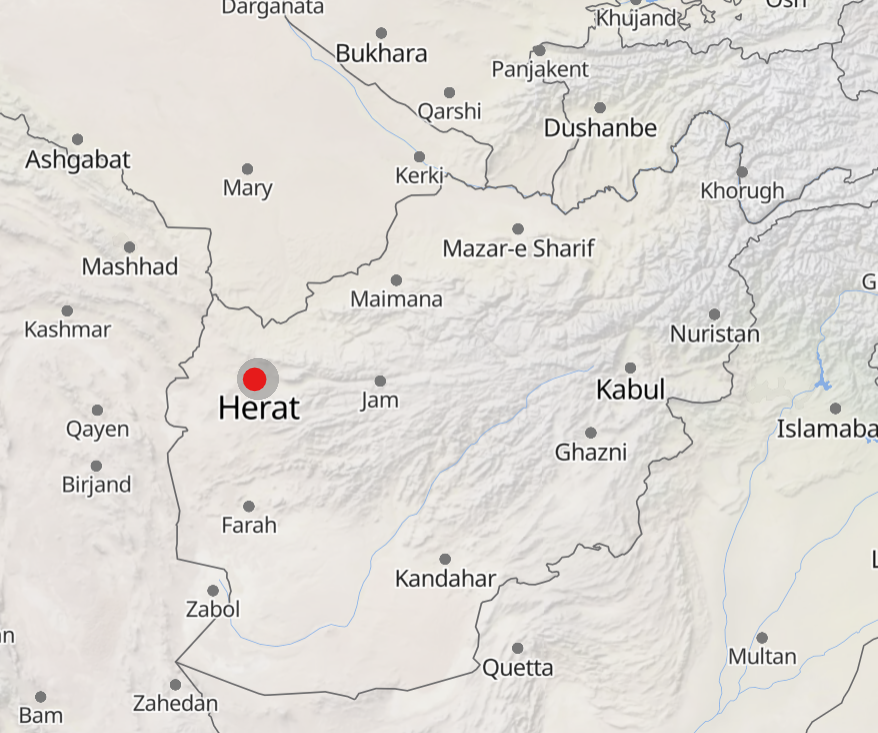
Herat City, Afghanistan – One Taliban (IEA) fighter was killed in an armed attack in Herat City, according to reports. The National Resistance Front (NRF) has taken ownership of the operation that occurred in the Ganj-e-Shalbafan location of Police District 14 (PD-14).
National Resistance Front (#NRF) Militants Kill One #Taliban (IEA) Fighter in an Unspecified Attack on IEA Forces, Ganj-e-Shalbafan Area, PD-14, #Herat City, #Afghanistan https://t.co/6h7HG4x8Ge pic.twitter.com/Bmds3HdMun
— TRACTerrorism (@TracTerrorism) December 10, 2025
This event highlights the ongoing security challenges of the Taliban government within the entire Afghanistan, including its main cities. Although the Taliban tries to display the image of complete dominance, the fact that there are still structured military forces such as the NRF indicates that the fight to dominate all areas is still a challenging and complicated endeavor.
Regional Concerns and Mobility
The attack raises even greater issues of governance and stability within the region. The capability of militants to transport and carry out activities in densely populated regions, including Herat City, indicates the presence of spaces beyond Taliban control.
Moreover, this kind of prolonged military action has caused concern to the neighboring nations about the possibility of militant mobility and security threats spilling beyond the regional boundaries.
The current conflict is a sign of disputed power and the difficulties in building peace and security in the country after a change of government in 2021.
The local officials are yet to make a formal statement on the incident. The NRF is known to attack mostly military targets and other infrastructure linked to the ruling government of the day.
Taliban’s “Total Control” Narrative Collapses
The NRF attack in Herat is another indicator that armed resistance to Taliban rule is expanding across Afghanistan, a trend Kabul has been largely unable to contain. A report by South Asia Terrorism Portal (SATP) noted that the NRF conducted 401 attacks across 19 provinces between March 2024 and March 2025.
As of 2022, NRF operations, such as weekly hits and runs, ambush, and targeted attacks, have in fact exceeded the frequency of Islamic State – Khorasan Province (ISKP) attacks in multiple quarters. This signifies deepening instability inside Afghanistan, which is being driven by internal resistance rather than merely external interference.
The Herat strike follows this recorded pattern of resistance. The NRF has been positioning itself strategically westward of its historic strongholds of Panjshir and Baghlan into Herat, Farah, and Badghis. This growth is an indicator of the increasing anti-Taliban sentiments and the apparent failure of the regime to ensure the security of its urban centers.
According to UN, EUAA, and US Congressional reports (2024-25), the Taliban’s claim of total control is not true. Afghanistan remains fragmented among competing armed groups, including the NRF, ISKP, TTP factions, and various foreign militant networks. The fact that the NRF has been sustained in 20 provinces demonstrates that the regime is experiencing a multi-front internal insurgency, not a peaceful Afghanistan.
Implications for Regional Security
For Pakistan, the key concern is not merely which anti-Taliban group struck, but the clear evidence that Afghan soil remains unstable and permissive. This instability enables different militants, such as NRF, ISKP, Jaish e Adal (JaA), Tehrik-i-Taliban Pakistan (TTP), East Turkistan Islamic Movement (ETIM)/Turkistan Islamic Party (TIP), to move freely across provincial boundaries without fear of prosecution.
Taliban’s weakness at home fuels their reliance on cross-border militant proxies, especially TTP, as a pressure tool. The recent NRF operation highlights the reason why Islamabad is demanding verifiable counterterror guarantees from Kabul. A state that cannot prevent attacks in Herat, Guzara, Baghlan, or Kabul cannot keep TTP networks running freely in its territory in check.
Pakistan has continuously expressed that Kabul must stop its assistance to external terror groups to ensure regional security. The fact that internal resistance movements are gaining momentum only underscores the fact that the Taliban have lost control of the territories, ideologically and politically.