Skip to content
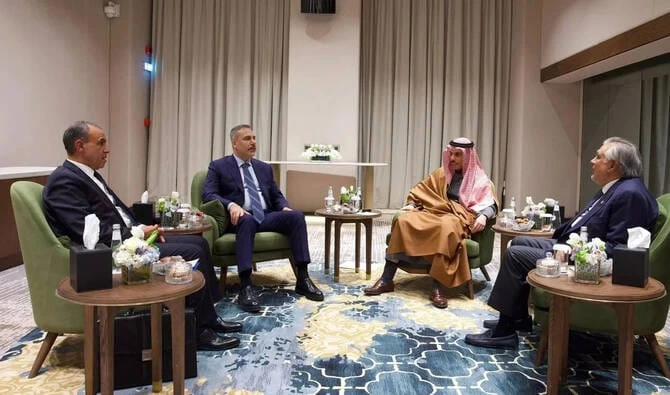
A recent meeting of the foreign ministers of Pakistan, Turkey, Saudi Arabia, and Egypt in Riyadh has sparked a new debate on the diplomatic map of the Middle East and the broader Muslim world. This was not just a ceremonial handshake; it came at a time when the region is grappling with war, instability, unpredictable US policies, tensions with Iran, and Israeli-American confrontations. Because of this, the meeting is being viewed in the context of a potential new Islamic security framework, although no formal alliance has yet been announced.
The foreign ministers of Turkey, Saudi Arabia, Egypt, and Pakistan this week held talks in Riyadh on the sidelines of an Islamic summit to discuss combining their strengths for the first time.
This discussion is not mere speculation. In September 2025, Pakistan and Saudi Arabia signed a formal strategic and mutual defense agreement, under which an attack on one country would be considered an attack on both. This marked a milestone in decades-long military ties, turning them into a formal defense framework.
Turkey’s interest is now particularly significant. In January 2026, Pakistan’s Minister for Defence Production, Raza Hayat Haraj, told Reuters that a trilateral defense agreement between Pakistan, Saudi Arabia, and Turkey had been under consideration for almost a year. A draft exists, and final consensus is pending. This suggests that the recent Riyadh meeting was not a sudden idea but part of a pre-existing diplomatic and defense process.
Turkey has been seeking to broaden this defense framework for over a year. Turkish Foreign Minister Hakan Fidan emphasized in Riyadh that these countries are trying to pool their resources to address regional issues and promote “regional ownership.” This is significant in diplomatic terms, indicating that major Muslim nations are now seeking to manage security themselves rather than relying on external powers.
Sources say Turkey wants not only to be part of the agreement but also to include Egypt, integrating defense industries, weapons production, and intelligence cooperation. In this context, Pakistan and Egypt signed an intelligence-sharing and counterterrorism agreement in January 2026, while Turkey and Egypt signed a $350 million defense cooperation deal in February 2026.
If Egypt joins, the arrangement moves beyond a three-country defense cooperation. Egypt is a major Arab military power, Saudi Arabia provides financial and strategic weight, Turkey brings advanced defense industry, drones, and regional reach, while Pakistan contributes nuclear capability, a large military, operational experience, and a unique defense position in the Muslim world. Together, these four could form a new “Islamic Strategic Spine.”
Some call it an “Islamic NATO,” but experts say it is more of strategic coordination or hedging rather than an immediate formal defense alliance. Turkey’s NATO membership limits any mutual defense commitments, so current talks are focused on informal cooperation, intelligence sharing, defense industry collaboration, and logistics.
Saudi Arabia has increasingly felt the limits of the US security umbrella, while Pakistan and Turkey are already close in defense industries, naval shipbuilding, air training, and drone programs. A formal or informal bloc could serve as a security bridge between the Middle East and South Asia.
Pakistan is not just a participant but potentially a pivot in this arrangement. Its existing defense agreement with Saudi Arabia, longstanding military cooperation with Turkey, and nuclear and military capabilities place it as a possible leading pillar of a future Islamic defense framework. Saudi Arabia could provide financial and political support. However, this remains analytical; no official leadership or alliance structure has been announced.
This dialogue comes as tensions between Iran, Gulf states, the US, and Israel are intensifying. The broader regional meeting in Riyadh on March 18, 2026, involved multiple Muslim countries discussing recent attacks and instability. The closeness of Pakistan, Turkey, Saudi Arabia, and Egypt is thus more of a strategic signal than a formal defense alliance.
It could also elevate practical cooperation in defense industries, intelligence sharing, joint training, weapons manufacturing, missile and drone collaboration, maritime security, and energy protection. Pakistan could gain in economy, investment, and defense exports; Saudi Arabia would gain a reliable military partnership; Turkey could enhance regional strategic autonomy; and Egypt could become a new Arab-Islamic security link.
However, hurdles exist: Turkey’s NATO membership, past disputes between Egypt and Turkey, differing interests with Iran, and relations with the US all pose challenges to any formal “Islamic NATO.” Therefore, the Riyadh meeting strengthens the possibility of a new security axis but does not constitute a complete alliance.
While no formal alliance was announced, the meeting sets a clear direction. Major Muslim countries are moving toward joint security thinking and cooperation. It is too early to say whether this will become an “Islamic NATO,” but Pakistan, Saudi Arabia, Turkey, and Egypt’s closeness is clearly reshaping the regional balance of power, with Pakistan playing a key role.