A look at history reveals a recurring truth: states are often weakened less by external attacks and more by internal unrest. This unrest almost always arrives under a lofty slogan—sometimes in the name of religion, sometimes revolution, and sometimes public rights. Yet, when we look beneath the surface, a consistent mindset emerges—one that seeks to disrupt state order and divide society.
In Islamic history, this mindset was associated with the Kharijites. Outwardly, they appeared devout, praying at length and observing religious duties meticulously. Yet, their ideology carried intensity, excommunication, and rebellion, which sparked fires within the community whose effects were felt for centuries.
Today, the same external mindset has taken new forms. It is no longer confined to religious groups; it now appears in certain political movements, armed groups, and proxy networks. Their primary goal is not reform but the creation of chaos.
In many Muslim countries, stirring opposition against elected governments, weakening state institutions, and keeping societies in constant turmoil reflects this modern manifestation. These groups’ strategy is simple: inflame public sentiment, mobilize youth with religious or political slogans, and create an environment that challenges state authority.
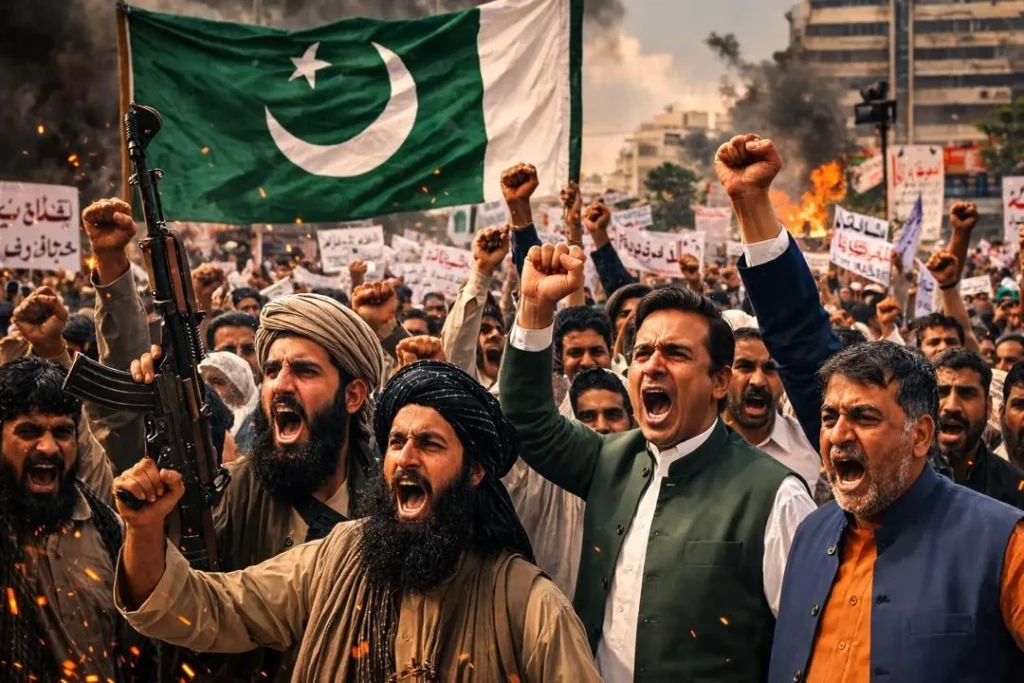
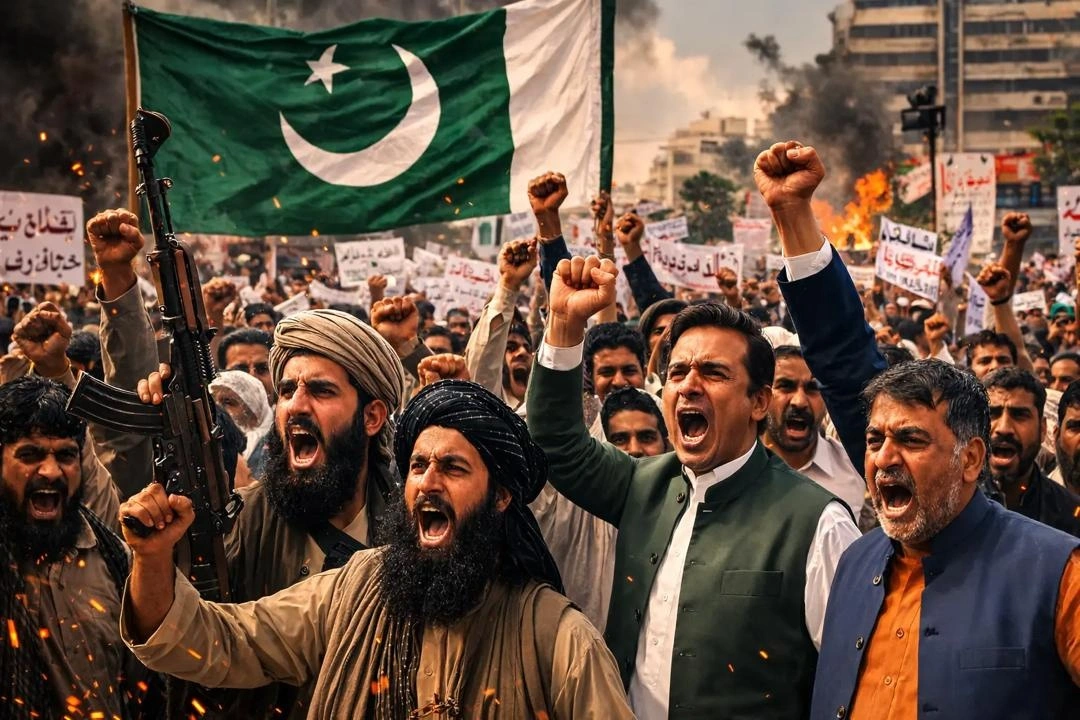
Recent events in Pakistan provide a clear example of this dangerous trend. Violent protests have erupted in various cities despite restrictions and legal orders. Some groups openly encouraged people to take to the streets and challenge state control.
The consequences are predictable: blocked roads, suspended public transport, disrupted businesses, and ordinary citizens bearing the brunt. Daily wage workers, small traders, students, and patients all suffered directly.
Even more concerning is the damage to public and government property—burned vehicles, attacks on government buildings, and scenes that are shameful for any civilized society. The question arises: are these protests or organized disorder?
Another critical aspect is the state’s response. When authorities attempt to enforce law and take action against violent elements, uproar ensues. Arrests are labeled oppression, law enforcement is termed coercion, and the situation is reframed into a new emotional narrative. Certain media outlets often become allies of this unrest.
However, there is another perspective worth considering. Why do governments and state institutions repeatedly fail to preempt such unrest? Why is the same cycle repeated: provocative statements, protest calls, street blockages, violence, and only then state action? A state’s primary duty is not only reaction but maintaining peace through proactive strategy. When the same groups repeatedly disrupt streets, paralyze public life, and damage state property, why are there no effective, long-term measures against them?
Sometimes, governments show leniency due to political expediency, temporary interests, or weak governance. This leniency often becomes a bigger problem later. Unequal and inconsistent enforcement of law sends the message that power and chaos are the real language of society.
Recognizing the external mindset is straightforward. Whenever the rhetoric of a political or religious group, institution, or individual repeatedly encourages hatred, incitement, destruction, or violence, it is not just about differing opinions—it reflects a dangerous mindset. These individuals may appear devout or sincere, their speeches emotionally charged, and their writings grandiose. Outward piety, however, is not a guarantee of correct thought.
Historical accounts of the Kharijites describe how even the companions of the Prophet (RA) were astonished by their devotion, yet their ideology led them to rise against the leaders of their own society. Today, glimpses of the same mindset appear in various forms—under the guise of religion, politics, rights, or revolution—pushing society toward extremism where dialogue, moderation, and state order have no place.
In a complex society like Pakistan, the consequences of this mindset can be extremely dangerous. The country already faces multiple internal and external challenges. Inciting unrest, violence, and rebellion benefits only those who seek to weaken Pakistan.
This places a responsibility on the government and state institutions: they must not remain limited to reactive measures but must proactively block the path of such elements through clear and strong strategies. A state’s strength lies not just in power but in consistent and timely enforcement of law.
We must understand that not every emotional slogan is true, and not every passionate speech leads to reality. Often, the most dangerous voice is the one using the most sacred language. In such situations, it is important to ask whether the discourse and mobilization improve society or lead to chaos and unrest.
Pakistan’s future depends on recognizing this external mindset, rejecting the politics of hatred and violence, and building a society where there can be disagreement but not chaos, criticism but not rebellion, and expression of emotion tempered with reason and responsibility.
States are strengthened not by slogans but by stability, rule of law, and collective awareness. This is the path through which Pakistan can become a safe, balanced, and stable society, though that day is still far off.