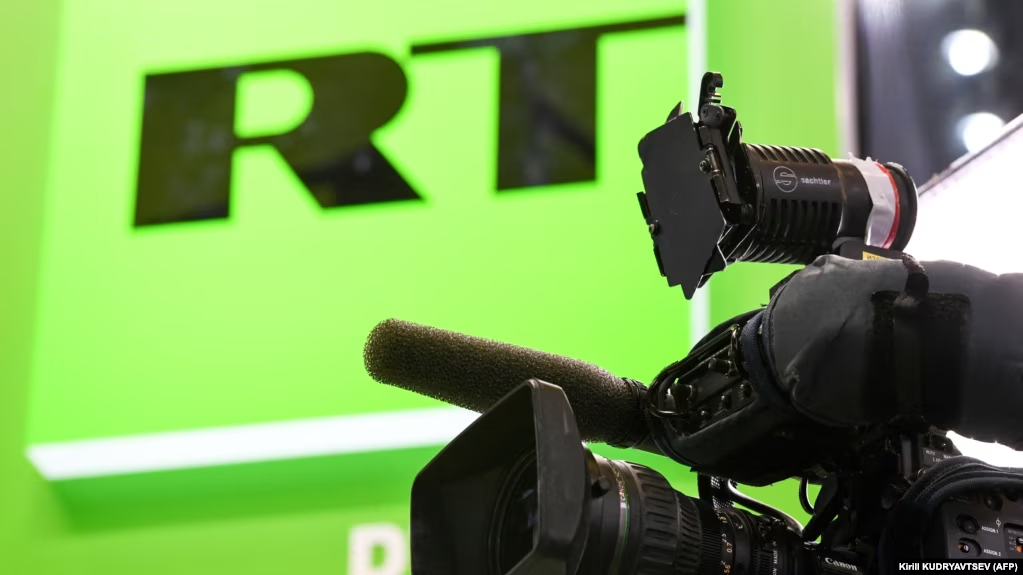
Islamabad – An unverified social media post published and quickly deleted by RT India regarding a high-level diplomatic interaction between Pakistan’s Prime Minister Shehbaz Sharif and Russian President Vladimir Putin has ignited a serious debate over journalistic standards, editorial independence, and geopolitical bias within the state-linked media network.
The incident centres on a post suggesting a supposed misstep or delay in the Sharif-Putin meeting, which was later deleted with a vague statement that the content “may have been a misrepresentation of the events.”
We deleted an earlier post about Pakistani Prime Minister Sharif waiting to meet Vladimir Putin at the Peace and Trust Forum in Turkmenistan.
— RT_India (@RT_India_news) December 12, 2025
The post may have been a misrepresentation of the events.
The Sourcing and Autonomy Puzzle
The central issue posed by this episode is a basic sourcing question of whether the video was framed through the central editorial apparatus of RT, or was it framed independently by RT India?
Who released this video? Did RT Russia, which is a state outlet of Russia, release it to RT India? Do they have any media ethics? Shouldn't RT office and Pakistan be expelled? Such inaccurate and disgraceful post is not expected from a troll, leave aside a media outlet.
— Ammar Solangi (@fake_burster) December 12, 2025
Shame!!… pic.twitter.com/RV0kW1OwYq
RT India has a unique national media context, and the fact that the content was not approved by the headquarters is indicative of a serious question of editorial independence being acted upon without proper checks.
It is particularly problematic in coverage that deals with active international diplomacy, where each detail counts.
Allowing a country-specific handle like RT India to circulate unverified claims risks importing local geopolitical preferences into a global media brand, particularly in regions where Russia maintains parallel partnerships.
Failures in Journalistic Standards
The mishandling of the error that followed has also come under scrutiny. The fact that the post was deleted without providing a proper apology or correcting the attribution does not correspond to the minimum standards of international journalism.
In the case of a state-controlled media house whose contents have a diplomatic overture to them, this is worrying.
Misrepresentation in journalism does not mean a factual error of omission or commission, but narrative framing, a spin on facts. This demands much more openness on how the claim came into circulation in the first place.
Distorting Regional Realities
Context is important in South Asia. Pakistan-Russia relations have steadily developed over the last several years, and Russia also has a long-term strategic collaboration with India. This diplomatic fact is two-track and complicated.
Such false representations of interactions, such as in the post that has been deleted in RT India, are of no use in analysis and are biased in representing the regional signaling.
Call for Credibility and Clarity
Without a clarification from RT headquarters on sourcing, editorial oversight, and corrective action, the episode risks being interpreted less as an innocent error and more as agenda-driven framing amplified under a recognized international outlet’s name.