
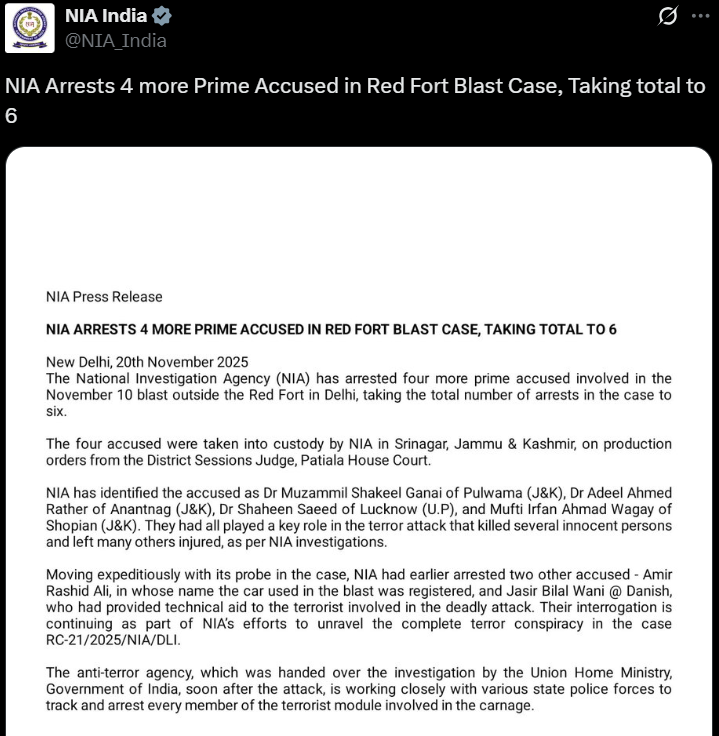
Delhi/Islamabad – In the aftermath of the November 10 car blast near Delhi’s iconic Red Fort, Indian media has been accused of leveraging a so-called “women card” to advance an anti-Pakistan narrative, exploiting both gendered and communal sensitivities. The National Investigation Agency (NIA) claimed on Thursday to have arrested four more suspects in the case, bringing the total arrests to six. While these arrests relate to the deadly attack that killed 15 and injured several others, media coverage has increasingly focused on alleged links between Pakistani women and terrorist activities.
Social media posts, particularly on platform X, circulated images of a Pakistani CNIC purportedly belonging to Afeera Bibi, claiming she is the wife of Muhammad Umar, a primary suspect in the Pulwama attack of 2019. Investigations revealed that the image originated from a 2020 post by CNN-News18 editor, predating the Delhi blast, indicating a deliberate recycling of content to reinforce a narrative connecting Pakistani women to terrorism. Similar claims were made about Shaheen Shahid, alleged to be the “mastermind” acting under Afeera Bibi’s direction. These narratives were often accompanied by AI-generated videos purporting to show these women involved in militant activities.
Experts have highlighted that this strategy appears calculated to exploit Western audiences’ sensitivity to women’s rights, making the anti-Pakistan narrative more persuasive internationally. Since late October 2025, Indian outlets have increasingly portrayed Pakistani women from Azad Jammu and Kashmir as part of terrorist networks such as Jaish-i-Mohammed, falsely linking them to operations in India.
Propaganda and Islamophobia
The systematic portrayal of Pakistani Muslim women as terrorists is part of a broader Islamophobic and political propaganda campaign. National channels like Zee TV have broadcast AI-manipulated videos and doctored images designed to humiliate and demonize Muslim women, falsely associating them with banned outfits such as Lashkar-e-Taiba and ISIS. This selective targeting contrasts sharply with India’s state-backed rhetoric on protecting Hindu women, exposing a double standard: the glorification of Hindu womanhood as a political shield while maligning Muslim women to justify aggression.
The consequences are both ethical and geopolitical. By associating Muslim women with terrorism, Indian media reinforces communal stereotypes, undermines the dignity of Pakistani women, and exacerbates regional instability. Analysts warn that the circulation of doctored videos and misinformation fuels hatred, incites communal tension, and undermines the principles of ethical journalism.
Resilience and Contribution of Pakistani Women
In reality, Pakistani women have demonstrated resilience and played a substantial role in national development. Despite the country’s ongoing struggle against terrorism since 2001, women contribute significantly to the economy, over $37 billion annually, across sectors including agriculture, healthcare, education, and entrepreneurship. Female participation in professional and public life continues to grow, spanning medicine, law, engineering, media, politics, and the armed forces. The false narratives propagated by Indian media deliberately undermine these achievements and the peaceful identity of Muslim women.
Technology, Misinformation, and Accountability
The rise of AI-generated content and social media manipulation has amplified this disinformation campaign. In 2025 alone, over 1,300 AI-generated posts targeting Muslims were identified on Indian platforms, with many designed to depict Muslim women as terrorists. Observers caution that this trend represents a new front in information warfare, where media becomes a tool for state-backed narratives rather than factual reporting.
The deliberate targeting of Pakistani Muslim women highlights the urgent need for international intervention. Human rights organizations, INGOs, Muslim-majority countries, and global media must expose and condemn these campaigns, ensuring ethical standards in journalism are upheld. Platforms and governments must hold Indian media accountable through diplomatic and legal channels to prevent further stigmatization and protect the dignity and rights of Muslim women worldwide.

Indian media’s portrayal of Pakistani Muslim women as terrorists, through AI-generated videos, doctored images, and selective narratives, reflects a calculated, Islamophobic propaganda strategy. Beyond misinformation, these campaigns aim to delegitimize Pakistani women, distort regional security narratives, and justify political agendas. Experts insist that exposing these campaigns is both a national and global imperative to defend truth, human rights, and social justice.











