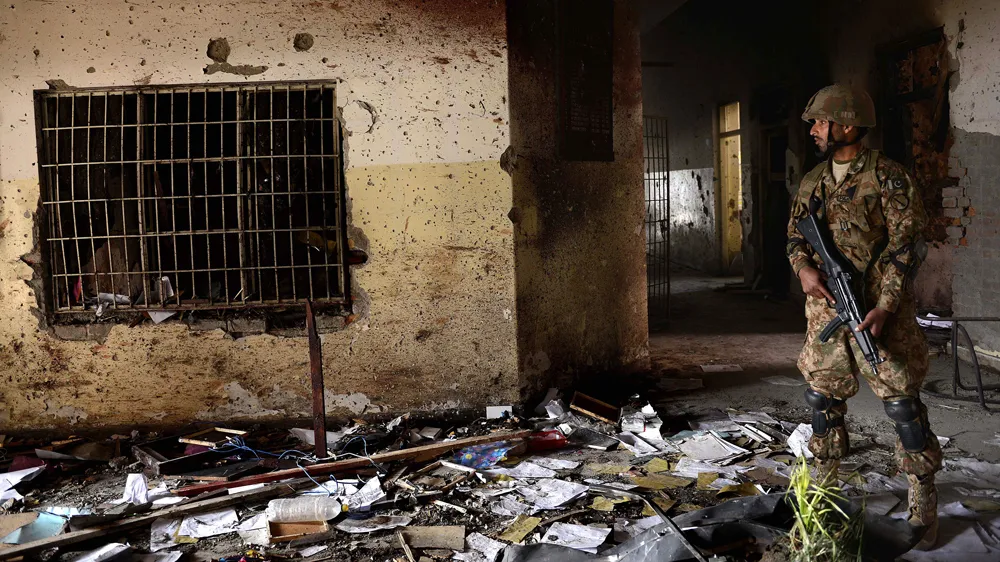
Islamabad_ December 16 is not simply a date in Pakistan’s calendar; it is a wound carried in national memory. On this day in 2014, the Army Public School (APS) in Peshawar was attacked by militants of the Fitna-al-Khawarij Tehrik-e-Taliban Pakistan (TTP), resulting in the brutal murder of 147 people, including 132 innocent schoolchildren.
The attack was designed to break the morale of the state by targeting its most innocent and defenceless citizens.
Instead, it produced the opposite outcome. APS became the moment when ambiguity collapsed, denial ended, and Pakistan made an irreversible choice to confront terrorism in all its forms.
"آج ہم سانحۂ آرمی پبلک اسکول پشاور کے شہداء کو خراجِ عقیدت پیش کرتے ہیں، جنہوں نے وطنِ عزیز کے مستقبل کے لیے اپنی قیمتی جانوں کا نذرانہ پیش کیا ان بے گناہ بچوں اور اساتذہ کی قربانی ہمیشہ کے لئے ہمارے قومی ضمیر میں ثبت ہے۔
— Prime Minister's Office (@PakPMO) December 16, 2025
آرمی پبلک اسکول سانحے کے تمام شہداء کی قربانی دہشت گردی…
December 16 and the day Pakistan changed
The APS massacre did not occur in isolation. It was the culmination of more than a decade of violence that followed Pakistan’s transformation into the frontline state of the post-9/11 global security order.
Yet APS marked a decisive rupture. It stripped away remaining illusions about the nature of the threat and exposed the moral bankruptcy of extremist violence that cloaked itself in the language of religion.
From that moment onward, counter-terrorism in Pakistan ceased to be a reactive security policy and became a matter of national survival.
This article examines Pakistan’s counter-terrorism trajectory through that lens.
APS is not treated merely as a catalyst, but as the ethical and strategic reference point around which subsequent state actions were organized.
From the National Action Plan (NAP) and Operation Zarb-e-Azb to ideological de-radicalization, border hardening, financial reforms, and the more recent Operation Azm-e-Istehkam, Pakistan’s response reflects a long, costly, and evolving effort to assert sovereignty, ensure stability, and social cohesion.
Today, we commemorate the martyrs of APS Peshawar tragedy – the innocent children, teachers and staff whose sacrifice is forever etched in our national conscience.
— Shehbaz Sharif (@CMShehbaz) December 16, 2025
Their sacrifice remains a constant reminder of our collective responsibility to defeat terrorism.
The Pakistani…
The Pre-APS environment: inherited constraints and strategic confusion
In the years following 2001, Pakistan faced an unprecedented convergence of internal and external pressures.
The state confronted a complex insurgent ecosystem rather than a single adversary: the TTP sought to overthrow Pakistan’s constitutional order; sectarian outfits targeted minorities; and separatist violence exploited instability in peripheral regions.
Before APS, Pakistan’s response reflected the difficulty of managing this multi-layered threat under constrained circumstances.
Counter-terrorism efforts were often episodic, regionally contained, and influenced by the broader regional security environment.
In hindsight, this period is best understood not as deliberate tolerance of extremism, but as a phase of strategic evolution shaped by limited options, fractured consensus, and the absence of a unifying national moment.
The cost of this ambiguity was severe. By 2013, militant violence had eroded public confidence, disrupted economic activity, and challenged the writ of the state in parts of Khyber Pakhtunkhwa and the tribal belt. APS brought this phase to a definitive close.
Message to “ apologists, facilitators and supporters of terrorists: The people and the armed forces of Pakistan shall not spare them and will defeat them, no matter what political, ideological or fake religious garb they try to shroud themselves in.” #APSMartyrsNeverForgotten
— The President of Pakistan (@PresOfPakistan) December 16, 2025
APS: the national reckoning
The attack on APS was not only an act of terror but an assault on the very idea of Pakistan as a functioning society.
The deliberate targeting of children eliminated any residual space for moral relativism. Across political, ethnic, and ideological lines, Pakistanis reached an unprecedented consensus: there could be no distinction between militants, and no justification for violence against civilians.
The state responded immediately. The moratorium on the death penalty for terrorism cases was lifted.
Military courts were established through constitutional amendment to address the paralysis of the civilian justice system under extremist intimidation.
Most importantly a comprehensive framework, the National Action Plan, was adopted with rare unanimity.
APS also reshaped the public narrative.
Terrorism was no longer viewed as an external imposition or a distant conflict spilling over borders, but as an existential threat that demanded sustained national commitment. Every major counter-terrorism initiative that followed drew its legitimacy from the memory of APS.
راہِ حق کے ننھے شہیدوں کے نام 🇵🇰
— Attaullah Tarar (@TararAttaullah) December 16, 2025
اے پی ایس پشاور کا سانحہ پاکستانی قوم کے اجتماعی ضمیر پر لگا وہ زخم ہے جو آج بھی تازہ ہے۔ 16 دسمبر 2014 کو دشمن نے ہماری سرزمین پر صرف ننھے معصوم بچوں کا قتلِ عام نہیں کیا، بلکہ انسانیت، علم اور ہمارے مستقبل پر حملہ کیا۔ اس روح کو جھنجھوڑ دینے… pic.twitter.com/ZPuFIlny2M
The National Action Plan: a whole-of-state framework
Adopted after APS, the 20-point National Action Plan represented a structural shift in Pakistan’s approach to internal security. Unlike earlier policy documents, NAP combined kinetic action with legal reform, financial regulation, ideological counter-measures, and administrative coordination.
Key elements included the elimination of armed militias, action against hate speech and extremist literature, choking terror financing, regulating religious seminaries, protecting minorities, and dismantling militant communication networks.
The creation of provincial apex committees institutionalized civil-military coordination, ensuring that intelligence, law enforcement, and administrative authority operated in concert rather than isolation.
While implementation varied across sectors, NAP succeeded in restoring coherence to the state’s counter-terrorism posture.
Importantly, it was APS that gave NAP its political and moral force. Without the national consensus forged on December 16, such a sweeping framework would likely have remained aspirational.
سانحہ آرمی پبلک اسکول پشاور کے 11ویں یومِ شہادت پر ہم معصوم شہداء بچوں اور اساتذہ کو سلامِ عقیدت پیش کرتے ہیں۔
— Bilawal Bhutto Zardari (@BBhuttoZardari) December 16, 2025
سانحہ اے پی ایس ایک ایسا زخم ہے جو کبھی مندمل نہیں ہوگا، مگر اسی نے دہشتگردی کے خلاف قوم کے عزم کو مضبوط کیا۔
ہم شہداء کے خاندانوں کے ساتھ کھڑے ہیں اور ایک پُرامن، محفوظ… pic.twitter.com/qOaIN2ZIW6
Operation Zarb-e-Azb: reclaiming territory and authority
If NAP provided strategic direction, Operation Zarb-e-Azb delivered decisive action.
Launched in North Waziristan, the operation targeted the epicenter of militant infrastructure that had developed over years of conflict. The military campaign was comprehensive, sustained, and deliberately final in intent.
The operation dismantled command centers, training camps, and logistics networks that had enabled terrorism across Pakistan and beyond.
Thousands of militants were neutralized, vast quantities of explosives recovered, and territory long beyond state control was reclaimed.
The displacement of civilians during the operation posed a significant humanitarian challenge, but the successful repatriation and rehabilitation of affected populations reinforced public trust in the state’s objectives.
Zarb-e-Azb was not merely a military success; it marked the restoration of state authority in areas previously governed by fear.
For many Pakistanis, the operation symbolized the state’s fulfilment of its promise made after APS: that such violence would never again be allowed to flourish unchecked.
اسپیکر قومی اسمبلی سردار ایاز صادق کا سانحہ آرمی پبلک اسکول پشاور کے شہداء کو 11ویں برسی پر خراجِ عقیدت
— National Assembly 🇵🇰 (@NAofPakistan) December 16, 2025
سانحہ اے پی ایس پاکستان کی تاریخ کا ایک دلخراش اور ناقابلِ فراموش واقعہ ہے، اسپیکر سردار ایاز صادق
اسپیکر سردار ایاز صادق کا دہشت گردی کے خلاف قومی اتحاد اور مشترکہ عزم کی… pic.twitter.com/7afInNczMq
Ideological Response: Paigham-e-Pakistan and the rejection of extremism
APS underscored that terrorism could not be defeated by force alone. Extremist groups relied on distorted religious narratives to legitimize violence and recruit followers.
In response, Pakistan facilitated the development of Paigham-e-Pakistan, a unanimous declaration by over 1,800 religious scholars representing all major Islamic schools of thought.
The document categorically declared suicide attacks and armed rebellion against the state as un-Islamic. By grounding its arguments in Quranic injunctions and prophetic tradition, Paigham-e-Pakistan deprived militant groups of theological legitimacy.
This ideological consensus was unprecedented in Pakistan’s history and directly addressed the moral confusion exploited by extremists.
The significance of Paigham-e-Pakistan lies in its continuity with APS.
Just as APS unified the nation emotionally, the declaration unified religious authority against violence, reinforcing the state’s narrative that terrorism was a deviation from both religion and national values.
Today marks a black day, when eleven years ago, on December 16, 2014, 147 people, including 132 schoolchildren, were massacred in one of the deadliest terrorist attacks in Pakistan’s history when terrorists stormed Army Public School in Peshawar Cantonment and opened… pic.twitter.com/JBQLCWRfCA
— SenatorSherryRehman (@sherryrehman) December 16, 2025
Securing the Border: enforcing sovereignty on the western frontier
Another lesson of the post-APS era was the necessity of physical border control.
The fencing of the Pakistan-Afghanistan border transformed a historically porous frontier into a regulated boundary. Despite diplomatic friction, the project significantly reduced cross-border infiltration, disrupted militant logistics, and strengthened internal security.
The border fence represents a material expression of the post-APS doctrine: that sovereignty must be enforced, not assumed.
It also reflects Pakistan’s shift from reactive counter-terrorism to preventative security architecture.
We remember the innocent lives lost in the APS attack with deep sorrow and heavy hearts. Their sacrifice will never be forgotten. We stand united against terrorism in all its forms and reaffirm our commitment to peace, justice and the protection of our future generations.…
— Barrister Aqeel Malik (@BrAqeelMalik) December 16, 2025
The Cost of Survival: economic and human sacrifice
Pakistan’s counter-terrorism campaign came at extraordinary cost. More than 80,000 lives were lost, including civilians, security personnel, and victims of targeted violence. The economic toll exceeded $126 billion, diverting resources from development, education, and healthcare.
APS gives meaning to these sacrifices.
The memory of innocent schoolchildren contextualizes the hardships endured by the nation and underscores why compromise with extremism was never an option. Pakistan’s eventual removal from the FATF grey list and the revival of tourism in formerly violent regions illustrate that these sacrifices, though immense, were not in vain.
Azm-e-Istehkam: adapting to a new phase of conflict
The launch of Operation Azm-e-Istehkam in 2024 reflects the evolving nature of the threat.
With militant groups leveraging digital platforms, misinformation, and cross-border sanctuaries, counter-terrorism has entered a hybrid phase. Azm-e-Istehkam emphasizes intelligence-based operations, legal closure, and narrative resilience rather than mass displacement.
The operation has also generated political debate, highlighting the challenges of sustaining consensus in a polarized environment. Yet its strategic rationale remains anchored in the same principle articulated after APS: that instability, whether physical or digital, must be confronted decisively.
APS as memory, mandate, and measure
Eleven years after the APS tragedy, Pakistan stands transformed.
Markets once destroyed by bombings are active, valleys once ruled by fear host tourists, and the state exercises authority where militants once dictated terms.
This transformation was neither accidental nor cost-free. It was shaped by grief, sacrifice, and an unyielding resolve forged on December 16, 2014.
APS remains more than a memory. It is the moral measure against which Pakistan’s security policies are judged. Every operation, reform, and doctrine since that day draws legitimacy from the promise made to those children: that their deaths would not be reduced to statistics, and that the state would not retreat from its responsibility to protect life.
Pakistan’s counter-terrorism journey is unfinished. The threat has evolved, and vigilance remains essential. But the trajectory is clear. From APS to Azm-e-Istehkam, Pakistan’s response reflects a nation that learned through tragedy, adapted through sacrifice, and chose resilience over surrender.
Read more: 27th Constitutional Amendment Modernizes Defence Governance Without Altering Nuclear Command