
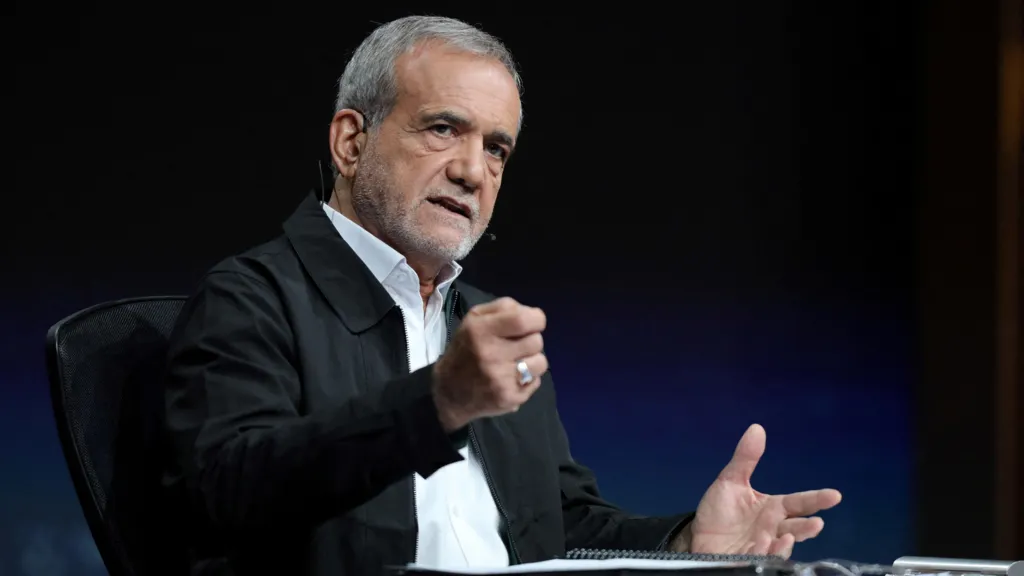
Tehran – The Islamic Republic of Iran is expanding its strategic and economic presence in the region, as part of the Neighborhood First policy, initiated by President Masoud Pezeshkian.
Through increased regional trade ties, Tehran is establishing itself as a key hub for landlocked Afghanistan, marking a shift from regional isolation to economic integration.
This move is timely because Afghanistan has been actively diversifying its trade relationships with Iran and India to overcome the consequences of recurrent trade breaks and border shutdowns with Pakistan. To reinforce these ties, Afghan officials have recently conducted consecutive high-level visits to Tehran and New Delhi, with an emphasis on infrastructure projects and the development of the Chabahar port.
In the latest strategic trip to South Khorasan, a province at the center of border cooperation, President Pezeshkian highlighted that Iran will not leave any effort to assist its neighbor.
Iranian President Masoud Pezeshkian has said that his country will spare no effort in strengthening relations with Afghanistan, particularly along their shared border, Iranian media reported.
— TOLOnews English (@TOLONewsEnglish) December 20, 2025
He made the remarks during a visit to South Khorasan, a province bordering Afghanistan,… pic.twitter.com/7OAQ3Hugaq
The President gave directives to provincial governments to enforce pragmatic measures that would boost bilateral trade. Such attempts to enhance Regional Trade Ties portray a desire to achieve shared borders via development and not merely defense.
Tehran as a Hub for Regional Consensus
Recently, the Iranian capital became the hub of regional diplomatic engagements as a major regional conference was held there on December 14-15, 2025, titled Developments Related to Afghanistan.
This summit had combined the special representatives of other neighboring countries, such as China, Russia, and Pakistan, in order to organize an integrated response to the local security and economic issues in the region.
Although the Taliban administration was not present at the summit directly, the negotiations were very fruitful, as the international community coordinated its efforts to support the stability and security of Afghanistan as well as its stronger link with the rest of the region.
After the successful end of the summit, an Iranian diplomat, Mohammad Reza Bahrami, went to Kabul to meet with the Afghan Foreign Minister, Mawlavi Amir Khan Muttaqi. Bahrami gave a comprehensive briefing on the Tehran meeting and invited Muttaqi to come to Iran.
Also See: Iran Briefs Kabul After Taliban Skips Tehran Summit, Raising Questions Over Regional Cooperation
This gesture highlights the positive bilateral ties and acknowledges Afghanistan’s reported progress in the areas of security and internal governance.
The opening up of Afghan trade routes via the Chabahar port is a concern for regional sovereignty in Tehran.
Through the strengthening of regional trade ties, the Islamic Republic is assisting its neighbors by circumventing artificial trade obstacles and border closures.











