
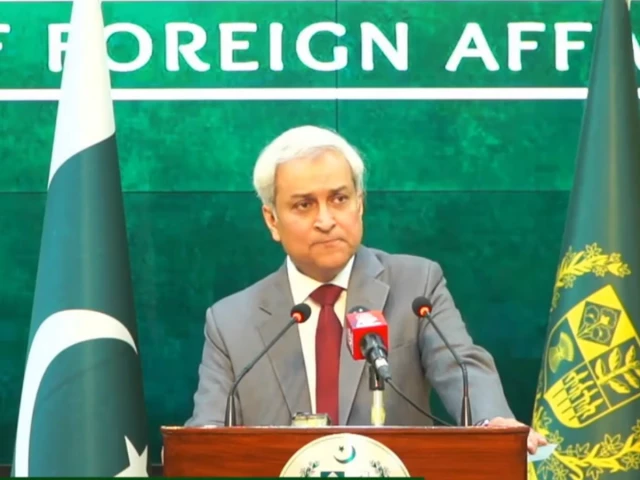
Islamabad – On Thursday, the Foreign Office spokesperson, Tahir Hussain Andrabi, confirmed that the two neighbors had successfully completed their Annual Diplomatic List Exchange, providing information about nuclear installations and prisoners they were currently holding.
This has been the case since 1992 and is an important communication line even in the face of political tension between the two nuclear-armed powers.
Foreign Office Spokesperson told in news briefing, “In continuation of the practice, the exchange took place today as well.”
“A list of nuclear installations and facilities in Pakistan was officially handed over to the representative of the Indian High Commission in the Foreign Office today.”
“I understand that the Indian government is also sharing the list of Indian nuclear installations with our High Commission in New Delhi today,” he added.
Nuclear and Prisoner Data Shared
The two countries, under an Agreement on Consular Access signed in 1988, are obliged to report their nuclear facilities to one another so that there are no accidental attacks.
A comprehensive list of prisoners was also provided in the Annual Diplomatic List Exchange.
The 2008 Consular Access Agreement provides that such lists are exchanged every six months, on January 1 and July 1.
Spokesperson Andrabi observed that the lists had been formally given to representatives of the respective governments of the two countries in their respective High Commissions so that both governments kept one another informed on the whereabouts of their citizens detained on the other side of the border.
Concerns Over Water Rights
Although the list exchange was cordial, the Foreign Office aired serious concerns over the recent Indian approvals of hydroelectric projects.
In particular, the 260-megawatt Dulhasti Stage-II project along the Chenab River has caused concern in Islamabad.
Andrabi told New Delhi that the Indus Waters Treaty (IWT) was an international binding law.
“We have seen these media reports regarding Indian plans to construct the Dulhasti Stage-II hydroelectric [project] on the Chenab River,” he said. “Obviously, these reports raise serious concerns as no prior information or notification was shared with Pakistan about this project.”
He stressed that the same spirit of cooperation in the annual diplomatic list exchange must apply to the water rights and that India needed to go back to treaty compliance and provide technical information before constructing water projects on the western rivers.
“In the absence of formal communication from the Indian side, Pakistan is unable to access the project’s conformity with the treaty provisions. We, therefore, call upon India to urgently return to treaty compliance and respond to the queries raised by our Indus water commissioner in his latest as well as his earlier communications.”
Also See: India Relaunches Winter “Water War” as Sudden Chenab Flow Manipulation Alarms Pakistan
Regional Diplomacy and Rare Encounters
A rare diplomatic encounter was also mentioned in the briefing. It was reported that Indian Foreign Minister Subrahmanyan Jaishankar had a brief meeting with former National Assembly Speaker of Pakistan Ayaz Sadiq in Dhaka during the funeral of the former Bangladesh Prime Minister Khaleda Zia.
Although there were no official discussions, the two shared pleasantries and a handshake, which was a significant point of interaction.
Meanwhile, Pakistan reiterated its firm support for the One-China principle regarding Taiwan and rejected Israel’s recognition of Somaliland, standing in solidarity with Somalia’s sovereignty.
Spokesperson said, “We would urge all relevant countries to abide by their historical commitments, take steps to foster peace, security, and development in Taiwan.”
Also See: Indian FM S. Jaishankar and NA Speaker Ayaz Sadiq Met at the Sidelines of Khaleda Zia’s Funeral
Citizen Welfare and Foreign Ties
The spokesperson also reported that 15 students and 291 other Pakistanis stranded in Afghanistan have returned home safely. “We are in contact with the Afghan authorities,” he said.
After recent border closures, about 300 people, such as students, were safely transported home.
The spokesperson emphasized that the government is in continuous communication with the Afghan authorities to help the hundreds of citizens who are still looking to get back.











