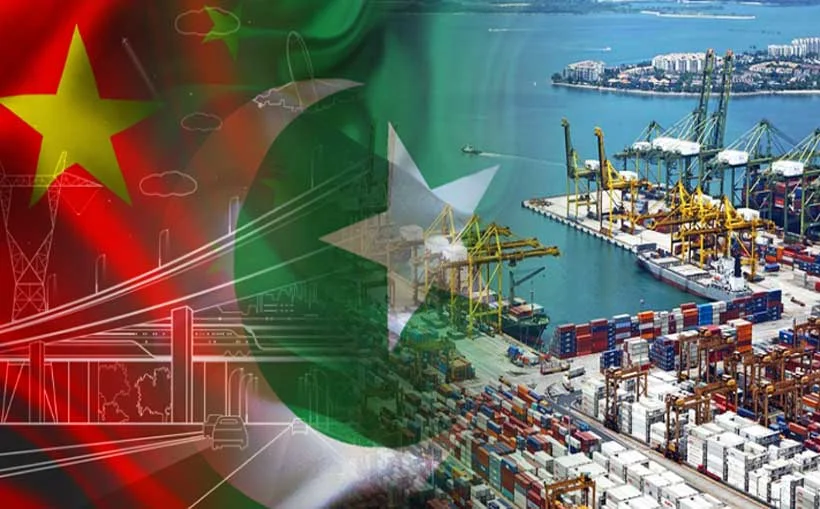
For much of the last decade, the China–Pakistan Economic Corridor (CPEC) was understood mainly as an infrastructure story: roads, power plants and ports designed to fix Pakistan’s long-standing bottlenecks.
That phase was necessary, but it was never the final destination. In 2026, Pakistan is entering a far more consequential stage. With the rollout of CPEC 2.0, the country is no longer positioning itself merely as a transit corridor.
It is steadily emerging as a regional center for modern manufacturing and maritime trade.
CPEC 2.0: from infrastructure to industrialization
The shift is deliberate. While CPEC Phase I focused on energy security and connectivity, CPEC 2.0 marks a transition toward industrialization, value addition and export-led growth. T
his change aligns closely with Pakistan’s URAAN framework and China’s emphasis on high-quality development.
At the center of this new phase is the Industrial Cooperation Action Plan (2025–2029), which aims to relocate selected segments of Chinese manufacturing to Pakistan and integrate the country into regional and global supply chains.
The focus is not on low-value assembly lines. Priority sectors include chemicals and pharmaceuticals, engineering goods, iron and steel, agro-processing, light manufacturing, home appliances, and construction materials, with a strong emphasis on energy-efficient and environmentally sustainable technologies.
This signals a strategic move toward localized, value added production rather than simple import substitution.
Special economic zones and the rise of value-added manufacturing
Special Economic Zones (SEZs) are the backbone of this transformation. Zones such as Rashakai, Allama Iqbal Industrial City in Faisalabad and Dabaji in Sindh are already attracting investment in manufacturing, processing, electronics, automobiles, textiles and consumer goods.
By 2025, early phases in key clusters, especially around Faisalabad had reached around 73 percent occupancy or sales rates a strong indicator of investor confidence.
Expansion is continuing into 2026, supported by tax incentives, customs facilitation and ready infrastructure.
Chinese investment and Pakistan’s integration into global supply chains
China’s role remains central. It is Pakistan’s largest source of foreign direct investment, contributing USD 188.6 million in the first quarter of FY2026 alone more than 33 percent of total FDI in that period.
Business-to-business engagements have added further momentum. The investment MoUs worth around USD 8.5 billion signed in September 2025 and repeated visits of Chinese delegations to Pakistani SEZs show that industrial cooperation is moving from planning to execution.
The economic logic is clear. These partnerships are expected to boost exports, create jobs, transfer technology and embed Pakistan into global value chains.
Combined with reforms to improve the ease of doing business and regulatory stability, Pakistan is gradually reshaping its image from an import-dependent economy to a competitive regional production base.
Gwadar and the blue economy: building Pakistan’s maritime future
This industrial push on land is being matched by a strategic expansion at sea through the blue economy, with Gwadar as its focal point.
Operational since 2016, Gwadar is evolving into a smart transshipment hub linking Central Asia, the Middle East, Africa and South Asia.
The East Bay Expressway, the new international airport operational in 2025, and ongoing port modernization are turning Gwadar into a serious alternative gateway.
Projections suggest it could lead national cargo throughput by 2030, easing pressure on Karachi Port and Port Qasim, which still operate at roughly half of their potential capacity.
Shipbuilding is a cornerstone of this maritime strategy. The Gwadar Shipyard Mega Project and the revitalization of Gadani are designed to build Pakistan’s maritime manufacturing capacity, generate large-scale employment especially for the Balochistan workforce and position the country in regional and global shipbuilding markets.
At the same time, fisheries and aquaculture are being modernized through cold chains, processing facilities, value addition and international branding, opening new export routes to Gulf, African and Southeast Asian markets.
Logistics reforms including digital customs and modern port operations under CPEC 2.0, are improving trade efficiency and reducing congestion.
Marine tourism along Gwadar, Jiwani, Ormara, and Pasni is emerging as another high-potential sector while a proposed Maritime Training Institute aims to ensure that local communities are equipped with the skills needed to participate in this growth.
From transit corridor to regional production and trade hub
Security, provided in large part by the Pakistan Navy, underpins this entire vision by safeguarding maritime routes against piracy, smuggling, and illegal fishing, and by ensuring a stable environment for investment.
Taken together, these developments point to a deeper structural shift.
Pakistan in 2026 is no longer just a passageway for others’ trade. It is becoming a place where goods are made, processed, shipped and exported.
By aligning CPEC 2.0 with URAAN Pakistan, the country is converting its geostrategic location into industrial strength.
The long-term ambition of a USD 1 trillion economy is still a journey, not a destination.
But for the first time in decades, the direction is clear which is from corridor to manufacturing and maritime hub at the crossroads of Asia, the Middle East and Africa.
Read more: Empowered Women Driving Pakistan’s Productivity, Innovation, and Social Progress