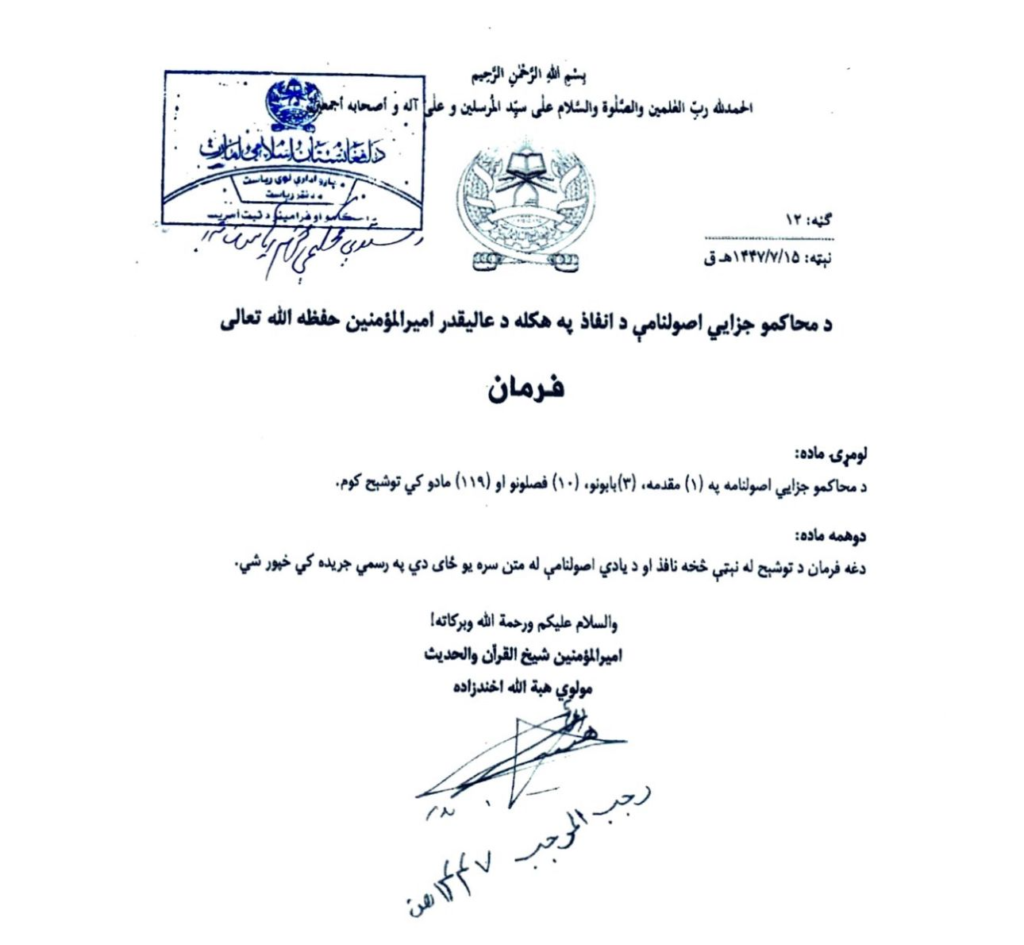
Sources within the Afghan Taliban have confirmed that the so-called Criminal Procedure Code released by the human rights organization Rawadari is authentic. According to the sources, the law was formally enacted on 7 January (17 Rajab) after being signed by Taliban leader Mullah Hibatullah Akhundzada.
Structure and Legal Status of the Document
Issued in Pashto under the title Qanoon-e-Jazai (Penal Code), the document spans 59 pages and includes a cover letter, three chapters, ten sub-chapters, and 119 articles. The Taliban have granted the document full legal status in areas under their control and have instructed all institutions to enforce it.
Society Divided Into Four Classes
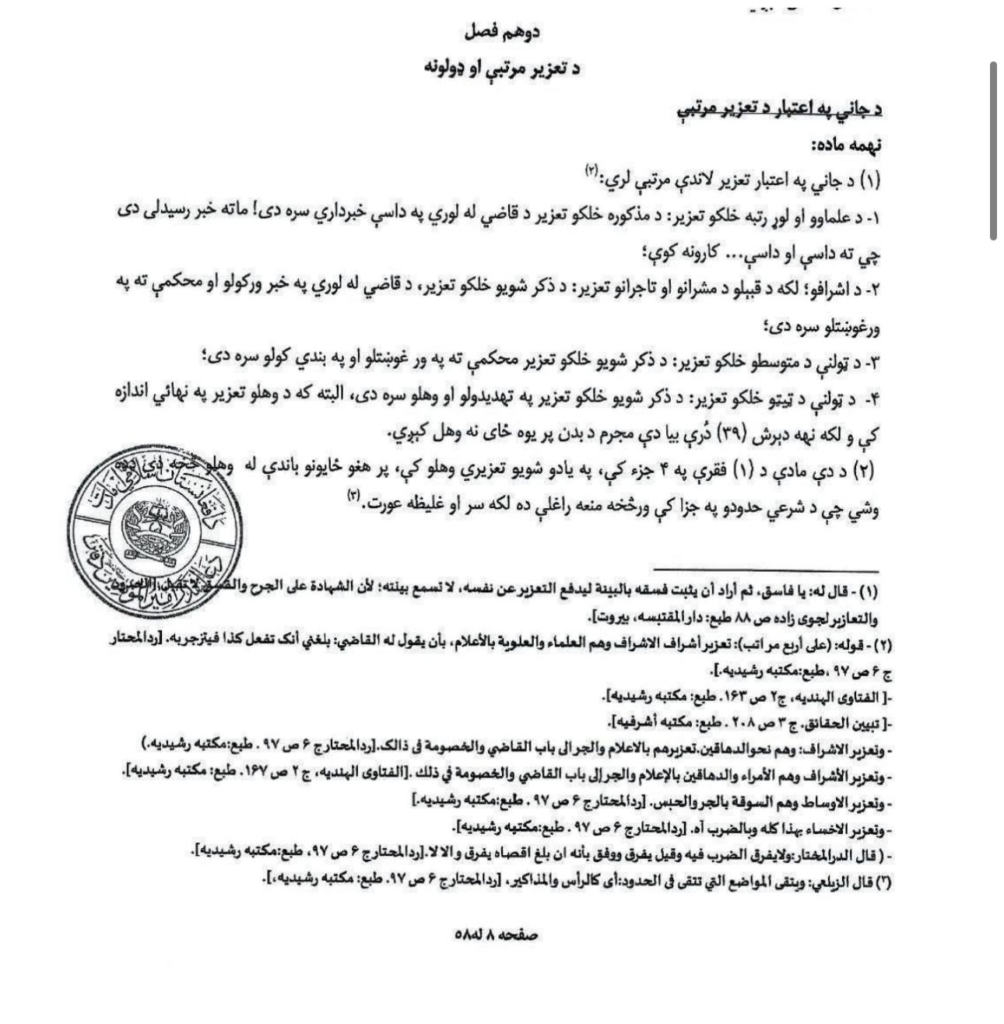
Under the new law, society is divided into four classes, with different punishments prescribed for the same crime depending on social status. Religious scholars are placed in the highest category and are exempt from severe punishment, with admonition deemed sufficient in case of wrongdoing.
The second category includes respected elites such as tribal elders, military commanders, and influential figures. Individuals from this group may be summoned and warned but will not face imprisonment or corporal punishment.
The third category consists of the middle class, for whom imprisonment may be imposed. The fourth and lowest category includes ordinary citizens, who may face imprisonment, flogging, and other severe punishments for the same offenses.
Religious Provisions
The document recognizes only the Hanafi school of jurisprudence as Islamic law. Followers of other schools are required to accept Hanafi jurisprudence, and adherence to any other school may result in up to two years’ imprisonment.
Article 2, Clause 8 defines only Hanafi followers as Muslims, while other sects—including Shiites, Ahl-e-Hadith, Ismailis, Sikhs, and Hindus—are labeled as deviants.
Punishments for Opposition and Insult
Opposition to the Taliban is defined as rebellion and punishable by death. Under Article 2, Clause 11, Taliban opponents are classified as insurgents and subject to capital punishment.
Insulting Taliban leader Mullah Hibatullah Akhundzada carries a penalty of 20 lashes and six months in prison.
Women and Family Regulations
The law introduces additional restrictions on women. Article 34 states that a wife repeatedly visiting her parental home without her husband’s permission is a criminal offense, punishable by up to two months in prison for the woman and her relatives.
Legalization of Slavery and Discretionary Punishments
The document explicitly legitimizes slavery, repeatedly using the term “slave.” Article 15 states that discretionary punishments may be imposed whether the offender is free or enslaved.
Article 4, Clause 5 authorizes husbands or guardians to administer discretionary punishment, while religious punishments are to be carried out by an imam. The clause also allows husbands to punish wives and owners to punish slaves.
Vigilante Justice and Property Destruction
Article 4, Clause 2 grants individuals the right to punish anyone they witness committing a sin. Article 13 permits the destruction of salons and beauty parlors, labeling them as centers of corruption.
Killing and Other Severe Provisions
Article 14 allows the killing of individuals defending “false beliefs” with the imam’s approval. However, the law does not clearly define false beliefs or the authority of the imam, raising concerns about misuse.
Article 24 prescribes up to two years in prison for failing to report alleged subversive activities. Article 40 criminalizes mere presence at gatherings deemed corrupt, regardless of intent.
Human Rights Concerns
Legal experts and human rights organizations warn that the law’s vague and harsh provisions violate international principles of human rights, religious freedom, and justice. There are growing concerns that the law could be used to suppress dissent, target women, and persecute minorities on a wide scale.
Read more :Turkish Report Warns Taliban Drug Ban Reshaped, Not Reduced, Afghanistan’s Narcotics Economy