
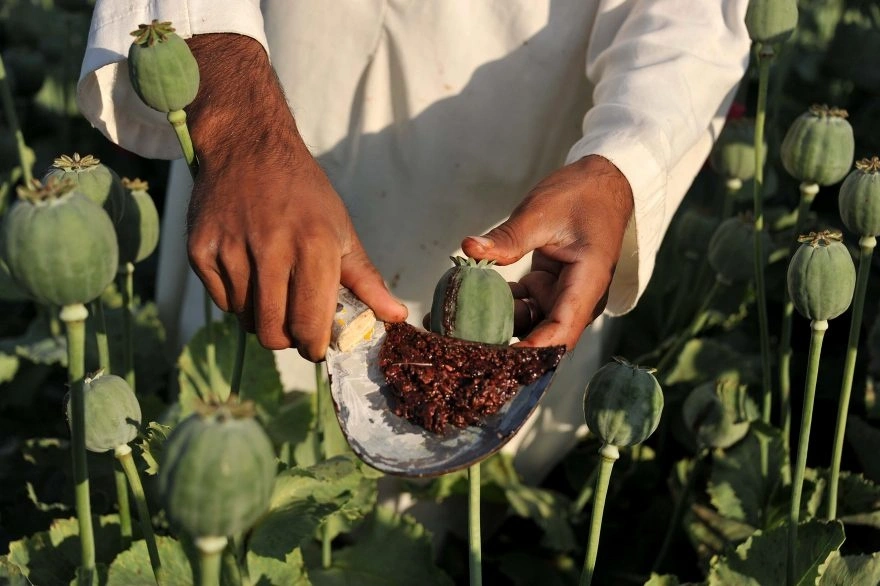
From Eradication to Market Control
The 2025 Turkish Drug Report warns that Afghanistan’s narcotics economy has not declined under Taliban rule but has instead been reorganized into a more controlled and strategic system. While the Taliban’s April 2022 decree banning poppy cultivation led to a sharp drop in opium production in 2023, the report finds that the ban was never intended to dismantle the drug trade.
According to the report, the ban followed years of record opium output that had created a glut in global markets. By restricting cultivation while allowing traffickers to clear existing stockpiles during a 10-month grace period, the Taliban engineered artificial scarcity, pushing opium and heroin prices sharply upward and shifting market power away from farmers toward traffickers and intermediaries.
Strategic Shift Toward Synthetic Drugs
The report highlights that alongside managing opiate scarcity, Afghanistan accelerated its transition toward synthetic drugs, particularly methamphetamine. Traffickers increasingly rely on the country’s abundant ephedra plant to extract ephedrine, enabling large-scale production that is independent of agricultural cycles and harder to detect or disrupt.
International monitoring cited in the report shows that restrictions on poppy cultivation did not negatively affect the expanding methamphetamine trade. Neighboring states, as well as Europe and East Africa, have reported significant increases in seizures of Afghan-origin synthetic drugs, signaling a deeper transformation of regional and global narcotics markets.
Afghanistan as a Managed Narco-State
The Turkish assessment describes Afghanistan as evolving into a sophisticated narco-state, where illicit drugs function as a central economic and strategic asset rather than a criminal byproduct. Despite visible declines in cultivation at certain points, trafficking routes, laboratories, storage hubs, and cross-border logistics networks remained largely intact.
By selectively enforcing cultivation bans while preserving trafficking capacity, the Taliban reshaped the drug economy toward managed scarcity, stockpile leverage, and synthetic diversification. The report concludes that this model has strengthened Afghanistan’s influence within international narcotics markets, allowing it to continue shaping global supply, prices, and trafficking patterns while exporting instability far beyond its borders.
Read more :Trump Says Nato Troops Stayed “a Little Off the Front Lines” in Afghanistan











