
Islamabad — Pakistan has unveiled its first large-scale, homegrown governance index aimed at measuring transparency and accountability based on citizens’ real-life experiences, challenging long-standing global narratives that portray corruption as uniformly pervasive across the country.
The Index of Transparency and Accountability in Pakistan (iTAP), commissioned by the Federation of Pakistan Chambers of Commerce and Industry (FPCCI) and conducted by international research firm Ipsos, surveyed more than 6,000 citizens nationwide using face-to-face interviews supported by the Pakistan Bureau of Statistics.
Unlike international indices that rely heavily on elite opinions and secondary data, iTAP combines public perception with lived experience, offering what researchers describe as the most comprehensive and locally grounded assessment of governance practices in Pakistan to date.
Perception vs Reality: A Striking Gap
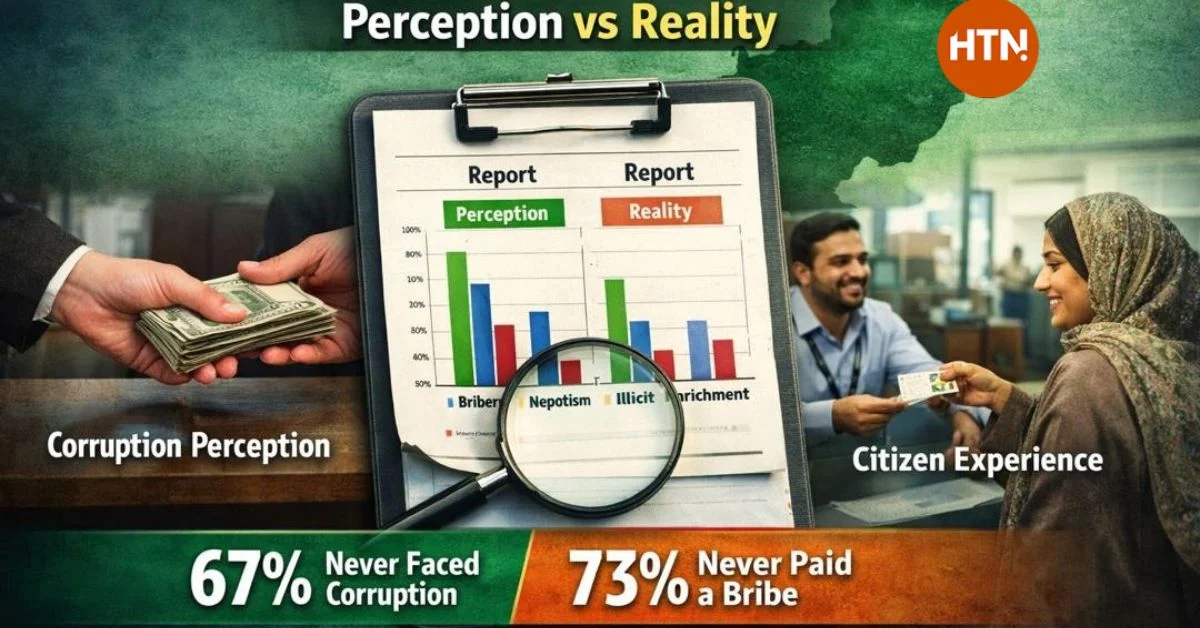
The findings reveal a significant disconnect between how corruption is perceived and what citizens actually experience in daily interactions with public institutions. While 68 percent of respondents believe bribery is common, only 27 percent reported personally encountering it. Similarly, 56 percent perceive nepotism as widespread, but just 24 percent have faced it, and although 59 percent believe illicit enrichment is prevalent, only 5 percent have witnessed it firsthand.
Overall, 67 percent of Pakistanis said they had never experienced any corruption malpractice, and 73 percent reported never paying a bribe to access public services.
Impact of Reforms and Digitalization
Researchers link these results to governance reforms over the past decade, particularly the digitalization of public services, automation of procedures, and reduction of discretionary human interfaces. Services such as NADRA, government hospitals, and public education institutions ranked among the best in terms of transparency and citizen satisfaction.
However, the report notes that public perceptions change slowly, often lagging behind structural reforms and improved service delivery.
Rethinking Global Assessments
FPCCI officials argue that international corruption rankings largely reflect how Pakistan is viewed externally rather than how citizens are actually served. iTAP, they say, provides empirical evidence that everyday governance outcomes are improving, even if global reputations have yet to catch up.
The index is intended to be updated regularly, allowing Pakistan to track progress over time, identify institutional weaknesses, and design targeted reforms based on data rather than assumptions.
By shifting the focus from perception alone to lived reality, iTAP marks a significant step toward a more balanced and evidence-based understanding of transparency and accountability in Pakistan.
Read more: Pakistan Highlights Türkiye’s Darülaceze Model for Inclusive Long-Term Care at UN Event











