
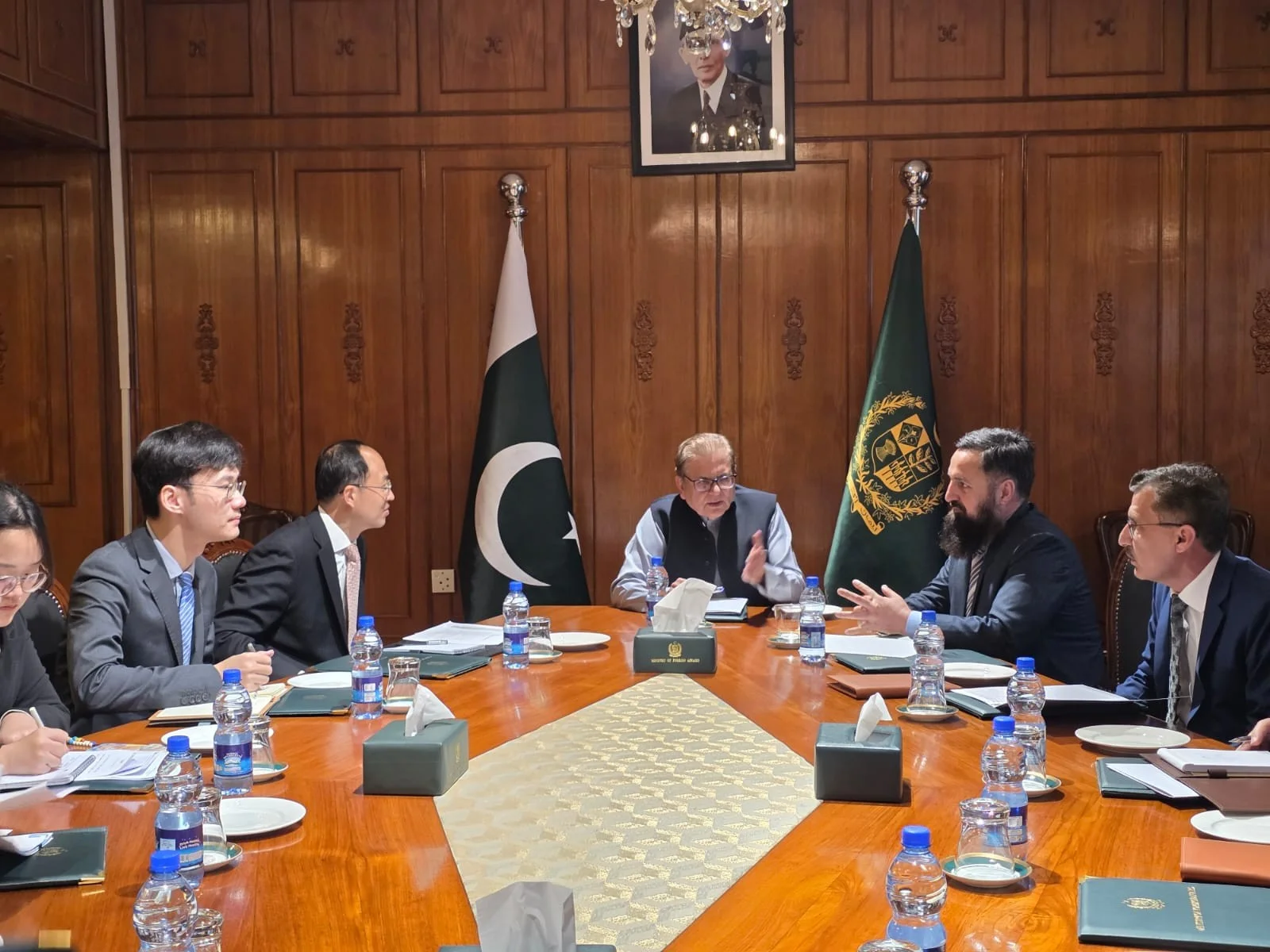
Pakistan has stepped up efforts to strengthen regional trade connectivity after Mohammad Sadiq, Special Assistant to the Prime Minister and Pakistan’s Special Representative for Afghanistan chaired a meeting of Pakistani stakeholders and Chinese officials on the Quadrilateral Traffic in Transit Agreement (QTTA).
In a post on X, Sadiq said traffic from Pakistani ports to Central Asia via China using CPEC routes has been ongoing for years but has risen noticeably in recent months.
He added that with some adjustments currently under discussion, the route could become Central Asia’s most efficient link with Pakistani seaports.
Chaired a meeting of Pakistani stakeholders and Chinese officials on Quadrilateral Traffic in Transit Agreement (QTTA) which regulates connection from Paksitani ports to Central Asia via China using CPEC routes. Some traffick on this route had been continuing for years but it is… pic.twitter.com/RxazmTNRDh
— Mohammad Sadiq (@AmbassadorSadiq) February 4, 2026
The meeting reflects growing regional interest in using Pakistan’s port and road infrastructure to access global markets, at a time when traditional trade routes face political and security challenges.
What QTTA means for regional trade connectivity
The QTTA was signed in 1995 by Pakistan, China, Kyrgyzstan and Kazakhstan to facilitate smooth and secure transit trade between member states.
The agreement provides Central Asian countries direct access to Pakistani ports through China, using the Karakoram Highway and routes linked with the China-Pakistan Economic Corridor.
Operating under the international TIR system, QTTA simplifies customs procedures and reduces transit delays.
Analysts note that the agreement has gained renewed importance as it offers a reliable alternative when routes through Afghanistan are disrupted by instability.
Interest from other Central Asian states, including Uzbekistan and Tajikistan, further highlights the agreement’s growing relevance.
According to assessments by the Islamabad Policy Research Institute, QTTA has the potential to cut transit time and costs while strengthening Pakistan’s role as a regional trade hub linking South Asia, China and Central Asia.
From policy to practice on the ground
QTTA’s potential has already been tested. On June 2, 2023, Pakistan successfully sent its first transit consignment to Kazakhstan via the historic Silk Route.
The shipment departed from the Silk Route Dry Port in Sost near the Khunjerab border and travelled through China to reach Almaty.
The milestone was made possible through close coordination between Pakistan Customs and other government departments, demonstrating Pakistan’s capacity to manage complex transit trade.
Officials said the development marked a new phase in trade relations with Central Asia and showcased the potential of Sost and Khunjerab to emerge as an international hub for cross-border commerce.
With transit traffic now rising and coordination with China underway, Pakistan appears set to deepen its role as a key gateway for Central Asian trade to the Arabian Sea.
Read more: Pakistan and Ghana Hold First Bilateral Political Consultations, Says Foreign Office











