
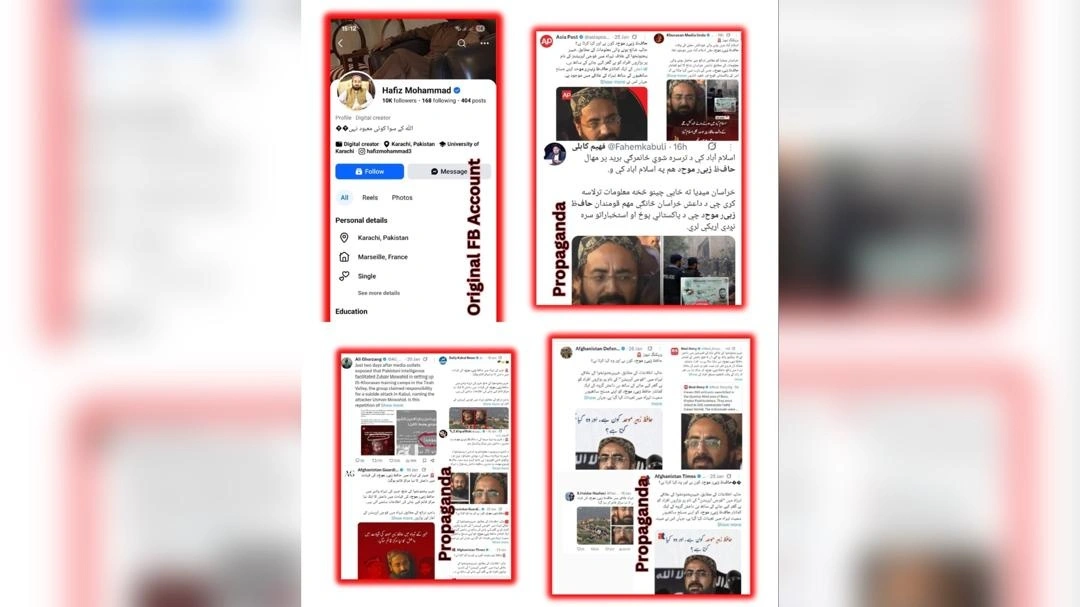
Accounts linked to Taliban intelligence have been accused of spreading false and misleading propaganda by falsely identifying a well-known Pakistani businessman as a commander of the Islamic State Khorasan Province (ISKP).
According to findings shared by Mahaz, Taliban intelligence–linked social media accounts associated with the General Directorate of Intelligence (GDI) have, over the past three weeks, circulated claims alleging the presence of ISKP in the Tirah area of Khyber District. As part of this narrative, these accounts used the fabricated name “Hafiz Zubair Mohad,” claiming he was leading ISKP operations in Tirah and was present in Islamabad at the time of the recent suicide bombing.
However, investigations revealed that the photograph being shared under the name “Hafiz Zubair Mohad” actually belongs to Hafiz Muhammad, a well-known Karachi-based businessman and property dealer who is active on social media. Evidence confirms that Hafiz Muhammad has no links to ISKP, has never visited Tirah, and has no connection to militancy.
The propaganda campaign involved deliberately altering his name and identity to falsely associate him with terrorism, effectively portraying a civilian businessman as an ISKP commander. Observers describe this as a dangerous misuse of misinformation that not only damages individual reputations but also fuels regional instability and false security narratives.
The verified Facebook profile of Hafiz Muhammad, which documents his business activities and personal life, has been shared to counter the false claims and establish his civilian identity.
Analysts warn that such disinformation campaigns highlight the growing use of digital propaganda by militant-linked intelligence networks, where fabricated identities and manipulated visuals are used to shape narratives, deflect responsibility, or create confusion following major security incidents.
This case underscores serious concerns about accountability, misinformation, and the weaponization of social media in regional conflict dynamics.











