
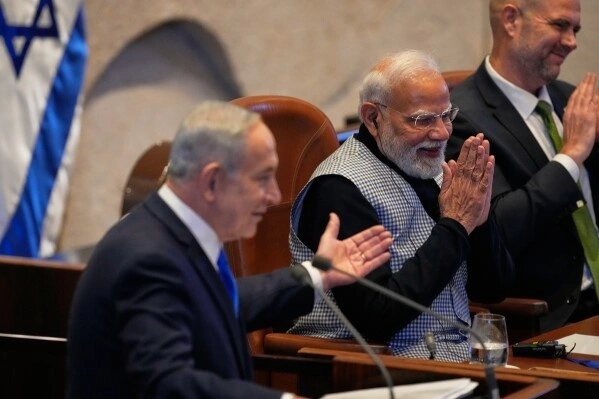
Indian Prime Minister Narendra Modi’s recent visit to Israel has triggered growing debate among analysts and regional observers, many of whom believe the trip signals a troubling shift in India’s long-standing foreign policy balance in the Middle East.
For decades, India attempted to maintain a delicate diplomatic equilibrium between Israel, Iran, and the Arab Gulf states. However, Modi’s highly visible engagement with Israeli leadership — particularly his public show of solidarity with Israeli Prime Minister Benjamin Netanyahu — is being interpreted by critics as a significant departure from that balanced approach.
A Visible Tilt Toward Israel
Observers note that the visit went beyond routine diplomatic engagement. The optics of the meeting, combined with strong public messaging in support of Israel, have reinforced perceptions that India is increasingly aligning itself with the Israeli strategic camp.
This shift has raised concerns that New Delhi may be abandoning its traditional position of strategic neutrality in the region. Critics argue that such alignment risks placing India closer to the geopolitical bloc led by Israel and supported by the United States, potentially alienating other regional partners.
Strained Ties With Iran
One of the most immediate consequences of this perceived alignment could be the deterioration of India’s relationship with Iran.
Tehran has historically maintained important economic and strategic ties with New Delhi, particularly through projects such as the Chabahar Port, which India views as a crucial gateway to Central Asia and Afghanistan. Analysts warn that if India continues to visibly side with Israel during a period of heightened regional tensions, it could damage long-standing trust between Tehran and New Delhi.
Some experts also fear that growing US pressure on Iran could further complicate India’s position and potentially undermine Indian investments and strategic projects linked to Iran.
Impact on India’s Image in the Gulf
Beyond Iran, Modi’s overt closeness with Israel may also affect India’s perception across the Gulf region.
Public opinion in several Arab countries remains deeply critical of Israeli policies in the Middle East. By appearing openly aligned with Israel at a time of regional tensions, India risks being viewed as part of a pro-Israel security axis — a perception that could weaken its traditionally strong relations with Gulf societies.
Potential Risks for India’s Diaspora
Perhaps the most sensitive issue is the potential impact on India’s massive expatriate workforce in the Gulf.
Millions of Indian workers live and work across the Gulf region, sending billions of dollars in remittances back home each year. Analysts warn that if regional public sentiment shifts against India due to its perceived alignment with Israel, it could create social or political pressure affecting migrant workers, employment opportunities, or visa policies.
While such outcomes are not inevitable, experts caution that foreign policy decisions must consider the broader consequences for millions of citizens whose livelihoods depend on stability in the region.
Strategic Gamble
Critics argue that Modi’s Israel visit may ultimately prove to be a strategic gamble. By appearing to abandon its traditional balancing diplomacy, India risks straining ties with Iran, complicating its relations with the Arab world, and exposing its overseas workforce to unintended political fallout.
As tensions in the Middle East continue to evolve, many analysts believe New Delhi will face increasing pressure to clarify whether its regional policy remains independent — or whether it is gradually drifting into a more rigid geopolitical alignment.
Read more :Modi’s Visit to Israel-Strategic Partnership or Regional Flashpoint?











