
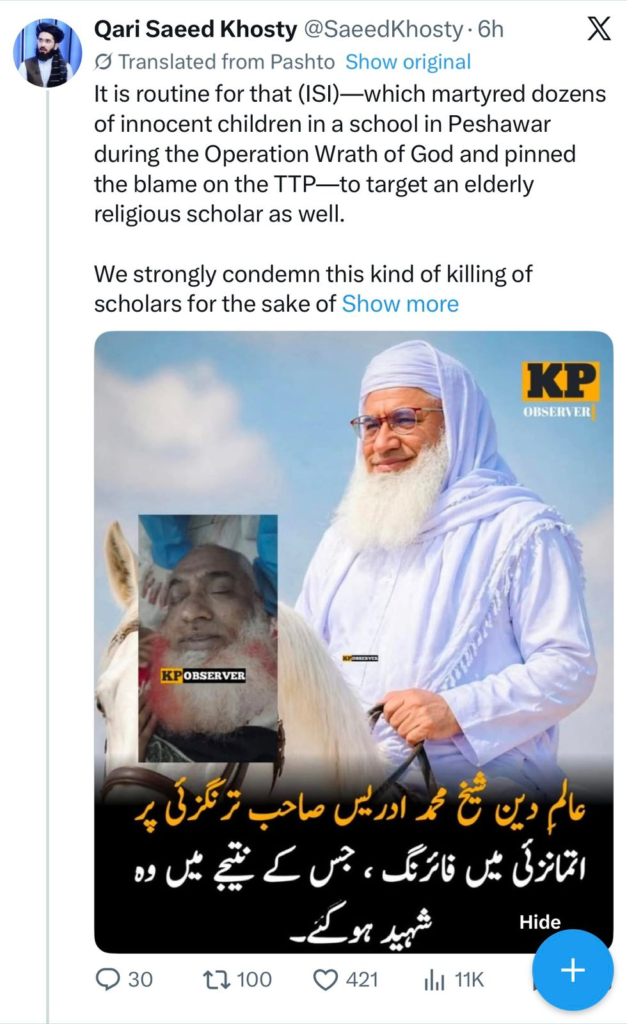
Recent controversial remarks shared on social media by Taliban official Qari Saeed Khosty have once again drawn attention to what critics describe as the group’s double standards, alleged protection of militant networks, and systematic attempts to distort facts.
In his statement, Khosty attempted to attribute the martyrdom of Sheikh Muhammad Idris to Pakistan and also made misleading claims absolving the Tehrik-i-Taliban Pakistan of responsibility for the tragic Army Public School Peshawar attack. Analysts say such narratives reflect a recurring strategy aimed at shifting attention away from serious allegations regarding militant sanctuaries.
Avoiding Accountability and Distorting Facts
Security and policy experts argue that these statements are not isolated opinions but part of a broader communication pattern designed to deflect international scrutiny. They say the Taliban administration is increasingly being accused of providing safe havens, operational space, and protection to militant groups operating across the region.
According to observers, despite repeated global concerns, Afghanistan under Taliban control continues to be viewed as a permissive environment for multiple militant networks, raising serious questions about governance and accountability.
Targeting of Religious Scholars
Reports of targeted killings of religious scholars have further intensified criticism. Analysts note that scholars promoting peace, moderation, and traditional religious education have increasingly been targeted in areas influenced by militant factions. The killing of Sheikh Muhammad Idris in Charsadda is being seen by some observers as part of this wider pattern aimed at silencing moderate voices.
Regional Security Concerns
Security assessments suggest that Afghanistan has become a hub for more than 20 international militant organizations, according to various reports. These safe havens are alleged to have enabled the Tehrik-i-Taliban Pakistan to carry out hundreds of attacks in Pakistan, resulting in significant human and material losses.
Despite these allegations, Taliban representatives continue to reject responsibility and instead issue counter-accusations, which analysts describe as an effort to influence international perception and avoid accountability.
Experts conclude that the current communication approach of Taliban officials raises serious concerns about credibility, as they are seen defending a system accused of harboring militant groups while simultaneously engaging in narrative-driven blame shifting.











