
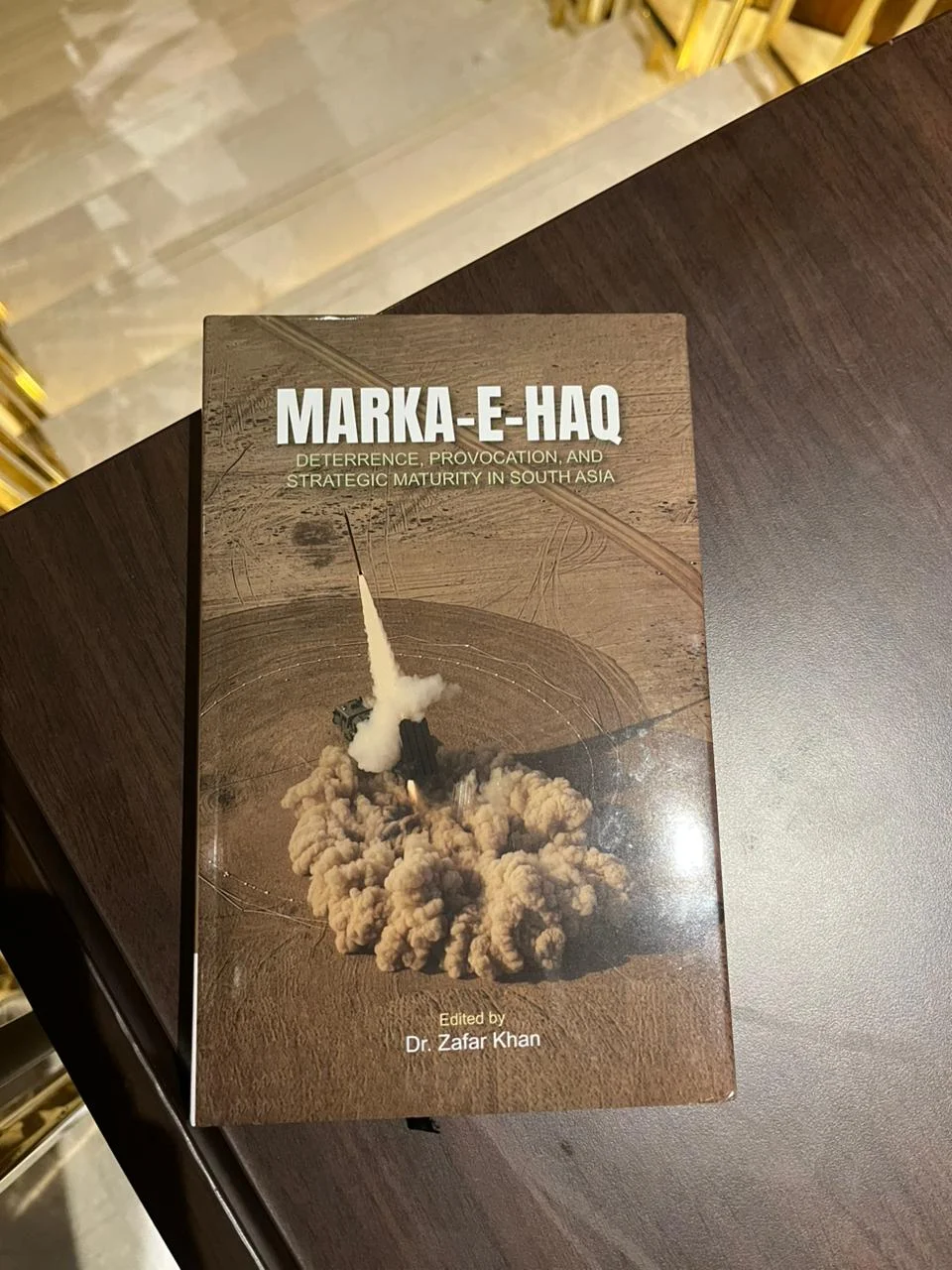
A special launch ceremony was held in Islamabad on the completion of one year since the success of Marka-e-Haq, where the book titled “Marka-e-Haq: Deterrence, Provocation and Strategic Maturity in South Asia” was formally presented. The event brought together prominent figures from diplomatic, military, academic, and policy circles. Detailed discussions were held on South Asia’s strategic environment, rising regional tensions, deterrence policy, and Pakistan’s position.
Opening of the Ceremony
At the start of the event, Director of the Centre for International Strategic Studies Ambassador Ali Sarwar Naqvi welcomed all participants and congratulated those associated with the book. He said that “Marka-e-Haq” is not just a military achievement but a reflection of Pakistan’s sovereignty, strategic vision, and restraint as a responsible nuclear state. He added that the book is a serious academic contribution to global debates on deterrence and strategic balance.
Ali Sarwar Naqvi noted that modern warfare is rapidly evolving, where cyber warfare, drones, precision strike capabilities, narrative warfare, and emerging technologies are creating new challenges. According to him, deterrence is no longer only about military strength but also includes political, psychological, and diplomatic dimensions. He said the book also covers important issues such as the future of South Asia, Kashmir, water disputes, and India’s evolving narrative.
Address by Dr. Zafar Khan
Editor of the book Dr. Zafar Khan said that the aim of the book is to provide a critical and research-based analysis of “Marka-e-Haq” from different perspectives. He shared that the ten chapters of the book were written by well-known scholars, diplomats, and former military officials, including Dr. Rizwana, Dr. Jaspal, Lt. Gen. Mazhar Jamil, Zameer Akram, Dr. Zahir Kazmi, Dr. Akhtar, Dr. Naim Sadiq, Dr. Khalid, Lt. Gen. Sarfaraz, and Lt. Gen. Amir Riaz.
He said the book collectively supports the view that Pakistan’s approach to crisis management and strategic decision-making during tense situations has been a major success.
Special Address by Zubair Mahmood Hayat
Chief guest General Zubair Mahmood Hayat said that miscalculations in South Asia often spread faster than reality, and this remains the region’s biggest risk. He said the book offers a realistic analysis of threats, mistakes, and strategic challenges in the region.
He noted that over the past decade, attempts were made to establish a “new normal” in South Asia, but Pakistan made it clear that no unilateral strategic dominance would be allowed in the region. He said Pakistan’s full spectrum deterrence policy ensures balance in the region, and “Marka-e-Haq” proves Pakistan’s capability to respond at all levels.
He further added that Kashmir and water disputes are two major nuclear flashpoints in South Asia that require responsible conduct and dialogue. According to him, India’s aggressive actions are harming regional peace, while RSS-influenced extremist thinking is also becoming a global concern.
Remarks by Zameer Akram
Former ambassador Zameer Akram said that India’s behavior has historically promoted tension and conflict in the region. He said “Marka-e-Haq” has significantly challenged India’s aspirations of becoming a superpower and its idea of “Akhand Bharat.”
He added that India has repeatedly used hybrid warfare, terrorism, and political pressure against Pakistan but has faced failure at every stage. He said Pakistan has played an effective diplomatic role in both the region and the Middle East, while India’s policies have increasingly isolated it internationally.
Views of Dr. Jaspal and Gen. Sarfaraz
Vice Chancellor of Quaid-e-Azam University Dr. Jaspal said that India’s offensive defense policy, cross-border actions, and attempts to destabilize Pakistan are part of its national security approach. He added that India’s unbalanced military strategy shows its failure to achieve political and strategic goals.
General Sarfaraz said Pakistan must focus on monitoring India’s policies and regional behavior. He noted that India’s current political and social structure is heavily influenced by RSS and Hindutva ideology, which policymakers must recognize.
Closing Remarks by Senator Mushahid Hussain Sayed
Senator Mushahid Hussain Sayed said that Marka-e-Haq represents the biggest strategic setback for India since 1962. He stated that Muhammad Ali Jinnah had already identified the Hindutva mindset a century ago.
He said that India’s current political system is increasingly influenced by extremist ideology, while Pakistan has demonstrated strong military, diplomatic, and national capabilities during Marka-e-Haq.
He added that India’s policy mistakes have strengthened Pakistan’s global position, and the event marks a historic moment for Pakistan.
Conclusion
At the end of the ceremony, participants agreed that responsible diplomacy, effective deterrence, crisis management, and dialogue are essential for lasting peace in South Asia. They said the book documents different dimensions of Marka-e-Haq and will serve as an important reference for future generations, policymakers, researchers, and students of strategic affairs.
The event concluded with the formal launch of the book, where participants described it as an important contribution to Pakistan’s strategic narrative and regional security discourse.











