
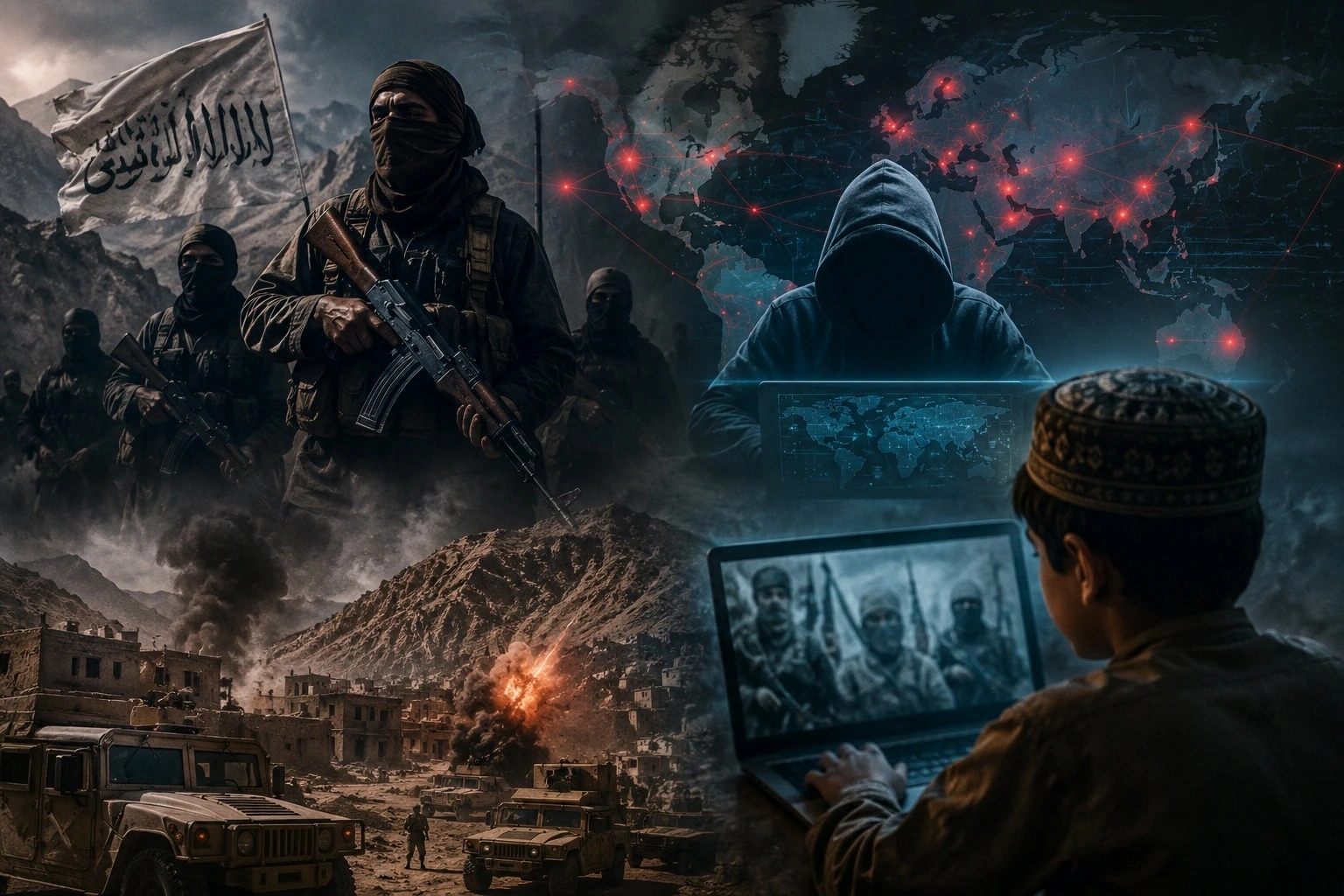
Global peace and regional stability stand at a critical and fragile juncture where cross-border militancy and digital extremism have fundamentally reshaped traditional security assumptions. Recent details of the deadly suicide attack on the Damangi Camp in Bajaur district of Khyber Pakhtunkhwa, along with a confidential European Union “Threat Assessment Report,” have simultaneously reinforced long-standing claims repeatedly raised by Pakistan at international forums.
These developments indicate that Afghanistan, under the Taliban regime, has increasingly become a major hub of international militancy and cross-border terror networks, posing a threat that now extends beyond South Asia and reaches the doorstep of Europe.
Investigative findings into the overnight assault on the Damangi Camp present strong evidence that successive attacks in Pakistan, including the killing of civilians and targeting of security forces, are directly linked to Afghan soil. According to the investigation, the suicide bomber involved in the attack, identified as Jalaluddin alias Sajad, was a resident of Narakh district in Wardak province of Afghanistan’s Daulat village. Officials further confirmed that all other militants killed in the retaliatory operation were also Afghan nationals.
More concerning is the fact that funerals and condolence ceremonies were reportedly held for the deceased attacker inside Afghanistan, which is being viewed as further evidence of tolerance or indirect support for militant elements operating across the border. The presence of such networks challenges Kabul’s repeated claims that Afghan territory is not being used against any other country.
The issue is no longer confined to Pakistan or South Asia alone. A 23-page confidential EU threat assessment report has triggered concern across the international community. The report states that ISIS-Khorasan, operating from safe havens inside Afghanistan, has emerged as one of the most dangerous external threats to Europe, with expanding capabilities to conduct disruptive operations across European countries.
The report further highlights alarming trends in digital radicalization, stating that militant groups in Afghanistan are exploiting social media platforms such as Telegram and TikTok to influence and recruit children as young as 12 years old. Through online propaganda and psychological manipulation, these networks are attempting to expand recruitment for cross-border militancy.
According to international defense analysts, the leaked EU document strongly validates Pakistan’s long-standing position that the current structure in Afghanistan has become a central hub for global extremism, digital radicalization, and transnational narcotics networks. Analysts warn that ongoing attacks in Khyber Pakhtunkhwa, targeting of civilians, and sabotage attempts against development projects will continue unless the international community increases pressure on Kabul to dismantle militant sanctuaries.
Pakistan, meanwhile, remains committed to defending its sovereignty and ensuring national security. However, experts emphasize that without coordinated global action and decisive countermeasures against emerging cross-border threats from Afghanistan, the situation could further destabilize not only South Asia but also global security as a whole.
Read more: 28 Million Afghans Deprived of Basic Needs as Humanitarian Crisis Deepens, UNDP Report Warns











