Canberra – The Australian government has imposed financial sanctions, and travel bans on four senior officials in the Taliban government of Afghanistan, citing the radical and worsening human rights conditions, particularly of women and girls.
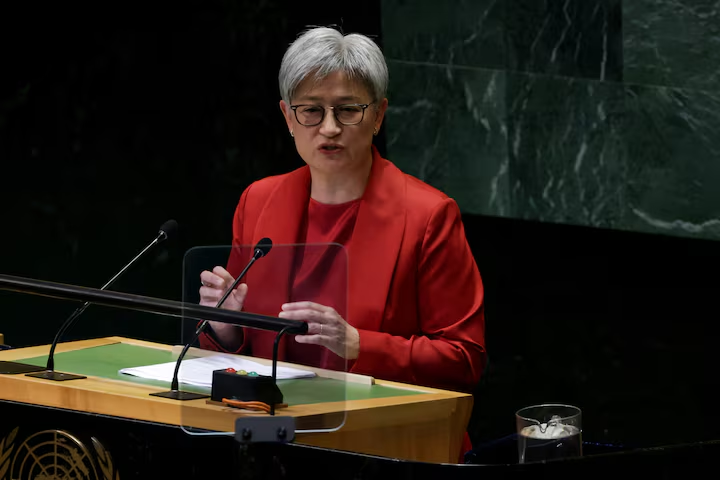
The measures were announced on Saturday by the Foreign Minister Penny Wong, who mentioned that Canberra had designed an indicator-first autonomous framework of sanctions that specifically aimed at the Taliban.
The Australian Government has established a world-first autonomous sanctions framework for Afghanistan, as part of our ongoing efforts to hold the Taliban to account.
— Senator Penny Wong (@SenatorWong) December 5, 2025
In effect from today, we have also announced the first listings under the new framework.
This new framework will enable Australia to directly apply its own punitive measures, exerting more pressure on the regime.
The new policy also places an arms embargo and outlaws the delivery of related services to Afghanistan.
Officials Targeted for Oppression
The Department of Foreign Affairs and Trade (DFAT) named the four authorized Taliban officials because they were directly involved in the oppression of women and girls, as well as weakening good governance or the rule of law.
The officials facing sanctions include Muhammad Khalid Hanafi, the Minister for the Propagation of Virtue and the Prevention of Vice, Neda Mohammad Nadeem, Minister of Higher Education, Abdul-Hakim Sharei, Minister of Justice, and Abdul Hakim Haqqani, Chief Justice.
Minister Wong clearly mentioned that these officials were being targeted to limit access to education, employment, freedom of movement, and the capacity of women in Afghanistan to engage in public life.
We have imposed financial sanctions and travel bans on three so-called Taliban ‘ministers’ and the so-called Taliban ‘Chief Justice’ for their involvement in the oppression of women and girls and in undermining good governance or the rule of law.
— Senator Penny Wong (@SenatorWong) December 5, 2025
The Chief Justice, Abdul Hakim Haqqani, is currently a subject of international scrutiny as the International Criminal Court (ICC) had issued an arrest warrant against him and the Taliban supreme leader in July over crimes against humanity against women and girls.
Context of Sanctions
Since the Taliban returned to power in August 2021, the regime has been implementing a series of extreme measures against the rights of women. These measures are the prohibition of female students in universities, a step taken in December 2022, and the prohibition of women serving in most sectors.
The United Nations had previously claimed that at least 1.4 million girls were deliberately denied their right to an education by the Taliban, representing about 80 percent of all girls of school-going age. The resultant prohibition of female participation in the workplace has also contributed to a humanitarian crisis that puts many Afghans further in the poverty hole.
The new framework is an addition to the 140 people and organizations that are already sanctioned by the existing Taliban framework of the United Nations Security Council.
Minister Wong acknowledged that there is a carve-out of a humanitarian permit in the new sanctions to ensure that the much-needed aid continues to reach the people of Afghanistan.
The Taliban government has not made a formal reaction to these new measures.