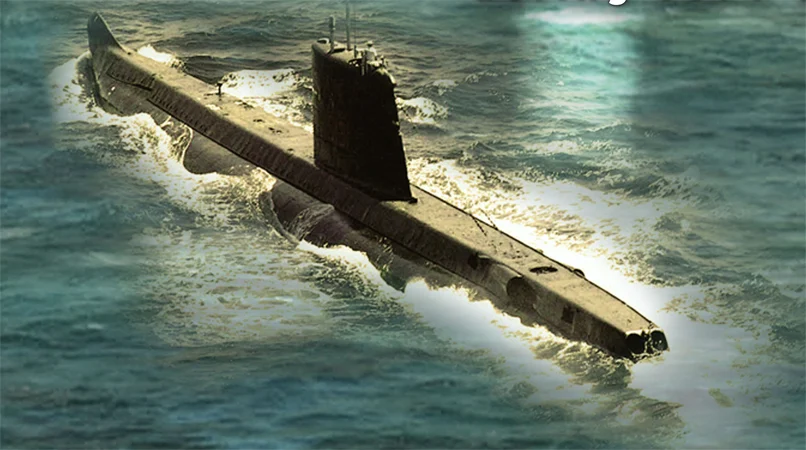
Islamabad_ Pakistan, is observing Hangor Day today with ceremonies in Islamabad and Karachi, honouring the crew of PNS Hangor whose action in December 1971 changed naval warfare in the region.
As the country marks this occasion, the Hangor Day Pakistan Navy narrative is no longer only about history; it is also about how that legacy shapes deterrence in the Arabian Sea today.
The day marks the moment when Pakistan Navy submarine PNS Hangor detected two Indian warships, INS Khukri and INS Kirpan, near the Gujarat coast.
Even though the shallow waters favored the Indian ships, Hangor’s crew moved with the attack. The first torpedo fired at INS Kirpan missed, alerting both vessels. Hangor then shifted its focus to INS Khukri and fired a second torpedo, which struck the ship with deadly accuracy.
Within minutes, Khukri sank, taking 18 officers and 176 sailors with it. This became the first instance since World War II of a conventional submarine sinking a warship in active combat.
Senior retired officers say this single action forced the Indian Navy into the defensive position for the rest of the war. Speaking to HTN English, Rear Admiral (Retd) Faisal Shah called it “a history-making operation” and “a unique example of the Pakistan Navy’s skill and professionalism.”
From Hangor to Markah-e-Haq
That legacy still shapes Indian calculations at sea. During the May 2025 crisis, the Indian Navy surged a carrier group and major units into the Arabian Sea and talked loudly about future “air and sea” offensives.
Yet no Indian warship came near Karachi or Gwadar. According to Pakistani official briefings, the Pakistan Navy kept Indian ships 700 kilometers away from its coast. Rear Admiral Faisal Shah stated that this distance was not accidental but the result of quiet deterrence rooted in the Hangor experience.
Pakistan Navy’s operational capabilities
Today, the Pakistan Navy still relies on undersea power as the ace of its arsenal. The Agosta-90B (Khalid-class) submarines, upgraded with air-independent propulsion, can stay hidden for long periods.
Armed with heavyweight torpedoes and modern anti-ship missiles, they turn the confined North Arabian Sea into a dangerous space for large Indian warships, including aircraft carriers.
Alongside submarines, Pakistan has fielded indigenous cruise missiles such as Harbah and coastal variants of the Babur family.
These systems allow sea-denial from land and sea, which means Indian task forces approaching Pakistani waters would face layered threats from below the surface and from the coastline.
Pakistan has also developed a sea-based nuclear option through the Babur-3 submarine-launched cruise missile, giving it a credible second-strike capability.
This complicates any Indian idea of a “limited” naval war. A missile fired from an Indian ship at a Pakistani port or naval base could easily be read as strategic escalation, regardless of its warhead.
For India, a miscalculation at sea would carry huge risks: the loss of high-value warships, disruption to energy imports, damage to ports, and global concern over conflict in vital shipping lanes.
For Pakistan, the message Hangor Day sends is clear. The Pakistan Navy does not need to match India ship-for-ship. It only needs to make any war at sea so costly and unpredictable that it never begins.
Read more: New USEFP Building Marks Stronger US-Pakistan Educational Partnership