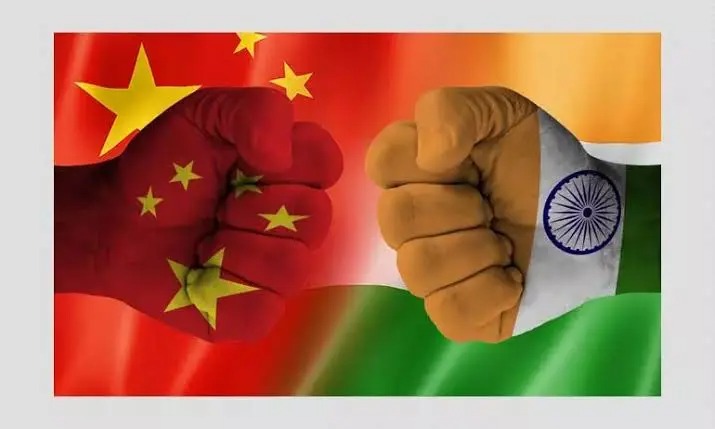
Despite apparent signs of improving relations between India and China, tension on the Himalayan border is becoming visible once again. Diplomatic contacts between the two countries continue, military commanders are meeting, and trade volumes are growing. But the situation on the ground suggests the border dispute is still far from resolved.
The latest situation is that in October 2026, reports emerged of Indian and Chinese troops coming face to face at several locations in Arunachal Pradesh. On October 22, Shatrujeet Kapur, head of India’s Indo-Tibetan Border Police, acknowledged that tensions had arisen between troops of the two countries at several points in the area. According to him, the pattern had been continuing since July, and at some locations Chinese personnel had returned in large numbers and set up tents.
Following these developments, a second round of talks between Indian and Chinese military officials was also completed. According to a report published by The Indian Express on November 22, the talks began on November 8 and continued for roughly ten days. The aim of these meetings was to improve communication between troops in border areas, avoid a possible clash, and reduce tensions before the onset of winter.
This raises an important question: if both countries had agreed in 2024 to reduce border tensions, why is friction emerging again only two years later?
Where Is the Border Dispute?
The dispute between India and China is not merely a disagreement over a few kilometres of land. Behind it lie a long historical background, regional interests, and security concerns on both sides.
The two countries share a border of roughly 3,488 kilometres, known as the Line of Actual Control (LAC). It is not an agreed international boundary whose full demarcation both countries have accepted. Instead, each side claims its own limits in certain sections of the border. This difference often turns into a dispute during military patrols.
Arunachal Pradesh in the eastern sector and Ladakh in the western sector are the main centres of the dispute. China describes Arunachal Pradesh as South Tibet, while India regards it as its own state. Similarly, China controls Aksai Chin, but India claims it as part of Ladakh.
The historical basis of the disagreement is linked to the 1914 Simla Convention and the McMahon Line. India accepts this boundary demarcation, while China rejects it. After India gave refuge to the Dalai Lama in 1959, mistrust between the two countries deepened further, and war eventually broke out in 1962.
In that war, China retained control of Aksai Chin, while withdrawing its forces from most of the territory it had taken on the eastern front. However, the border dispute did not end after the war. Military tensions in Sikkim in 1967 and near Tawang in 1986–87 made clear that differences between the two countries remained.
Why Do Aksai Chin and Arunachal Pradesh Matter?
To understand this dispute, it is necessary to know why both countries attach so much importance to these areas.
For China, Aksai Chin is not merely a disputed territory but also an important strategic route. A highway passing through it connects Xinjiang and Tibet. This link matters to China for military movement, administrative control, and logistics. For this reason, Beijing ties its control of the area to its own security.
Arunachal Pradesh, particularly Tawang, matters to both China and India. Beyond its geographic position, it has religious and historical dimensions. The Buddhist monastery in Tawang is counted among the important centres of Tibetan Buddhism. China describes the area as part of South Tibet, while India considers it a matter of its territorial integrity.
Thus, for both countries, the dispute is not just about a line drawn on a map but also about regional influence and security interests. That is why even a minor border disagreement can turn into a major diplomatic and military issue between them.
Why Have the Risks Increased?
One major reason for border tensions is the construction of military infrastructure in border areas by both countries.
China has expanded roads, airbases, military installations, and communication networks in Tibet and Xinjiang. This makes it easier for the Chinese military to reach border areas quickly and move essential supplies.
India has not lagged behind. New Delhi has focused on improving roads, bridges, tunnels, and military logistics in border areas, including Ladakh and Arunachal Pradesh.
On the surface, these steps are being taken for defensive needs, but they have another side. When the forces of both countries can reach disputed areas faster than before, even a minor dispute can bring large numbers of troops face to face.
This does not mean that every new road or military installation is preparation for an attack, but it does mean that growing military capability along the border can increase the chances of misunderstanding and confrontation.
The clash between Indian and Chinese troops in the Galwan Valley of eastern Ladakh in June 2020 proved a turning point in relations between the two countries.
In that incident, 20 Indian soldiers were killed, while China later acknowledged the deaths of four of its soldiers. It was the first major loss of life in the border dispute between the two countries since 1975.
The Galwan incident made clear that long-standing border agreements and military communication channels are not always sufficient to prevent confrontation. Afterwards, both countries increased troop deployments on the border, and in several places forces remained facing each other for a long time.
The impact of the incident was not confined to the border; political, diplomatic, and economic relations were also affected. A tougher stance against China emerged in India, and the crisis of trust between the two countries deepened further.
Why Has No Lasting Solution Emerged?
In October 2024, India and China agreed on patrolling arrangements in the Depsang and Demchok areas of eastern Ladakh. As a result, steps were taken to disengage troops at specific points and restore earlier patrolling arrangements.
The development was seen as a sign of improving relations between the two countries, but it was not accurate to describe it as a complete resolution of the border dispute.
The core problem is that the final demarcation of the border between the two countries has still not taken place. The 2024 agreement concerned reducing military tensions in specific areas and patrolling arrangements, not ending all territorial differences.
The reports emerging from the Arunachal Pradesh front in November 2026 point to this same reality. That is, tensions easing in one area does not mean conditions have normalised in another.
It is also worth noting that the continuation of talks between the two countries is a sign that they want to avoid a full confrontation. However, the real measure of the talks’ success is not merely the holding of meetings but lasting improvement on the ground.
Trade Grows Despite Rivalry
An interesting aspect of India-China relations is that, despite border disagreements, trade between the two countries continues to grow.
According to Indian government trade data, bilateral trade between the two countries reached approximately $151.10 billion in the 2025–26 financial year. During this period, India exported $19.47 billion worth of goods to China, while its imports from China stood at $131.63 billion. India thus recorded a trade deficit of $112.16 billion with China.
These figures show that while India regards China as a major defence and regional rival, its economy is also deeply dependent on Chinese products and industrial supply chains.
This highlights an important reality: in the modern world, economic interests keep countries connected despite political and military differences. India and China are facing the same situation. Both want to strengthen their defence and regional positions against each other, but a complete economic separation is not easy for either.
China-India Tensions and Pakistan
The impact of border tensions between India and China is not confined to the two countries; it can also affect the overall balance of power in South Asia. In this context, the situation holds particular significance for Pakistan.
Pakistan and China have a close strategic partnership and defence cooperation, while Pakistan has its own border and regional disputes with India. For this reason, rising tensions between China and India matter for Pakistan’s defence and regional planning as well.
If India has to allocate more military resources to its northern and eastern borders with China, its defence priorities and force deployments could be affected. India has to balance its defence needs with regard to China on one side and Pakistan on the other.
However, it would not be accurate to describe this situation as an immediate strategic advantage for Pakistan or as a definite military weakness for India. India also has extensive military resources and can plan its defence across multiple fronts at the same time.
On the other hand, China and India are both nuclear powers, and Pakistan also possesses nuclear capability. Any major military confrontation between these countries could therefore affect the security and economy of the entire region.
For Pakistan, what matters most is that tensions in South Asia do not escalate further and that efforts to resolve border differences through diplomatic means continue.
Given the current situation, it would be premature to say that a new war between India and China is inevitable. Border tensions between the two countries do exist, but diplomatic contacts and military talks are also continuing.
Even so, the risks cannot be ignored. An unclear border, mutual distrust, growing military installations, and the presence of forces in disputed areas could complicate the situation at any time.
Another important aspect of this dispute is that it is not easy for either country to retreat from its territorial claims. In India, the territorial status of Arunachal Pradesh and Ladakh is linked to national security and sovereignty, while China also stands firm on its position regarding these areas.
For this reason, tensions can be eased temporarily through talks, but a lasting solution will require both countries to make progress on determining the boundary, setting clear rules for military patrols, and restoring mutual trust.
The reality is that the real issue between India and China is not just a line on a map but power, security, and influence in the region. The tensions that re-emerged in 2026 after the 2024 understanding show that, while there is room for improved relations between the two countries, lasting peace remains a difficult goal. If diplomatic efforts do not change realities on the ground, the Himalayan border will remain a major security challenge for South Asia.