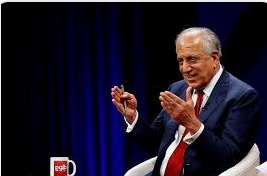
Zalmay Khalilzad’s recent visit to Kabul and his interview with Tolo News have reopened a familiar chapter in US–Afghan engagement, but with clearer signals than before.
Publicly the visit was framed around securing the release of two American citizens held in Afghanistan.
Privately, the tone and content of Khalilzad’s remarks suggest a broader objective: maintaining leverage, preserving strategic options, and reinforcing pressure.
Khalilzad confirmed that the Taliban have yet to give a clear response on the detainees. That uncertainty is telling.
It reflects a deep trust deficit between Washington and Kabul, one that the United States appears willing to manage rather than resolve.
The issue of detained Americans now functions as a diplomatic pressure point, useful for shaping future negotiations without granting political recognition.
Drones, Bagram and the limits of trust
Khalilzad’s defence of US drone activity over Afghanistan as a matter of “self-defence” carries a blunt message.
Despite Taliban assurances that Afghan soil will not be used against other countries, Washington does not accept those guarantees at face value.
By keeping the drone option publicly justified, the US signals that it reserves the right to act unilaterally if it perceives a threat emerging from Afghanistan.
His comments on Bagram Airbase reinforce this reading. Rather than dismissing the issue, Khalilzad suggested it could be addressed through negotiations, especially if the US embassy in Kabul were to reopen.
This ambiguity matters. It indicates that the United States is not fully closing the door on a limited security or technical presence in Afghanistan.
The narrative of total withdrawal is giving way to one of conditional, negotiated re-engagement.
Pakistan, TTP and the regional pressure matrix
He acknowledged Pakistan’s past cooperation but at the same time expressed reservations about Islamabad’s intentions. Khalilzad said that the Taliban had presented what he described as reasonable proposals on the issue of Tehreek-e-Taliban Pakistan (TTP), but questioned whether Pakistan was fully committed to resolving the problem.
Analysts view this narrative as a reflection of a long-standing US approach that portrays Pakistan as a conditional partner.
Khalilzad also described the ISIS threat as a major regional challenge, claiming that some ISIS elements operating in Afghanistan have taken refuge in Pakistan.
However, he avoided making direct accusations, instead framing the matter as an intelligence issue and proposing third-party monitoring mechanisms.
Analysts believe this framing represents another attempt to increase international pressure on Pakistan without issuing explicit allegations.
The revival of longstanding regional disputes, including the Durand Line and water-related issues, also featured in Khalilzad’s remarks.
Experts argue that raising these unresolved matters is part of a calculated narrative strategy aimed at reinforcing perceptions of persistent instability in the region and creating space for continued US involvement.
Taken together, Khalilzad’s visit and statements clearly indicate that the United States does not intend to fully withdraw its diplomatic, military, and narrative presence from Afghanistan.
Instead, Washington appears committed to maintaining engagement in a controlled and conditional manner.
While offering limited diplomatic acceptance to the Taliban, the United States continues to pursue a pressure-based approach toward key regional actors, including Pakistan, to safeguard its strategic interests.
The interview not only reflects the current direction of US policy but also underscores the uncertainty surrounding Afghanistan’s political and security future, which remains entangled in complex and unresolved regional challenges.
Read more: Yemen’s Crisis Highlights the Urgent Need for Coordinated Stabilization