
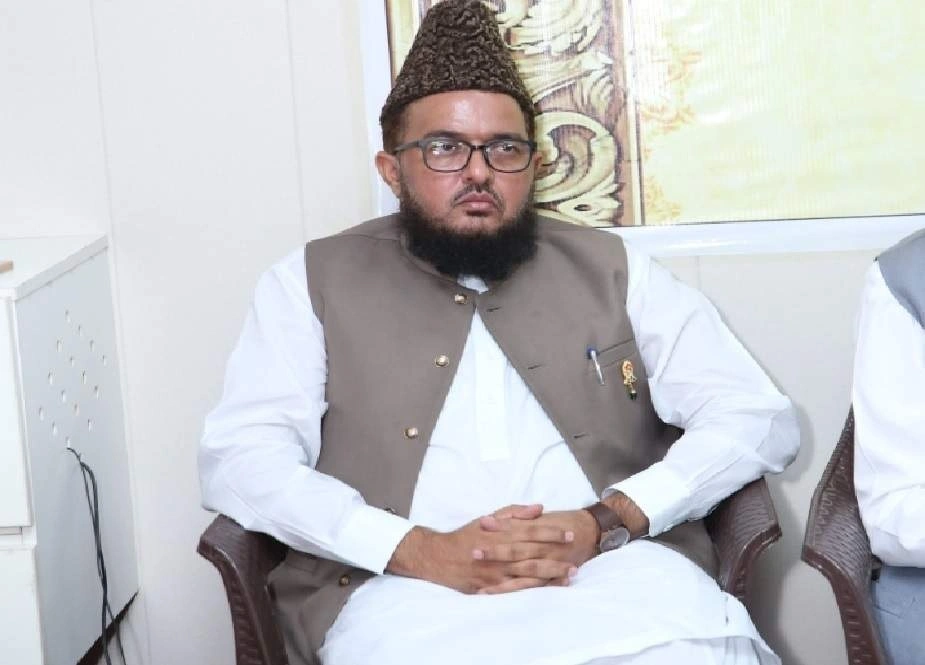
In a powerful and deeply reflective conversation, Mufti Dr. Muhammad Karim Khan, Chairman of Wafaq-ul-Madaris al-Razvia al-Islamia, has delivered a clear and uncompromising message against terrorism and violent extremism carried out in the name of religion. Speaking in an exclusive interview, he emphasized that taking up arms against a Muslim government is the earliest and most dangerous hallmark of the Khawarij ideology—an ideology that Islam itself has firmly rejected.
Mufti Karim Khan described it as a moment of rare unity and collective clarity that scholars across Pakistan and the wider Muslim world have reached a consensus: terrorism—whether physical, ideological, or psychological—is harmful to Islam, the state, and society at large. He noted that this consensus is not limited to one sect or school of thought but includes all religious communities, even minorities, standing together against violence.
He highlighted the historic importance of “Paigham-e-Pakistan,” a joint declaration against extremism that carries the signatures of more than 5,200 scholars from around the world. According to him, this is the first time in history that such a broad and unified religious stance against terrorism has not only been documented but is actively being preached from pulpits and classrooms.
Mufti Karim Khan strongly advocated for reforms within religious education, stressing that the Constitution of Pakistan should be made a compulsory subject in madrassas. He argued that when young students study the Constitution, they understand that Pakistan is an Islamic state by design—one whose laws explicitly state that no legislation can be enacted against the Qur’an and Sunnah. He added that documents like Paigham-e-Pakistan should be integrated into the curriculum to counter false narratives spread by extremist groups.
Reflecting on past terrorist incidents, including attacks intended to inflame sectarian divisions, he observed that such violence has often backfired. Instead of dividing society, it has reinforced a shared understanding that terrorism has no religion or sect.
Discussing the historical roots of Khawarij, Mufti Karim Khan explained that this deviant ideology emerged soon after the era of the Prophet Muhammad ﷺ and is one of the few movements explicitly warned against in authentic Hadith. He recalled that the Khawarij were the first to rebel violently against a legitimate Muslim ruler—Ameer-ul-Momineen Hazrat Ali (RA). Despite their outward appearance of extreme piety, their actions placed them outside the bounds of Islamic teachings.
Quoting Hazrat Abdullah bin Abbas (RA), he explained that external displays of religiosity—beautiful recitation of the Qur’an, long prayers, or simple dress—are not the measure of truth. What matters is obedience to legitimate authority and adherence to Islamic principles of justice, peace, and social order.
Mufti Karim Khan stressed that Pakistan holds a unique place in Islamic history as the first modern state created explicitly in the name of Islam. To even contemplate armed rebellion against such a state, he said, is a clear indicator of Khawarij thinking. He warned that extremist groups have aligned themselves with hostile non-Muslim forces, which further exposes the hypocrisy of their claims.
He also shed light on how suicide bombers are psychologically manipulated—told that Pakistan is an un-Islamic state and that killing innocents will guarantee paradise. He firmly rejected this distortion, reminding that the Prophet ﷺ used the harshest words only for the Khawarij, calling them “the dogs of Hell,” and declared that those who fight against them are among the greatest martyrs.
In closing, Mufti Karim Khan underscored the responsibility of scholars in promoting inter-sectarian and interfaith harmony. He reminded that Islam guarantees the protection of minorities and that any injustice against non-Muslims in an Islamic state is a grave sin. Pakistan’s pluralistic society, he said, can only survive through knowledge, unity, and a firm rejection of violence masquerading as faith.
His message is clear: extremism is not only a threat to national security but a betrayal of Islam itself—and confronting it requires truth, education, and collective moral courage.



![American federal agencies and local police have exposed large-scale human trafficking and organized crime networks operated by Indian nationals across multiple states [IC : by AFP]](https://htnworld.com/wp-content/uploads/2026/02/WhatsApp-Image-2026-02-19-at-15.14.16.webp)