
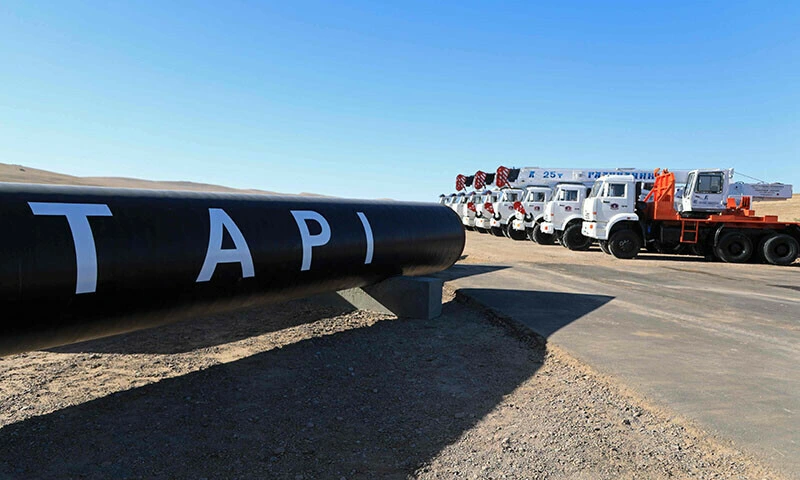
Herat — Afghanistan’s Deputy Prime Minister Mullah Abdul Ghani Baradar Akhund and Turkmen President Gurbanguly Berdimuhamedov jointly visited the TAPI Gas Pipeline Project site in Afghanistan, accompanied by high-level delegations from both countries. The visit marked a significant step forward in regional energy cooperation and economic integration between Afghanistan and Turkmenistan.
TAPI Project Overview
During the visit, Mullah Baradar hailed President Berdimuhamedov’s trip to Afghanistan as the beginning of “a new era of economic partnership and regional collaboration.”
He highlighted that the construction of the TAPI pipeline has been completed up to 14 kilometers within Afghan territory, affirming that the Taliban government remains fully committed to ensuring the project’s security and timely completion.
Baradar emphasized that the TAPI project is not merely an energy corridor but a symbol of regional interdependence that will foster “shared prosperity and stability across South and Central Asia.”
Beyond TAPI: Expanding Economic Corridors
The Afghan Deputy Prime Minister further noted that the government’s ambitions extend beyond TAPI. He revealed that work is also underway on the Afghanistan–Turkmenistan Economic Corridor, which includes projects in electricity transmission, rail connectivity, and road infrastructure development.
“Afghanistan is determined to become a bridge for regional trade, linking Central Asia with South Asia through energy and transport cooperation,” Baradar stated.
Investment Opportunities in Afghanistan
In his remarks, Baradar extended an invitation to Turkmen and international investors, encouraging them to invest in Afghanistan’s resource-rich landscape.
“This is a unique opportunity for global investors to benefit from Afghanistan’s vast natural resources and strategic location,” he said.
He reiterated that Afghanistan welcomes foreign direct investment and guarantees the protection of investors and their assets under the current administration.
Strengthening Bilateral Relations
Speaking at the event, President Berdimuhamedov praised the improving ties between Ashgabat and Kabul, describing the relationship as “steady and constructive.”
He reaffirmed Turkmenistan’s commitment to the TAPI project, noting that it remains a top national priority and an engine for economic stability in the region.
“The conditions are now highly favorable for the completion of TAPI, which enjoys broad international support,” Berdimuhamedov said.
He added that Turkmenistan will complete its portion of the project within the stipulated timeframe, projecting that Afghanistan could earn approximately $1 billion annually in transit fees once the pipeline becomes operational.
Commitment to Mutual Respect and Sovereignty
In his closing remarks, Mullah Baradar called upon neighboring countries to avoid confrontation and adopt policies based on mutual respect and sovereignty.
He reaffirmed that the Islamic Emirate of Afghanistan is committed to partnership, cooperation, and peaceful coexistence with all nations.
“Our future lies in collaboration, not conflict. Afghanistan seeks to be a partner in progress for every country in the region,” he concluded.











