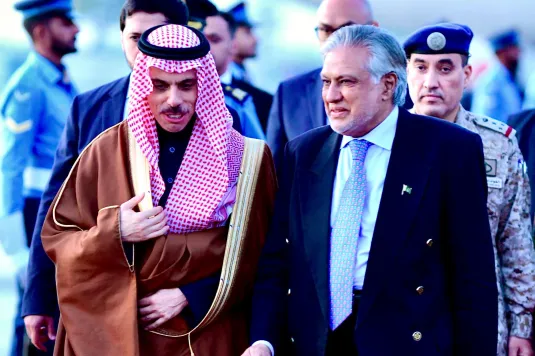
Islamabad – Deputy Prime Minister and Foreign Minister Ishaq Dar and his Saudi counterpart, Prince Faisal bin Farhan, held a phone call to discuss the ongoing situation in Gaza and reaffirmed their shared commitment to peace and stability in the region, the Foreign Office (FO) said on October 22.
“Deputy Prime Minister/Foreign Minister Senator Ishaq Dar spoke on the phone late last night with the Foreign Minister of Saudi Arabia, H.H. Prince Faisal bin Farhan,” the FO posted on X Wednesday.
Pakistan and Saudi Arabia have long maintained strong bilateral ties, particularly in the context of regional security and stability. Both countries were among eight Muslim nations that collaborated with the United States to address the crisis in Gaza and pursue a ceasefire to end the violence.
Earlier this month, both nations welcomed the ceasefire agreement between Israel and Hamas, expressing hope that the deal would help end years of conflict and devastation in Gaza. The signing was viewed as a step toward restoring peace after prolonged unrest.
Revisiting the Gaza matter, the two leaders “reviewed recent developments in the region, including [in] Gaza and Palestine,” the FO said, adding that both sides “reaffirmed their shared commitment to peace and stability in the region and agreed to stay closely engaged on matters of mutual interest.”
Beyond political coordination, Pakistan and Saudi Arabia enjoy a multifaceted strategic partnership rooted in economic cooperation, defense collaboration, and shared Islamic heritage. Riyadh remains a key source of financial aid and energy supplies for Islamabad.
In September, both countries signed a “Strategic Mutual Defence Agreement” in Riyadh, pledging that any attack on either nation would be treated as an act of aggression against both.
Pakistan’s Chief of Army Staff, Field Marshal Asim Munir, described the pact as a milestone for regional stability and cooperation. Speaking at the passing-out parade of the 152nd PMA Long Course, the 26th Lady Cadet Course, and the 37th Technical Graduate Course at the Pakistan Military Academy (PMA) Kakul on October 18, he stated: “The recent Strategic Mutual Defense Agreement with the Kingdom of Saudi Arabia is a reinforcement and formalization of Pakistan-Saudi brotherhood and a step toward ensuring peace and stability in the Middle East and South Asia.”
He added, “For the people and Armed Forces of Pakistan, it is a moment of unique pride to reaffirm our faithful commitment to the defense of Harmain Shareefain,” quoting Allama Iqbal’s verse that emphasizes Muslim unity in safeguarding the holy sites in the Kingdom.