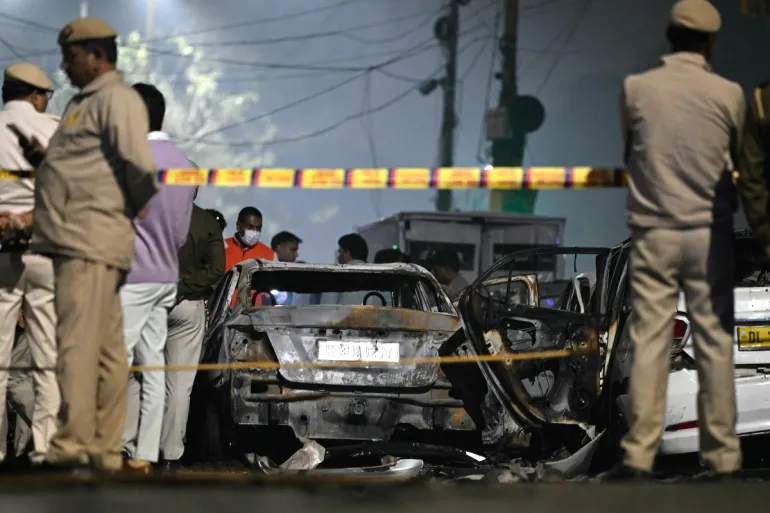
Istanbul – Türkiye on Wednesday strongly rejected allegations circulated in several Indian media outlets claiming that Ankara had links to terrorist attacks in India, including the recent deadly car blast in New Delhi. The reaction came as Indian officials confirmed that the explosion near the Red Fort, an iconic Mughal-era landmark, was being treated as a “heinous terror incident” that killed at least 13 people and injured several others.
The accusations, amplified by Indian channels, including News18 and India Today, reflect a deepening trend in India’s media landscape, framing Pakistan and, to some extent, Türkiye as central actors in narratives of extremism even before investigations are concluded. Analysts say this points to a broader political effort to externalize domestic security failures and shape public perception through selective reporting.
Türkiye Calls Allegations ‘Malicious Disinformation’
In its official response, Türkiye’s Directorate of Communications Center for Countering Disinformation (DMM) denounced the Indian media reports as “malicious disinformation” designed to tarnish Ankara’s reputation rather than reflect any credible evidence. The DMM dismissed allegations that Türkiye provided logistical, diplomatic or financial support to operatives in India, stressing that such claims lack factual grounding and appear to be part of an orchestrated attempt to distort public discourse. The directorate shared screenshots of Indian media reports with a bold cross mark, underscoring its firm position that Türkiye rejects terrorism “wherever and by whoever committed.” It emphasised Ankara’s active role in the UN Global Counter-Terrorism Strategy and NATO’s counter-terror efforts, positioning the Indian allegations not as investigative conclusions but as political messaging aimed at shaping regional perceptions.
The deliberate reports in certain Indian media outlets claiming that “Türkiye is linked to terrorist acts in India and provides logistical, diplomatic, and financial support to terrorist groups” are part of a malicious disinformation campaign aimed at damaging bilateral relations… pic.twitter.com/BUPjtnJokf
— Dezenformasyonla Mücadele Merkezi (@dmmiletisim) November 12, 2025
India Probes ‘White-Coat’ Terror Module
As investigations continue, Indian authorities have identified the suspected suicide attacker as Dr Umar Un Nabi, a Kashmiri doctor and professor at Al-Falah University, in Faridabad of Haryana State. The alleged network, dubbed a “white-coat terror module,”comprises several highly educated professionals, including multiple doctors accused of assembling explosives and plotting coordinated attacks across several cities.
Police have invoked the Unlawful Activities (Prevention) Act (UAPA) and handed the probe to the National Investigation Agency (NIA). While evidence points toward a local radicalisation circuit centred around university accommodations, Indian media narratives have disproportionately focused on alleged foreign links, despite the investigation being far from complete.
Alleged Pakistan and Türkiye Links Under Scrutiny
Indian outlets have claimed the module was connected to banned groups Jaish-e-Muhammad (JeM) and Ansar Ghazwat-ul-Hind (AGuH), framing the Delhi blast as part of an externally orchestrated revenge attack. A handler known as “Ukasa,” whom Indian media claims is based in Ankara, has been placed at the centre of this narrative.
According to Indian allegations, Dr. Umar and his colleagues travelled to Türkiye in 2021–2022 where they were allegedly radicalised and trained, claims Türkiye categorically denies and which remain unverified by independent sources. Analysts note that India’s insistence on emphasising Pakistan and Türkiye in the storyline, often through leaks to sympathetic media, mirrors a long-standing pattern of linking domestic militancy to foreign actors, regardless of investigative progress.
Operation Sindoor: The Root of India’s Anti-Türkiye Narrative
Türkiye’s firm stance on Indian-held Kashmir, especially its criticism of India’s revocation of Article 370 in 2019, sparked an aggressive diplomatic and media campaign from New Delhi. Following what observers describe as Operation Sindoor, India’s coordinated push to isolate and discredit Türkiye in global forums, anti-Türkiye narratives have proliferated across social media and news outlets.
The campaign mirrors the approach India has long taken against Pakistan, using media and diplomatic channels to frame external actors as threats in domestic security matters.
A Manufactured Narrative for Strategic Gain
While the Delhi blast investigation remains ongoing, the available evidence points largely to a domestic radicalisation module, not an orchestrated foreign plot. Türkiye’s explicit denial, backed by its record in global counterterror cooperation, further undermines Indian media claims.
Yet the accusations persist, because they serve a political purpose.
By portraying both Pakistan and Türkiye as sponsors of extremism, India strengthens its internal security narrative, deflects from lapses in domestic intelligence, and constructs an external enemy framework that resonates with its domestic political base.
The emerging pattern is clear. When domestic crises unfold, Indian media ecosystems increasingly pivot toward geopolitical scapegoating. For Pakistan, this is a familiar script, while for Türkiye, it has become the new frontier of India’s influence-building and perception-management operations.