
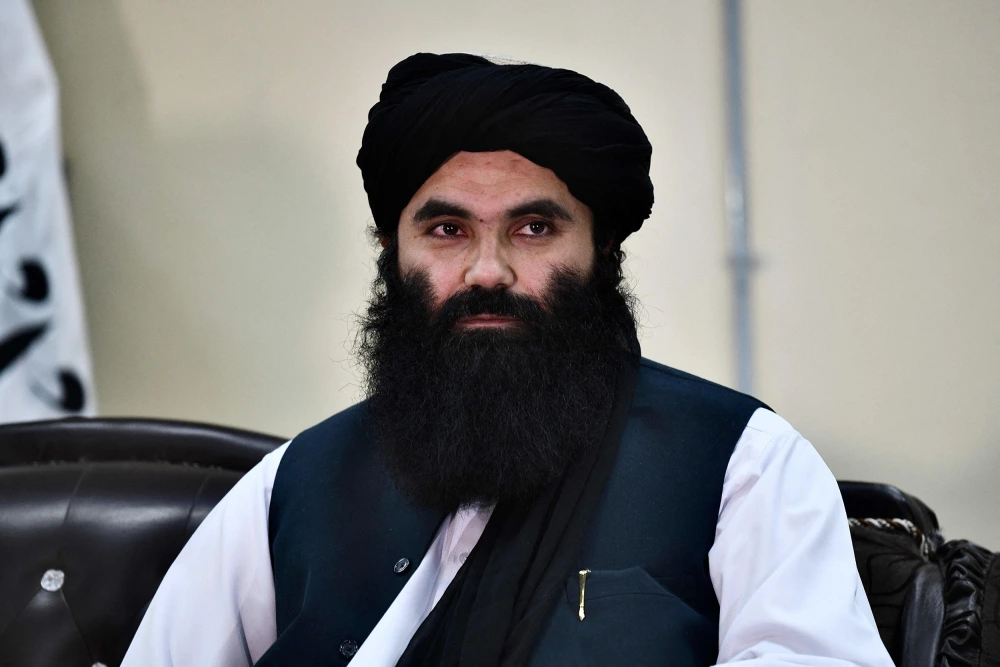
Khost, Afghanistan – The diplomatic strife between Afghanistan and Pakistan has intensified following the comments made by the Interior Minister of Afghanistan, Khalifa Sirajuddin Haqqani, who reacted publicly to the statement of the Pakistan Army Chief General Asim Munir referring to the Pakistani Taliban (TTP).
In an address given to local religious scholars and notables in Khost, Haqqani responded to the recent request issued by General Munir that the Islamic Emirate should either continue its relations with Islamabad or take part in the activities of the TTP.
Haqqani is in Khost as 11 December marked one year of Khalil Haqqani’s death. Khalil-ur-Rahman Haqqani was the brother of Mawlawi Jalaluddin Haqqani, the founder of the Haqqani Network, and the uncle of Sirajuddin Haqqani.
Haqqani emphasized that Afghans are not eager to destroy the households of people, and offered the Government of Pakistan and the TTP to solve their problems on their own land.
Significantly, Haqqani compared General Munir’s strong statements to the rhetoric once used by former US President George W. Bush.
Importantly, Haqqani likened the bold words of General Munir to the rhetoric that was used to be employed by the former US President George W. Bush.
The Stance from Pakistan
General Asim Munir had earlier this month commented when launching the new joint military command in Rawalpindi, Pakistan. His call to the Afghan government to make a choice was based on the record of escalating fatal attacks in Pakistan, conducted by TTP militants, coming from Afghanistan, a fact cited repeatedly in UN Monitoring Team and SIGAR reports.
Pakistan takes the stance that TTP is not an internal Pakistani issue when its leadership, training, and logistics bases are often located on the Afghanistan territory- this is what is mentioned in many global surveillance reports.
Trust Deficit Over Cross-Border Security
The exchange underscores the growing lack of trust between the two countries regarding border security. Analysts note that Haqqani frames this issue, trying to treat the TTP as a domestic issue, as seemingly avoiding the fact that the Taliban themselves, under the Doha Agreement, pledged not to use Afghan soil against other states.
Stability in the region, as Islamabad sees it, does not require rhetorical distraction, but rather tangible actions to de-weaponize militant infrastructure based in Afghanistan.
Pakistan is of the view that dialogue can be reached but must be accompanied by effective measures in neutralization of the cross-border threat.











