
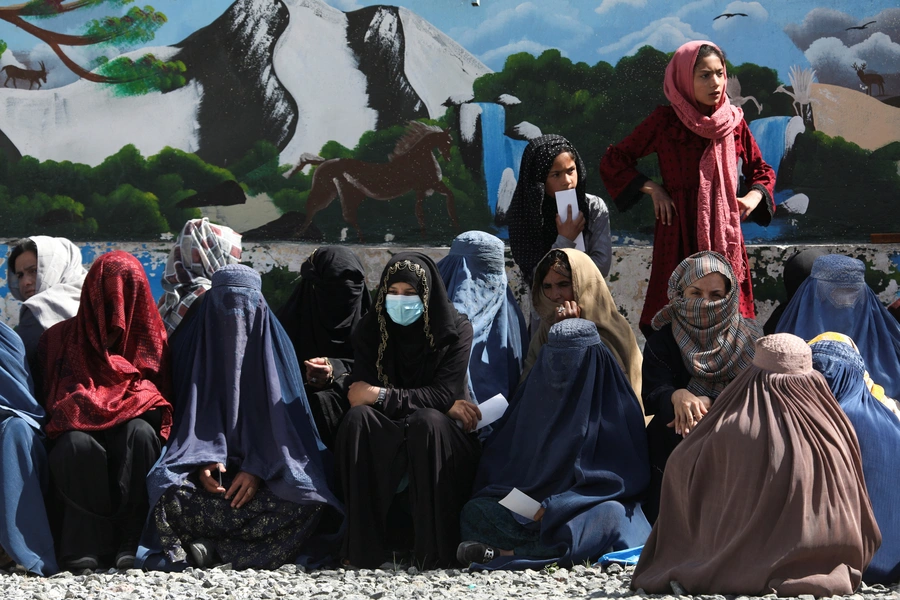
Kabul – Recent advertisement campaigns by pro-Taliban social media pages have emphasized the few cases of women working in Afghan factories as examples of economic development.
Afghan soil is today witnessing a new era, where a wave of reconstruction and economic stability can be seen rising from the Herat Industrial Zone.
— برهان الدین | Burhan uddin (@burhan_uddin_0) December 28, 2025
The Omid Afghan Food Products factory is a fine example of this positive change.
All the workers in this factory are women. pic.twitter.com/rKa3QGCRYw
But, according to humanitarian reports and on-ground data, these showcases are an effort to cover up an even larger context of Taliban repression that has methodically destroyed the rights and economic agency of Afghan women in the past three years.
Structural Exclusion and Institutional Shifts
Although individual units of the factory are used as a means of propaganda, the economy of the whole country continues to fall into ruin.
After the shift in governance, the Ministry of Women’s Affairs was abolished, and it was substituted with the Ministry of Promotion of Virtue and Prevention of Vice.
This organizational change has institutionalized Taliban repression, wherein the concern of the state is not on empowering women but rigidly enforcing the decree that curtails the role of women in society, the mode of dressing, and movement.
The Educational Deficit and Long-term Impact
According to economic experts, the integration of women in a few working places does not form a countermeasure to the bans that are systemic and instigated by the authorities.
The women have been completely shut out of the cabinet and all other forms of political decision-making.
Moreover, secondary and university education of girls is banned, which has practically closed the human capital stream.
This lack of education guarantees that even economic recovery in the future will not proceed due to a lack of a skilled female workforce, which is a direct result of continuing Taliban repression.
Workforce Barriers and Private Sector Stagnation
The limits do not stop at the office. Female contribution in the workforce has been crippled by the introduction of the mahram (male guardian) requirement to travel and the denial of women most jobs in the public sector, including the judiciary and other municipalities.
In the private sector, women who continue to work often do so to meet basic survival needs despite the absence of supportive governance.
According to the reports of international observers and agencies of the UN, the private sector is still declining due to uncertainty in policies and the lack of inclusion of half the population in the economy.











