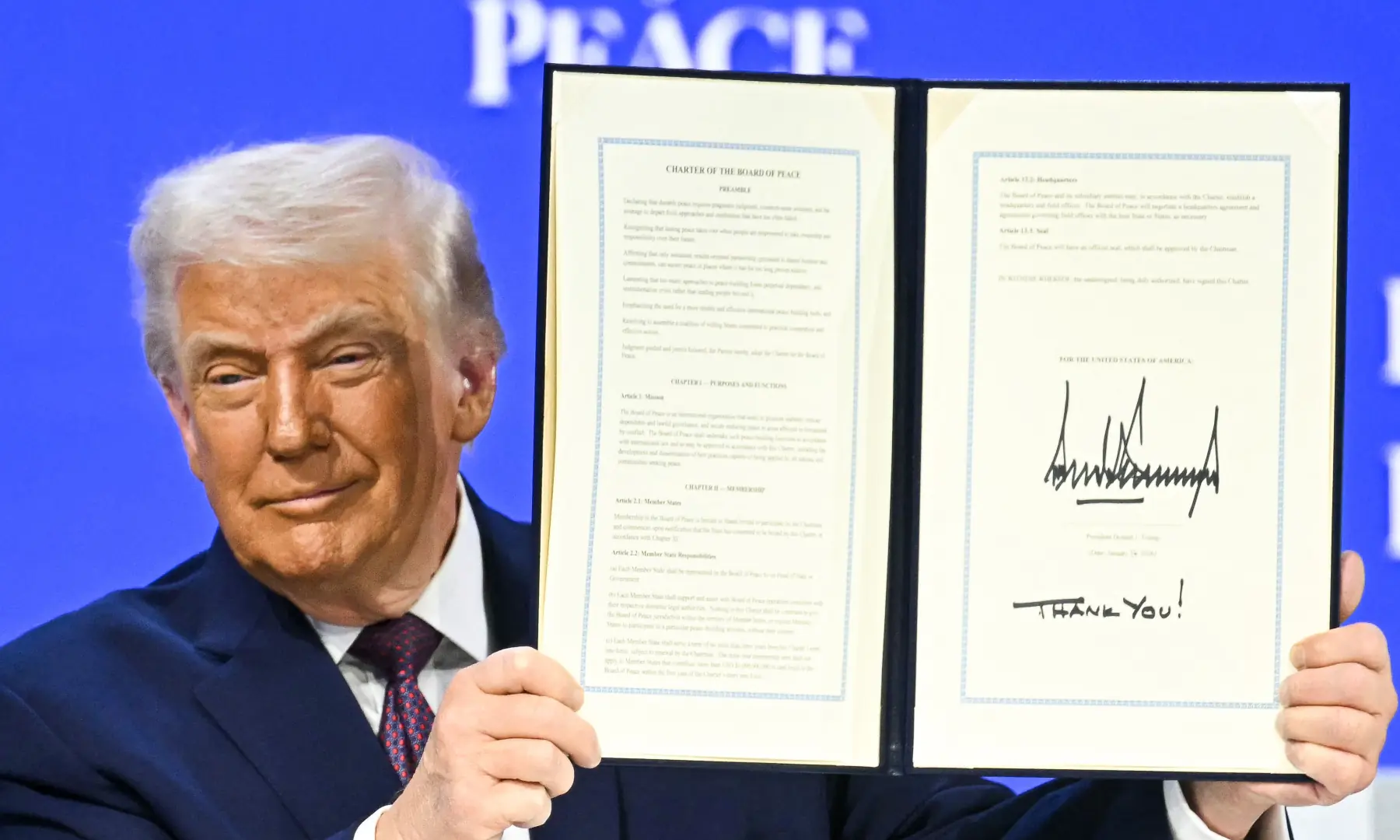
A new international initiative titled the “Board of Peace” was formally launched at the World Economic Forum in Davos, Switzerland, with the signing of its founding charter on January 22, 2026.
The initiative led by US President Donald Trump is presented as a new framework to guide post-war stabilization and peace efforts beginning with Gaza and potentially expanding to other conflicts.
The Davos event marked the first public institutional rollout of the body and functioned primarily as a political and strategic announcement rather than a negotiation forum.
1- Formation and Governance Structure
| Key Item’s | Details |
|---|---|
| Name | Board of Peace |
| Announced at | World Economic Forum, Davos |
| Charter signed | January 22, 2026 |
| Top Authority | Founding Executive Council |
| Chair | Donald Trump |
| Stated Role | Strategic authority for post-war stabiliZation and peace initiatives, starting with Gaza |
2- Founding Executive Council (Full Composition)
| No. | Name | Position |
|---|---|---|
| 1 | Tony Blair | Former British Prime Minister |
| 2 | Jared Kushner | Former US Senior Adviser |
| 3 | Marco Rubio | US Secretary of State |
| 4 | Steve Witkoff | US Special Envoy for the Middle East |
| 5 | Marc Rowan | CEO, Apollo Global Management |
| 6 | Ajay Banga | President, World Bank Group |
| 7 | Robert Gabriel | US Deputy National Security Adviser |
3- Countries That Signed the Charter (At Davos)
| Country Names | Country Names | Country Names | Country Names |
|---|---|---|---|
| United States | Bahrain | Morocco | Argentina |
| Armenia | Azerbaijan | Bulgaria | Hungary |
| Indonesia | Jordan | Kazakhstan | Kosovo |
| Pakistan | Paraguay | Qatar | Saudi Arabia |
| Türkiye | United Arab Emirates | Uzbekistan | Mongolia |
Leaders or representatives of more than 20 countries signed the charter during the ceremony. Donald Trump signed as chairman.
4- Countries That Declined or Opted Out
| Country | Status |
|---|---|
| United Kingdom | Opted out |
| France | Declined |
| Norway | Declined |
| Sweden | Declined |
| Slovenia | Declined |
5- Immediate Controversies
| Issue | Details |
|---|---|
| Objections | Raised by multiple Arab and Muslim states |
| Main Concern | Inclusion of Tony Blair |
| Reason | Blair Institute’s reported role in “day-after Gaza” planning |
| Additional Concern | Alleged links to Israeli business figures and a coastal development proposal sometimes described by critics as a “Trump Riviera” project |
| Jared Kushner Context | His 2024 remarks describing Gaza’s waterfront as “valuable” and suggesting population relocation were cited by critics in Davos |
6- President Trump’s Key Statements at the Charter Signing
6.1 On the Launch and Global Interest
| Theme | Statement |
|---|---|
| Launch | “A very exciting day, long in the making.” |
| Venue | “no better place” than Davos |
| Participation | “Everybody wants to be a part.” |
6.2 On the State of the World and His Record
| Claim | Statement |
|---|---|
| Global security | “Today the world is a safer, richer and much more peaceful place than it was one year ago.” |
| Middle East | “We have peace in the Middle East — no one thought that was possible.” |
| Wars | Claimed he had “stopped eight wars” and “put out all those fires.” |
6.3 On the Purpose, Scope and Authority of the Board
| Area | Statement |
|---|---|
| Initial focus | Gaza: reconstruction, demilitarisation, post-ceasefire stability |
| Expansion | Said the board would expand to other conflicts after Gaza |
| Authority | “Once this board is completely formed, we can do pretty much whatever we want to do.” |
| Ambition | “It has the chance to be one of the most consequential bodies ever created.” |
| His role | Said he was “honoured” to chair the board |
6.4 On the United Nations
| Topic | Statement |
|---|---|
| Cooperation | Said the board would work “in conjunction with the United Nations” |
| Rationale | Suggested the UN has untapped potential but referenced past shortcomings |
| Combined role | Said the Board plus the UN could be “something very, very unique for the world” |
6.5 On Hamas and Gaza
| Issue | Statement |
|---|---|
| Disarmament | Said Hamas must give up its weapons |
| Warning | “If they don’t do that, it is going to be the end of them.” |
7- Overall Assessment
| Supporters’ View | Critics’ View |
|---|---|
| A pragmatic, power-driven mechanism for faster conflict resolution | Risks bypassing or weakening existing multilateral and UN-based frameworks |
| Focused on execution rather than process | Governance model concentrates excessive authority |
| Backed by political and financial influence | Blurs lines between geopolitics, reconstruction, and commercial interests |
Conclusion
The launch of the Board of Peace at Davos represents a major political and strategic initiative with high-level backing and a defined starting focus on Gaza.
At the same time, the structure, leadership model and underlying assumptions have generated significant diplomatic and political controversy.
The Davos event did not mark the start of negotiations but rather the formal announcement of a new power based framework whose role in global conflict management will now be closely watched.