
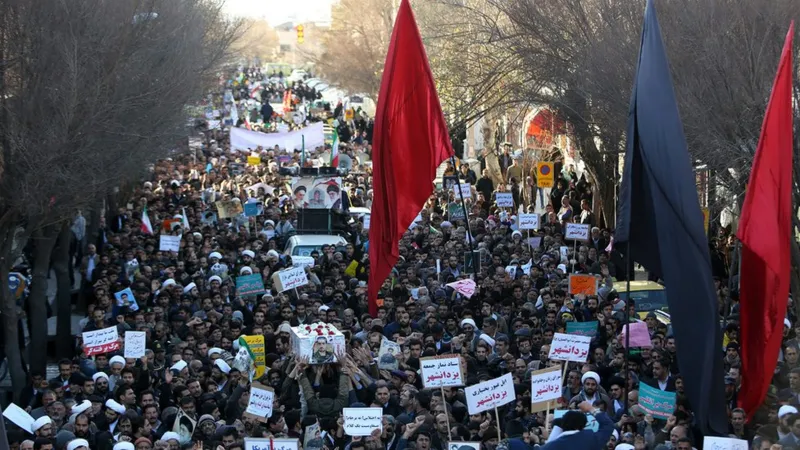
In mid-January 2026, Iran International published reports alleging that foreign militia forces allied with Iran’s Islamic Revolutionary Guard Corps (IRGC) helped suppress nationwide protests in January 2026. The reports accused the Zainabiyoun Brigade, the Fatemiyoun Brigade, and the Hashd al-Shaabi of participating in the crackdown.
These claims are serious. They are also unverified. Repeating such allegations without credible proof risks damaging the international image of the neighboring country of Iran and distorting public perceptions inside Iran, despite Pakistan’s long-standing policy of non-interference in Iran’s internal affairs.
Extraordinary claims without independent evidence
Iran International’s reporting relies almost entirely on anonymous sources and secondary assessments. To date, no United Nations body, international human rights organization or independent global media outlet has confirmed the presence of foreign militias in Iran during the January protests.
There has been no satellite imagery, no credible open-source intelligence, no visual evidence and no independent on-ground verification to support claims involving hundreds or thousands of foreign fighters.
Furthermore, Iran International’s Persian-language reporting further escalated the narrative by alleging that 12,000 to 20,000 protesters were killed within two days and that foreign militias carried out a “significant portion” of the killings.
Such figures would represent one of the largest civilian massacres in recent history and would inevitably leave extensive, verifiable traces, mass hospital records, burial evidence, satellite imagery and urgent international response. None of this exists.
Historically, protest crackdowns inside Iran have been handled by domestic forces, the IRGC, the Basij, and national law enforcement agencies.
These institutions are deeply embedded across the country and possess extensive experience in internal security operations. From an operational standpoint, there is no clear requirement for foreign militia involvement in domestic crowd control.
Moreover, using non-Iranian fighters against Iranian civilians would be politically explosive and would contradict Iran’s own internal security doctrine.
Such a move would also likely leave visible traces including footage, markings or corroborated eyewitness accounts, none of which have emerged.
Why unverified narratives matter for Pakistan and the region
Baseless allegations linking Pakistan to repression inside Iran carry real diplomatic and societal costs. When unproven claims are repeated by propagandist outlets, they can quickly harden into assumed truths in international discourse.
This risks unfairly portraying Pakistan as complicit in Iran’s internal actions despite Islamabad’s clear and consistent stance of non-interference.
There is also a social dimension. Tendentious narratives may shape negative perceptions among ordinary Iranians, creating mistrust where none is warranted. Such outcomes serve neither regional stability nor responsible journalism.
Moreover, Pakistan does not permit cross-border movement of armed groups and maintains strong border management mechanisms.
Pakistan has no strategic interest in Iran’s internal unrest and has consistently called for stability, dialogue and respect for sovereignty. Claims that suggest otherwise must be supported by verifiable evidence not repetition from the Indo-Israel-Afghan Disinfo Nexus.
In an era of information saturation, media responsibility matters. Extraordinary allegations demand extraordinary proof.
Pakistan’s position on Iran’s internal matters has been clear and consistent whcih is non-interference, respect for sovereignty and regional stability.
Read more: Trump Agrees to Iran’s Request to Change Venue of Talks











