
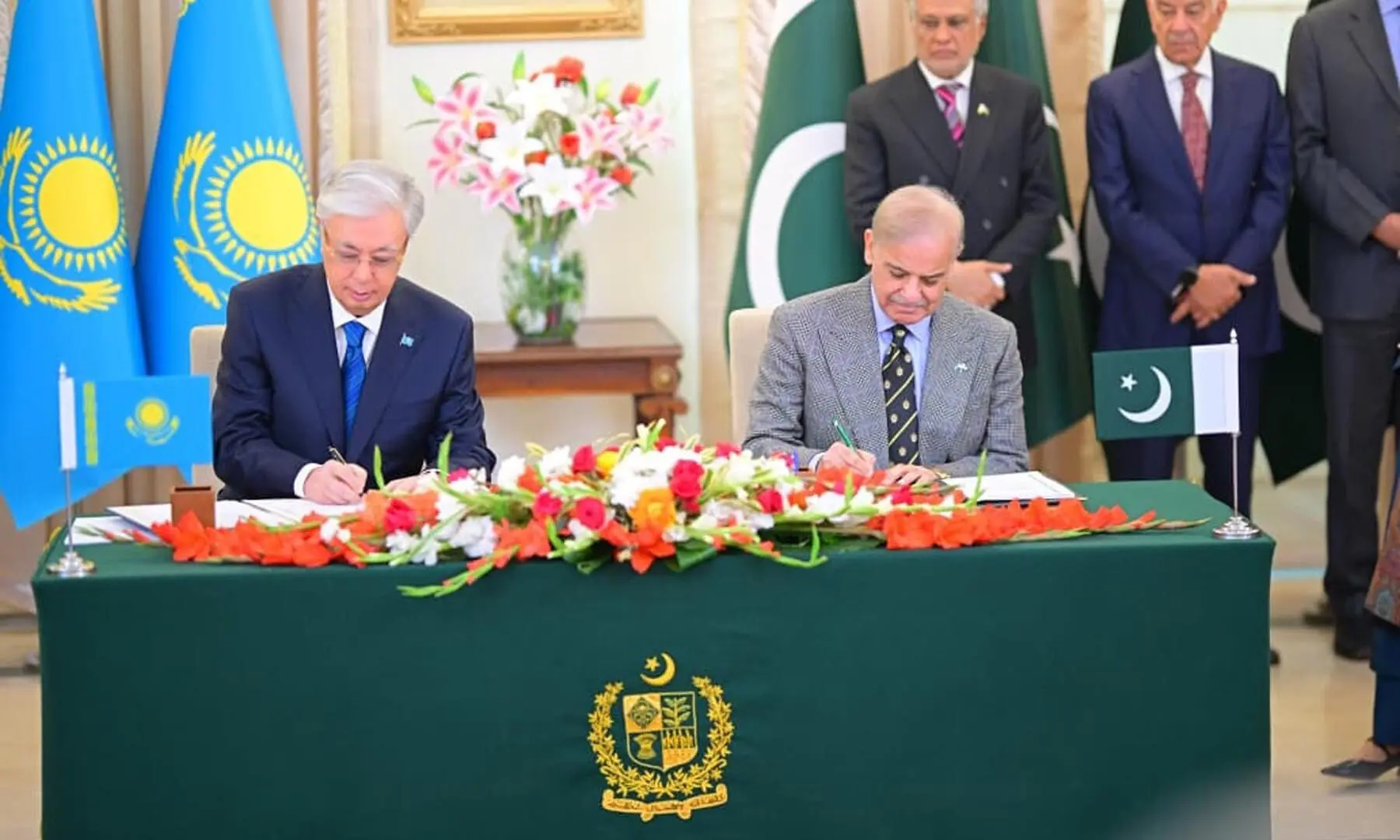
Pakistan and Kazakhstan have agreed to significantly deepen their economic and strategic partnership, with Prime Minister Shehbaz Sharif vowing to raise bilateral trade to $1 billion in the near future.
The commitment was made during a joint press conference in Islamabad with visiting Kazakh President Kassym-Jomart Tokayev who described Pakistan as a “reliable and important partner in South Asia and beyond”.
براہِ راست: قازقستان کے صدر قاسم جومارت توکایووف کی وزیراعظم ہاؤس آمد https://t.co/iB6SEd8hGL
— Government of Pakistan (@GovtofPakistan) February 4, 2026
President Tokayev is on a two-day official visit to Pakistan, the first by a Kazakh head of state in 23 years, marking a milestone in relations between Pakistan and Kazakhstan.
براہِ راست: پاکستان اور قازقستان کے درمیان مختلف شعبوں میں مفاہمتی یادداشتوں اور معاہدوں کی تقریب https://t.co/wRW6dyUULz
— Government of Pakistan (@GovtofPakistan) February 4, 2026
Major agreements signed to boost trade, energy and connectivity
During the visit, the two countries signed more than two dozen agreements and MoUs covering key sectors such as petroleum, mining, agriculture, transport, defence industry cooperation, IT and maritime affairs.
Both leaders stressed that these agreements must move quickly from paperwork to implementation.
Prime Minister Shehbaz Sharif assured “speedy execution” on Pakistan’s part and said stronger economic and trade ties would raise relations “to new heights”.
He invited business communities from both sides to invest in joint ventures noting that current investment levels remain far below potential.
A major highlight was agreement on strengthening regional connectivity through transport corridors linking Belarus, Russia, Kazakhstan, Uzbekistan, Afghanistan and Pakistan.
Pakistan also offered Kazakhstan full access to its ports at Karachi and Gwadar, positioning itself as a vital trade gateway for landlocked Central Asian states.
Deputy Prime Minister / Foreign Minister Senator Mohammad Ishaq Dar @MIshaqDar50 called on the President of the Republic of #Kazakhstan, Kassym-Jomart Tokayev @TokayevKZ, who is visiting Pakistan on a two-day official visit.
— Ministry of Foreign Affairs – Pakistan (@ForeignOfficePk) February 4, 2026
Welcoming him to Pakistan, DPM/FM extended warm… pic.twitter.com/8ijVMgnbXd
Strategic partnership and regional opportunities ahead
President Tokayev said the two sides had signed a joint declaration establishing a strategic partnership, opening new opportunities across economic, cultural and security cooperation.
He praised Pakistan’s growing regional and global role and highlighted its strong industrial base, defence industry and transit potential.
Both leaders agreed to prioritize transport and logistics, including rail and road links passing through Afghanistan, and to explore resuming direct air connectivity.
Cooperation in energy, including discussion on the TAPI gas pipeline, agriculture, food security, education and digital technologies also featured prominently.
At the Pakistan–Kazakhstan Business Forum, Prime Minister Shehbaz stressed that Pakistan is ready to act as a land bridge between Central and South Asia, calling the connectivity projects “game-changers for the entire region”.
President Tokayev echoed this view, saying the partnership stands at a pivotal moment and has the potential to deliver long-term prosperity for both nations.
The visit is widely seen as a win-win development, strengthening Pakistan’s regional connectivity role while helping Kazakhstan diversify trade routes and economic partnerships amid changing global conditions.
Read more: Pakistan Moves to Strengthen Central Asia Trade Through QTTA and CPEC Routes











