
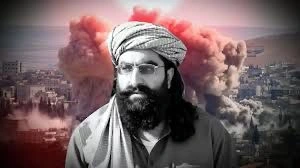
The claim of religious authority projected by Noor Wali Mehsud, the head of the banned Tehreek-i-Taliban Pakistan, has suffered a major blow after a prominent Karachi seminary formally disowned him and declared any certificates issued in his name as cancelled.
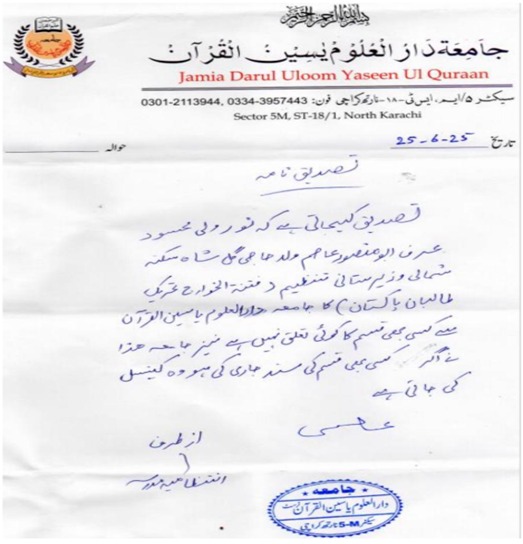
In an official statement, Jamia Dar-ul-Uloom Yaseen-ul-Quran clarified that Noor Wali Mehsud, also known as Abu Mansoor Aasim has no institutional link with the seminary. The statement said that if any document or religious certificate was ever attributed to him under the seminary’s name, it should be treated as null and void.
Religious scholars say this clarification strips Noor Wali of the clerical cover he has long used to justify violence and recruit followers.
For years, Noor Wali Mehsud has portrayed himself as a religious scholar while leading a militant campaign that has targeted civilians, security personnel and public infrastructure across Pakistan.
His sermons and statements often rely on selective religious language, which analysts say is designed to lend ideological legitimacy to acts that clearly violate Islamic teachings.
Religious scholars point out that the killing of innocents, attacks on mosques and places of worship and rebellion through deception have no basis in Islam.
More than 1,800 clerics from different schools of thought have already declared Noor Wali a “Khariji”, a term historically used for extremists who distort religion to justify bloodshed.
Security analysts believe the seminary’s disassociation is significant because militant leaders depend heavily on perceived religious credentials to maintain influence.
By publicly rejecting any association, the institution has drawn a clear line between authentic religious scholarship and extremist manipulation.
Despite this exposure, officials warn that the threat posed by the TTP under Noor Wali’s leadership remains serious.
Intelligence-based operations have disrupted several networks but authorities stress that countering extremist ideology is as important as kinetic action.
Experts say the cancellation of Noor Wali Mehsud’s religious credentials exposes the reality behind his leadership: a violent militant using a false clerical identity to advance terror, not faith.
As Pakistan continues its fight against extremism, religious clarity and institutional accountability are emerging as key tools in dismantling such deceptive narratives.
Read more: Why Terror Groups Target Civilians in Khyber Pakhtunkhwa and Balochistan











