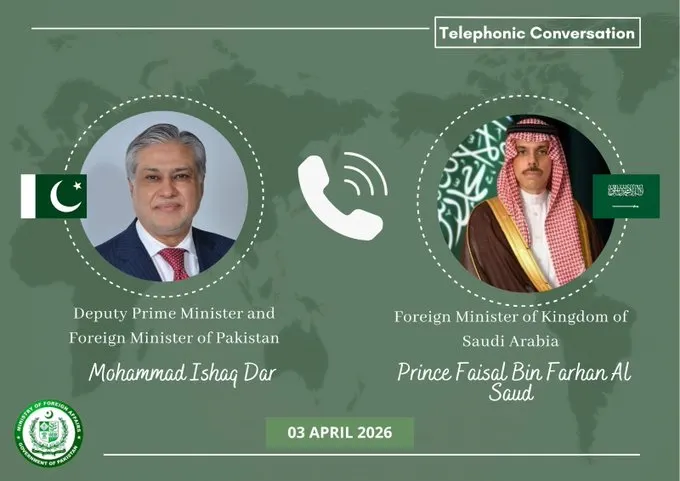
Pakistan’s Deputy Prime Minister and Foreign Minister, Senator Mohammad Ishaq Dar, spoke with Saudi Arabia’s Foreign Minister, HH Prince Faisal bin Farhan, in a high-level discussion on regional developments. Both leaders emphasized the urgent need for de-escalation and dialogue to prevent further tensions in the Gulf and Middle East.
During the call, Senator Dar highlighted Pakistan’s commitment to peace in the region through proactive diplomacy. The conversation also focused on the Pak China Five-Point Initiative, a collaborative framework designed to promote stability and constructive engagement among Gulf countries. Both sides agreed that dialogue is essential to avoid conflict and protect regional security.
Deputy Prime Minister/Foreign Minister, Senator Mohammad Ishaq Dar @MIshaqDar50 spoke with Saudi Foreign Minister HH Prince Faisal bin Farhan @FaisalbinFarhan.
— Ministry of Foreign Affairs – Pakistan (@ForeignOfficePk) April 3, 2026
The two leaders exchanged views on the latest developments in the regional situation, emphasizing the urgent need for… pic.twitter.com/EN01zURZfN
The discussion comes at a critical time when conflicts and tensions in the Gulf are affecting trade, energy supplies, and the safety of civilians. By advocating peaceful negotiation, Pakistan and Saudi Arabia are seeking to set an example for other nations in the region.
Strengthening Pakistan–Saudi Ties and Regional Cooperation
Apart from peace efforts, the leaders reaffirmed the strong and fraternal relationship between Pakistan and Saudi Arabia. They agreed to stay in close contact and coordinate on diplomatic initiatives to address regional challenges.
This renewed commitment reflects the long-standing partnership between the two countries. It also signals Pakistan’s growing role as a mediator in regional affairs, working alongside major partners like China to support dialogue and conflict resolution.
The conversation underscored the importance of collaboration, mutual trust, and proactive engagement. Both countries expressed optimism that diplomatic efforts and coordinated strategies can help reduce tensions and ensure lasting stability in the Gulf.
Looking ahead, Pakistan plans to continue working with Saudi Arabia and other regional partners to maintain communication channels and support peaceful resolutions. The focus remains on dialogue, cooperation, and regional stability rather than confrontation.
By promoting these measures, Pakistan positions itself as a constructive player in the Middle East, demonstrating that diplomacy and strategic collaboration can be effective tools for peace and security.